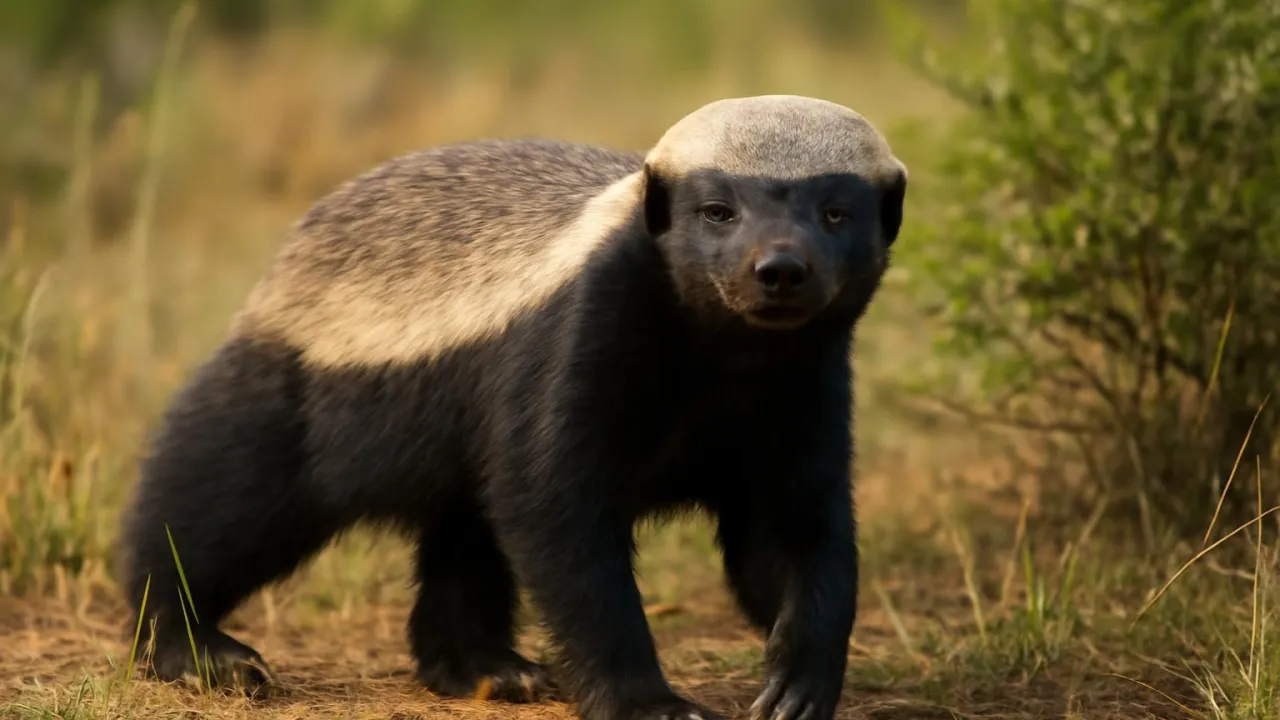
Honey badgers can survive bee stings and snake bites without much harm!
✨ Word Sparks (Grade 2 Glossary)
Tap 🔊 to hear
claws
Sharp nails animals use to dig or catch food
dig
To make holes in the ground
protect
To keep safe from danger
🪝
Can a small animal scare lions and snakes?
1
Where They Live
Honey badgers live in Africa and parts of Asia. They like dry places and forests. They holes to sleep safely. They are mostly active at night and dawn.
2
What They Eat
These animals eat honey, insects, and small animals. They use strong to find food underground. They also hunt snakes and rodents for meat. Their diet helps them survive in tough places.
3
Special Feature
Honey badgers have thick skin that them from bites. They are very brave and will fight bigger animals. This helps them stay safe from predators. Their fearless nature is their best defense.
1. What helps honey badgers find food underground?
2. Where do honey badgers sleep?
🤯 Mind-Blowing Fact • Grade 3
Honey badgers can survive venomous snake bites because of their special immunity!
✨ Word Sparks (Grade 3 Glossary)
Tap 🔊 to hear
omnivore
An animal that eats plants and animals
camouflage
Colors that help animals blend in
adaptation
A body change that helps survival
🪝
How does the honey badger’s tough skin help it survive predators?
1
Habitat and Range
Honey badgers live across Africa and Southwest Asia’s dry savannas and forests. They adapt well to many environments. Their habitat provides food and shelter. They often make burrows to hide from danger.
2
Diet and Hunting
They are eating honey, insects, small mammals, and reptiles. Their strong claws help dig for prey underground. They can hunt venomous snakes safely. This hunting skill ensures they get enough nutrients.
3
Physical Adaptations
Honey badgers have thick, loose skin that protects them from bites and stings. This skin allows them to twist and escape predators’ grip easily. Their sharp teeth and claws help defend themselves well. These keep them safe in the wild.
4
Survival Strategies
Honey badgers use their fearless nature to scare predators away. They also use to blend into their environment. Their boldness helps them hunt dangerous prey. These help them avoid becoming prey themselves.
Honey badgers can survive bee stings, snake bites, and even attacks from lions because of their thick skin and courage!
✨ Word Sparks (Grade 4 Glossary)
Tap 🔊 to hear
symbiosis
Close relationship between different living things
ecosystem
All living and nonliving things in one place
evolutionary
Changes over time to help survival
🪝
Why is the honey badger called one of the most fearless animals in the world?
1
Fearless Behavior and Defense
Honey badgers display fearless behavior by attacking animals much larger than themselves, which often surprises predators. Their thick, loose skin allows them to twist and escape when grabbed, making it hard for enemies to hold them. This defensive ability helps them survive dangerous encounters in the wild.
2
Role in the Ecosystem
Honey badgers help control insect and small animal populations by hunting them, which maintains balance in their . They also break into beehives to eat honey, which can affect bee colonies but also spreads pollen. Their interactions show a complex relationship within food webs and .
3
Geographic Distribution and Habitat
These animals live across much of Africa and parts of Southwest Asia, thriving in savannas, grasslands, and forests. They prefer dry, open habitats but can adapt to different environments. Human activities sometimes threaten their habitats, but they remain widespread in protected areas.
4
Cause and Effect of Their Toughness
Because honey badgers face many predators and dangers, their toughness evolved as a survival trait over time. Their ability to withstand bites and stings allows them to hunt dangerous prey like venomous snakes. This cause leads to their remarkable fearlessness and resilience.
1. How does the honey badger’s thick skin help it survive?
2. What role do honey badgers play in their ecosystem?
🤯 Mind-Blowing Fact • Grade 5
Honey badgers can survive venomous snake bites, bee stings, and attacks from larger predators due to their thick skin and fearless nature.
✨ Word Sparks (Grade 5 Glossary)
Tap 🔊 to hear
Mustelidae
Animal family with weasels and otters
physiological
How a body works inside
immunity
Body’s ability to fight off poisons
🪝
What makes the honey badger one of the toughest mammals on Earth?
1
Scientific Classification and Range
The honey badger, scientifically named Mellivora capensis, belongs to the family, which includes weasels and otters. It inhabits diverse regions across Africa and Southwest Asia, thriving in savannas, forests, and semi-arid areas. Its broad geographic range reflects its adaptability to various climates and ecosystems.
2
Physiological Mechanisms of Defense
Honey badgers possess exceptionally thick, loose skin that can be up to 6 millimeters thick, allowing them to endure bites and stings from venomous snakes and bees. Their skin’s looseness permits twisting movements to escape predators’ grips. Additionally, they have powerful jaws and sharp claws that aid in both defense and hunting.
3
Behavioral Adaptations and Fearlessness
This species exhibits remarkable fearlessness, often confronting animals much larger than itself, including lions and buffalo. Their aggressive behavior, combined with their physical defenses, deters many predators. Studies show honey badgers sometimes raid beehives to consume honey, demonstrating both boldness and resourcefulness.
4
Conservation Status and Human Impact
Although honey badgers are not currently endangered, habitat loss and human-wildlife conflict pose challenges in some regions. Conservation efforts focus on habitat protection and educating communities about their ecological role. Their resilience helps maintain ecological balance, but ongoing monitoring is necessary to ensure stable populations.
5
Quantitative Comparisons and Unique Traits
Adult honey badgers typically measure about 2.5 feet (75 centimeters) in length and weigh between 20 to 35 pounds (9 to 16 kilograms). They can run at speeds up to 19 miles per hour (30 kilometers per hour), which aids in hunting and escaping threats. Their ability to survive venomous snake bites highlights a unique rare among mammals.