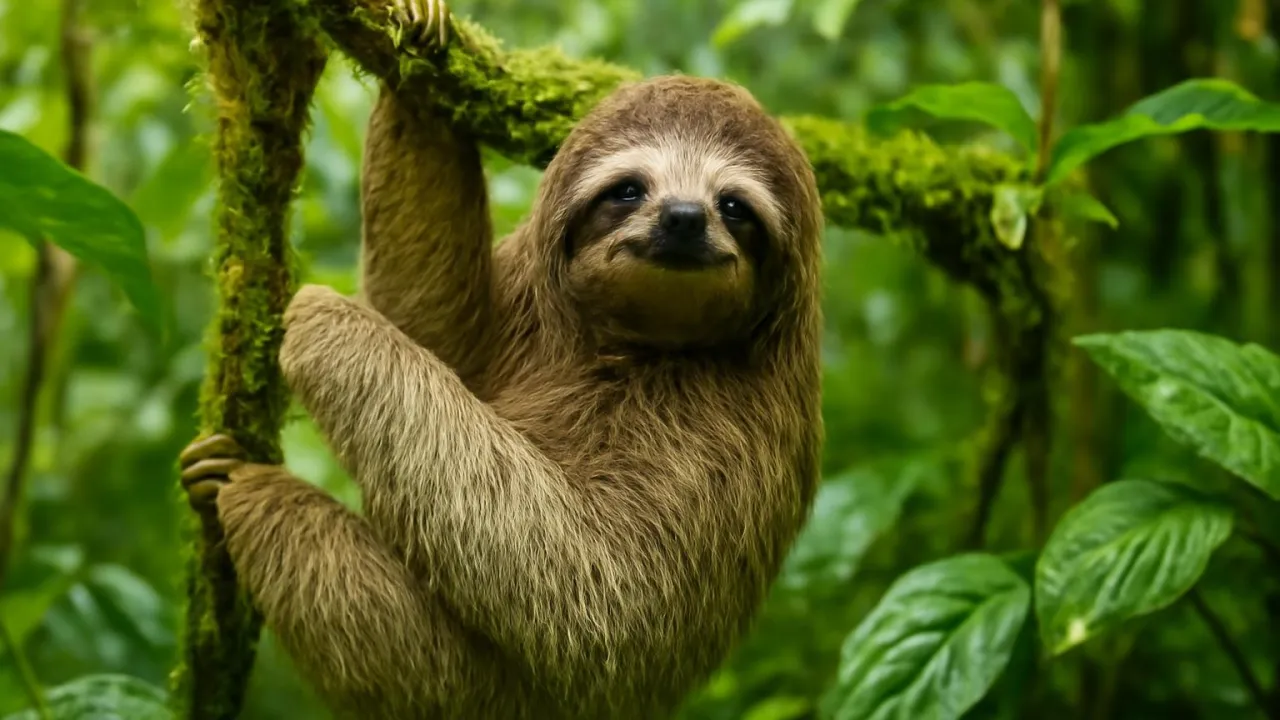
The green algae on a sloth’s fur not only hides it but also gives nutrients to its skin.
✨ Word Sparks (Grade 3 Glossary)
Tap 🔊 to hear
camouflage
Colors or patterns that help animals hide
predator
An animal that hunts other animals for food
metabolism
How an animal’s body uses energy
🪝
Did you know the three-toed sloth uses camouflage to hide from predators?
1
Slow Movements Help Survival
The three-toed sloth moves very slowly to avoid being seen by . Its slow pace helps it blend into the green leaves. This protects it from animals like jaguars and eagles. Moving slowly also saves energy because its diet has few nutrients.
2
Fur and Algae Camouflage
The sloth’s fur grows green algae that helps it blend with tree leaves. This algae acts like natural in the rainforest canopy. The algae also provides nutrients to the sloth’s skin. This unique adaptation helps the sloth stay safe in its habitat.
3
Tree Life and Diet
Three-toed sloths live high in tropical rainforest trees. They eat mostly leaves, which are hard to digest and low in nutrients. Because of this, the sloth moves slowly and sleeps up to 20 hours a day. It also uses a slow to survive on its leafy diet.
4
Head Turning and Claws
The sloth can turn its head almost 270 degrees to see around without moving its body. Its long, curved claws help it hang securely from branches. These claws also help it climb and move through the trees. This combination of traits helps the sloth survive in the wild.
2. What helps the sloth’s fur blend with the leaves?
🤯 Mind-Blowing Fact • Grade 4
The three-toed sloth’s fur supports a tiny ecosystem of algae and insects living together in the rainforest canopy.
✨ Word Sparks (Grade 4 Glossary)
Tap 🔊 to hear
symbiosis
When two living things help each other
deforestation
Cutting down many trees in a forest
ecosystem
A community of living things and their home
🪝
How does the three-toed sloth’s slow lifestyle affect its rainforest ecosystem?
1
Slow Movement and Energy Use
The three-toed sloth’s slow movements reduce energy use, allowing it to survive on a low-nutrient leaf diet. Because it moves so slowly, it avoids attracting predators like jaguars and harpy eagles. This slow pace also means the sloth spends most of its time resting or sleeping in the trees. Its slow metabolism helps it live on leaves that provide little energy.
2
Role in the Rainforest Food Web
Sloths serve as prey for many rainforest predators, making them an important part of the food web. Their fur hosts algae and insects, creating a small that benefits multiple species. This symbiotic relationship helps maintain biodiversity in the rainforest canopy. The sloth’s presence supports many other living things in its habitat.
3
Geographic Range and Habitat
Three-toed sloths live in tropical rainforests from Central America to northern South America. They prefer dense forests with tall trees that provide food and shelter. threatens their habitat, reducing safe areas where they can live and find food. Protecting these forests is critical for their survival.
4
Human Impact and Conservation
Human activities like logging and farming destroy sloth habitats, causing population declines. Conservation efforts focus on protecting rainforest areas and creating wildlife corridors. These actions help sloths move safely between forest patches and reduce risks from roads and predators. Education and habitat preservation are key to saving sloths.
1. What helps the sloth survive on a low-energy diet?
2. Why is deforestation bad for sloths?
🤯 Mind-Blowing Fact • Grade 5
The three-toed sloth’s neck has extra vertebrae allowing nearly 270-degree head rotation, rare among mammals.
✨ Word Sparks (Grade 5 Glossary)
Tap 🔊 to hear
metabolism
How an animal’s body uses energy for life
symbiotic
Living together where both help each other
deforestation
Cutting down many trees in a forest area
🪝
How does the three-toed sloth’s unique biology allow it to thrive in rainforest canopies?
1
Taxonomy and Scientific Classification
The three-toed sloth, scientifically known as Bradypus variegatus, belongs to the order Pilosa and family Bradypodidae. It is one of six species of sloths and is distinguished by three long claws on each limb. This species is native to the tropical rainforests of Central and South America, where it plays a vital ecological role.
2
Physiological Adaptations for Slow Living
This sloth’s slow allows it to survive on a diet primarily composed of tough, fibrous leaves that provide minimal nutrients. Its muscles are adapted for hanging and slow climbing, with long, curved claws that securely grip tree branches. The sloth’s fur hosts algae, which provides camouflage and nutrients, helping it avoid predators.
3
Ecological Role and Conservation Status
Three-toed sloths contribute to rainforest biodiversity by supporting a micro-ecosystem of algae and insects within their fur. They serve as prey for large predators, maintaining food web balance. Habitat loss from threatens their populations, but conservation efforts including protected reserves and wildlife corridors aim to preserve their natural habitats.
4
Quantitative Comparisons and Behavior
Adult three-toed sloths measure between 20 to 27 inches in length and weigh approximately 8 to 17 pounds. They move at an average speed of about 0.03 miles per hour, making them one of the slowest mammals. Their neck vertebrae allow nearly 270-degree head rotation, a rare trait among mammals, enhancing their ability to detect predators.
5
Botanical and Historical Insights
Unlike many mammals, the three-toed sloth’s fur hosts algae that is unique in providing both camouflage and nutrients. Historically, indigenous peoples have recognized the sloth’s slow movement as a survival strategy. Scientific studies continue to explore this species’ unique adaptations, contributing to broader understanding of evolutionary biology.