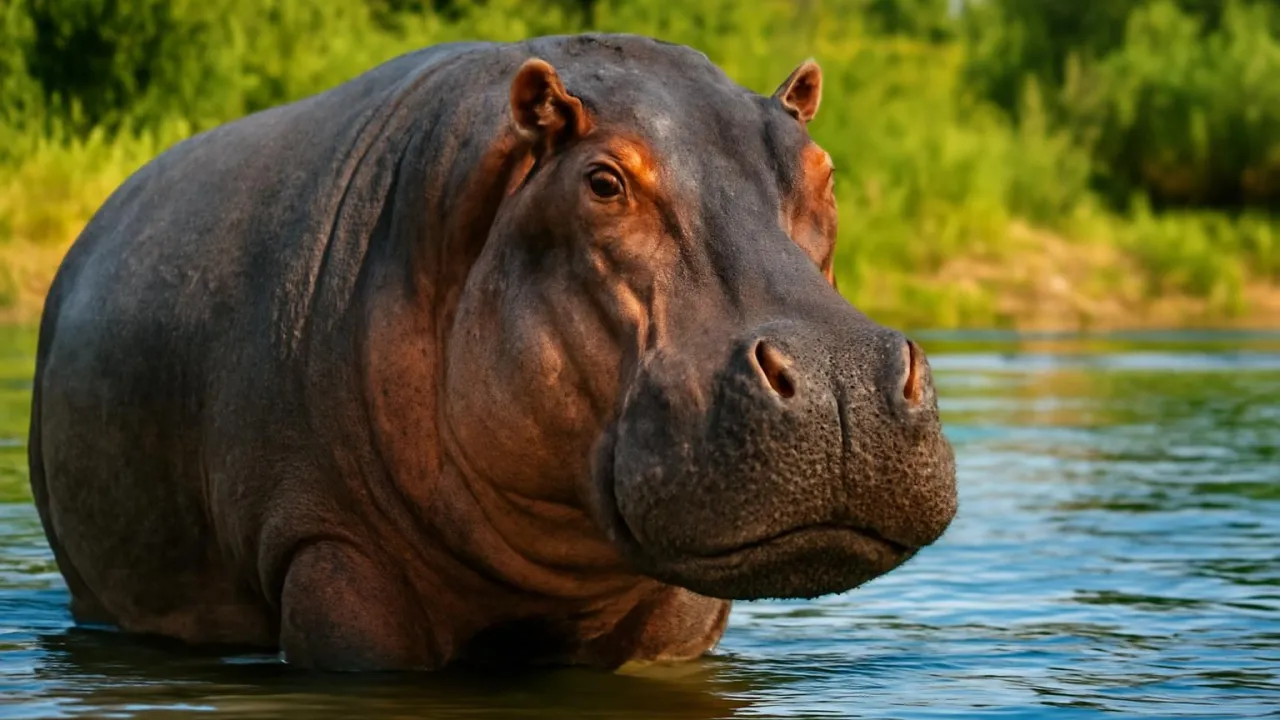
Hippos can close their ears and nostrils underwater to keep water out!
✨ Word Sparks (Grade 2 Glossary)
Tap 🔊 to hear
habitat
The natural home where an animal lives
herbivore
An animal that eats only plants
nostrils
The holes on the nose used for breathing
🪝
Have you ever wondered how hippos stay underwater so long?
1
Huge and Strong
Hippos are very large and strong animals that live in Africa. They have thick skin and big mouths. Their legs are short but very powerful. Hippos can weigh more than a car.
2
Water Homes
Hippos spend most of their days in rivers or lakes to keep cool. They swim and float easily in water. At night, they leave the water to eat grass on land. Hippos like places with lots of water and grass.
3
Special Features
Hippos can hold their breath underwater for up to five minutes. Their eyes and are on top of their heads. This helps them see and breathe while mostly underwater. Hippos use their big mouths to eat and protect themselves.
Hippos secrete a reddish oily substance that acts like natural sunscreen and moisturizer!
✨ Word Sparks (Grade 3 Glossary)
Tap 🔊 to hear
adaptation
A body change that helps survival
camouflage
Colors that help hide from others
herbivore
An animal that eats only plants
🪝
Did you know hippos have special adaptations for living in water and land?
1
Size and Strength
The common hippopotamus is one of the largest land mammals in Africa. It can weigh up to 4,000 pounds and stand about five feet tall. Its thick skin protects it from sunburn and injuries. Hippos use their strong legs to walk on land and swim in water.
2
Aquatic Adaptations
Hippos spend much of their time submerged in rivers or lakes to stay cool. Their eyes, ears, and nostrils sit high on their heads, allowing them to see and breathe while mostly underwater. This helps them avoid predators and stay hidden. Hippos can hold their breath underwater for nearly five minutes.
3
Feeding and Behavior
Hippos are that graze on grasses at night. They leave the water to find food and return before sunrise. Their large mouths and strong teeth help them gather and chew tough plants. Hippos also use their wide mouths to show dominance or scare rivals.
4
Survival and Camouflage
Hippos’ grayish skin helps them blend with river mud and water, providing from predators. They secrete a natural reddish oil that protects their skin from sunburn and infections. This oil acts like sunscreen and keeps their skin moist. Hippos live in groups called pods, which helps protect them from danger.
1. Why do hippos have eyes and nostrils on top of their heads?
2. What does the reddish oil on hippos’ skin do?
🤯 Mind-Blowing Fact • Grade 4
Hippos connect land and water ecosystems by fertilizing rivers with nutrient-rich dung!
✨ Word Sparks (Grade 4 Glossary)
Tap 🔊 to hear
ecosystem
A community of living and nonliving things
territorial
Protecting an area from others
conservation
Protecting animals and nature
🪝
How does the hippopotamus survive both in water and on land so well?
1
Physical Adaptations for Dual Life
The common hippopotamus has several physical adaptations that allow it to thrive in both aquatic and terrestrial environments. Its eyes, ears, and nostrils are positioned high on its head, enabling it to see and breathe while mostly submerged. The thick skin secretes a reddish oily substance that protects against sunburn and infections, allowing the hippo to spend long hours in the sun. Its powerful legs support its heavy body on land and help propel it underwater.
2
Role in the Ecosystem
Hippos play an important role in their by connecting aquatic and terrestrial food webs. Their grazing on grasses helps maintain healthy riverbank vegetation, while their dung fertilizes water, supporting fish populations. Hippos also serve as prey for large predators like lions and crocodiles, especially young hippos. Their presence influences the balance of both land and water habitats.
3
Geographic Distribution and Habitat
Common hippopotamuses are native to sub-Saharan Africa, mainly inhabiting rivers, lakes, and mangrove swamps. They require habitats with abundant water to keep their skin moist and regulate body temperature. Human activities such as farming and settlement have reduced their natural habitats, causing some populations to decline. efforts focus on protecting water sources and river to support hippos.
4
Behavior and Social Structure
Hippos live in social groups called pods, which usually consist of females, their young, and one dominant male. These groups help protect members from predators and rivals. Hippos communicate through grunts, bellows, and whistles both above and below water. Their behavior includes marking areas with dung and using their large mouths to display dominance.
2. What is one way hippos show they own their territory?
🤯 Mind-Blowing Fact • Grade 5
Hippos can run faster than humans on land, reaching speeds up to 19 miles per hour!
✨ Word Sparks (Grade 5 Glossary)
Tap 🔊 to hear
physiology
How an animal's body works
ecosystem
A community of living and nonliving things
conservation
Protecting animals and nature
🪝
What fascinating adaptations allow the common hippopotamus to thrive in African rivers and grasslands?
1
Scientific Classification and Physical Traits
The common hippopotamus, scientifically named Hippopotamus amphibius, belongs to the family Hippopotamidae. Adult hippos can weigh between 3,300 and 4,000 pounds and measure up to 16.5 feet in length. Their dense, barrel-shaped bodies are supported by short, sturdy legs adapted for both walking on land and swimming. Their skin secretes a unique reddish oily substance that protects against UV radiation and bacterial infections, an essential adaptation for their semi-aquatic lifestyle.
2
Physiological Adaptations for Aquatic Life
Hippos have evolved physiological features including nostrils and eyes positioned dorsally, enabling breathing and vision while mostly submerged. They can close their nostrils and ears underwater to prevent water entry. Their lungs and blood have high oxygen storage capacity, allowing them to hold their breath for up to five minutes during dives. Their muscular bodies and webbed toes aid in slow but powerful swimming and walking along riverbeds.
3
Ecological Role and Conservation Status
Hippos serve as engineers by transferring nutrients from land to water through their grazing and defecation, which supports aquatic life such as fish. They are prey for apex predators including lions and crocodiles, particularly when young. Despite their ecological importance, hippos face threats from habitat loss and poaching. The International Union for of Nature currently lists them as vulnerable, prompting conservation efforts focused on habitat preservation and anti-poaching measures.
4
Behavioral Patterns and Social Organization
Hippos live in pods typically consisting of one dominant male, multiple females, and their offspring. Males defend territories aggressively using vocalizations, jaw displays, and physical confrontations. Communication includes grunts, bellows, and whistles audible both above and underwater. Hippos are mostly nocturnal feeders, grazing on grasses during the night and spending daylight hours submerged to regulate body temperature.
5
Quantitative Comparisons and Interesting Facts
Adult hippos can weigh as much as a small car, sometimes reaching 4,000 pounds, and can run up to 19 miles per hour on land. They can stay underwater for nearly five minutes without breathing and dive to depths of up to 16 feet. Their skin temperature ranges from 35 to 37 degrees Celsius, regulated by water immersion and their unique skin secretions. These remarkable traits make hippos one of the most fascinating large mammals in Africa.