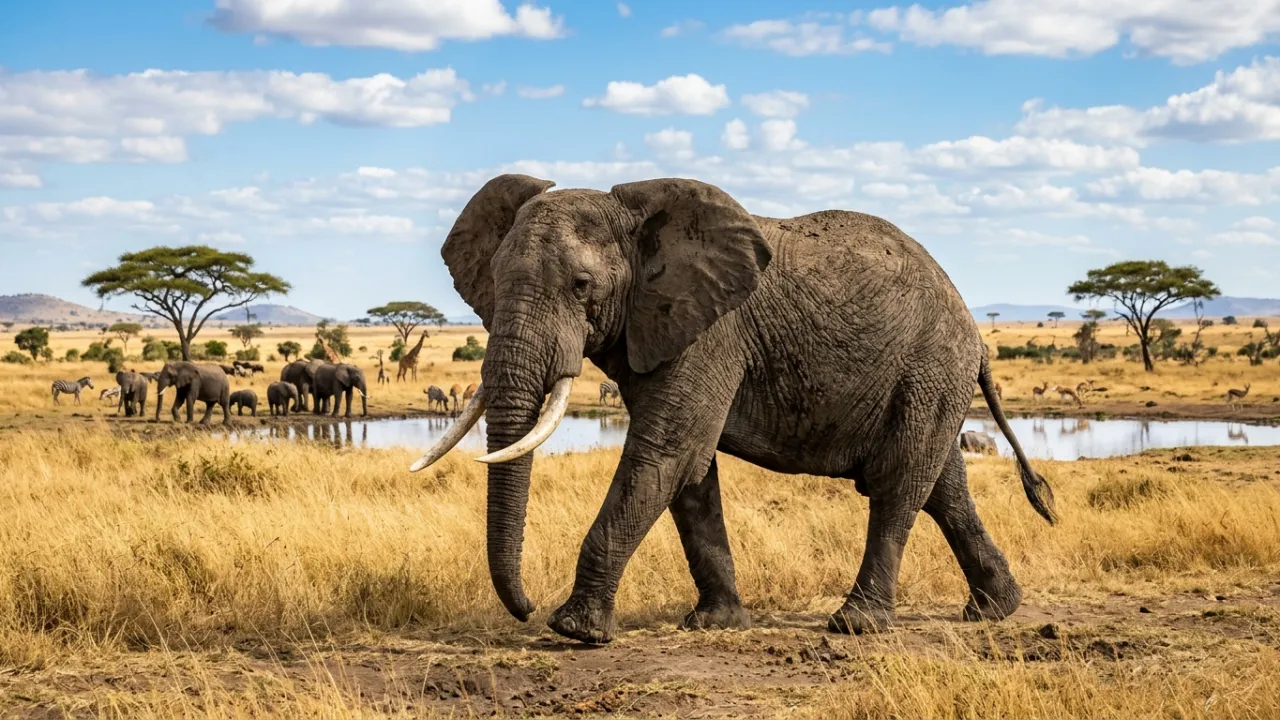
1. What body part does an elephant use to spray cool water and pluck leaves?
2. What kind of food do African Bush Elephants eat?
🤯 Mind-Blowing Fact • Grade 2
The tip of an African Bush Elephant's trunk has two nimble 'fingers' small enough to pick up a single peanut or berry!
✨ Word Sparks (Grade 2 Glossary)
Tap 🔊 to hear
savanna
Warm grassy plain with scattered trees
calf
Young baby elephant in the herd
mammal
Warm-blooded animal that drinks mom's milk
🪝
Did you know an elephant's giant ears are shaped like the map of Africa—and work like air conditioners?
1
Rulers of the Sunny Savanna
Step onto the grassy African , where Earth's largest land towers higher than a basketball hoop! African Bush Elephants roam across sunny plains and shady river valleys in close family herds led by a wise older grandmother.
2
Ears That Beat the Heat
Hot sunshine bakes the dry grasslands, so elephants flap their huge, Africa-shaped ears to cool off. Warm blood flows through tiny vessels near the thin ear skin, and each gentle breeze carries away extra body heat.
3
Growing Up With Giant Appetites
Newborn calves already weigh over 200 pounds when they stand up on wobbly legs! Adults munch grasses, roots, and tree bark for up to sixteen hours every single day.
1. How do giant ears help an African Bush Elephant on a hot day?
2. Who leads an elephant family herd across the savanna?
🤯 Mind-Blowing Fact • Grade 3
An elephant's trunk can hold up to two gallons of water at once before curling up to squirt a refreshing drink into its mouth!
✨ Word Sparks (Grade 3 Glossary)
Tap 🔊 to hear
herbivore
Animal that eats only plant foods
adaptation
Body trait helping an animal survive
vibration
Tiny rapid shaking felt through ground
🪝
How can two elephant herds have a secret conversation across miles of grassland without humans hearing a single sound?
1
Secret Messages Beneath Their Feet
Press your ear to the ground—elephants are sending secret messages right through the soil! Besides loud trumpet blasts, they rumble at deep pitches below human hearing. Spongy fat pads inside their wide feet feel these underground from miles away, warning distant herds about hungry predators or distant rainstorms.
2
A Boneless Tool of 40,000 Muscles
Imagine lifting a heavy fallen tree branch and then gently plucking a tiny berry with your nose! An elephant's trunk contains zero bones, yet roughly 40,000 muscles give this amazing incredible lifting strength, snorkel breathing underwater, and delicate control while sniffing fresh water miles upwind.
3
Sunscreen Made of Dust and Mud
Even inch-thick wrinkled skin can get sunburned or bitten by buzzing flies. Wallowing in cool mud and tossing dusty soil over their backs traps refreshing moisture inside tiny skin cracks like natural sunscreen.
4
300 Pounds of Plant Fuel Daily
As giant , adults strip tough acacia bark with curved ivory tusks and grind up to 300 pounds of fibrous grasses, roots, and leaves every single day while drinking nearly 50 gallons of cool water.
1. How do elephants detect low rumbles sent by other herds miles away?
2. Why do elephants spray mud and dust over their wrinkled gray skin?
🤯 Mind-Blowing Fact • Grade 4
Clever farmers in East Africa hang connected beehives around crop fields because even a six-ton elephant will turn around at the buzz of honeybees!
✨ Word Sparks (Grade 4 Glossary)
Tap 🔊 to hear
keystone
Species many other living things need
matriarch
Oldest female leader of family herd
corridor
Safe land pathway connecting wildlife habitats
🪝
Why would hundreds of savanna birds, antelopes, and trees struggle to survive if the African Bush Elephant disappeared?
1
Keystone Engineers of Sub-Saharan Africa
Without elephants bulldozing thorny scrub, vast stretches of sunlit African grassland would choke into dense, impassable thicket! Across 24 sub-Saharan nations—from Kenya's open savannas and Tanzania's woodlands to Botswana's flooded Okavango Delta—ecologists call African Bush Elephants ecosystem engineers because dozens of grazing mammals, insects, and songbirds depend directly on the open habitats they shape.
2
Digging Wells and Planting Tomorrow's Forests
When scorching dry-season heat dries rivers into sandy beds, experienced recall hidden underground streams from decades earlier and use their tusks and trunks to dig deep water wells that zebras, antelopes, warthogs, and birds later share. Meanwhile, elephants swallow tough wild fruits whole and deposit viable seeds miles away inside nutrient-rich dung—feeding dung beetles while planting shade trees across the plain.
3
Matriarchal Memory and Cooperative Defense
Generations of mothers, aunts, sisters, and calves travel together in tight matriarchal clans of ten to thirty relatives, forming protective outward-facing circles around youngsters whenever prowling lions or hyenas draw near. Because females live into their sixties, older leaders pass down irreplaceable mental maps of seasonal food webs and safe river crossings to younger elephants.
4
Wildlife Corridors and Beehive Fences
Because expanding farms, fences, and highways can slice across ancient migration paths—and illegal ivory poaching historically reduced herds—conservationists and rural African communities now partner to protect wildlife and hang clever beehive fences! Since elephants hate bee stings inside their sensitive trunks, buzzing honeybee hives peacefully guard farmer harvests while providing golden honey for local families. Every step an elephant takes helps keep the savanna thriving for generations of wild neighbors.
1. Why do ecologists call the African Bush Elephant a keystone ecosystem engineer?
2. How do beehive fences help both African farmers and wild elephants?
🤯 Mind-Blowing Fact • Grade 5
African Bush Elephants carry roughly 2,000 smell-detecting genes—more than five times as many as humans and over twice as many as domestic dogs!
✨ Word Sparks (Grade 5 Glossary)
Tap 🔊 to hear
proboscis
Flexible elongated nose or feeding tube
infrasound
Sound waves below human hearing range
terrestrial
Living primarily on land, not water
🪝
How does a six-ton mammal sustain Earth's largest land brain, detect seismic waves at 15 hertz, and replace its own molar teeth six times in a lifetime?
1
Taxonomic Distinction Among Living Proboscideans
Towering up to 13 feet (4 meters) at the shoulder and tipping the scales at 13,000 pounds (6,000 kilograms), Loxodonta africana reigns as Earth's largest living animal. Genomic sequencing confirmed in the early twenty-first century that Africa actually harbors two genetically distinct species within the order Proboscidea: the larger, concave-backed African Bush Elephant of savannas and woodlands, and the smaller, straighter-tusked African Forest Elephant (Loxodonta cyclotis) of Central African rainforests, alongside Asia's Elephas maximus.
2
Muscular Hydrostat Mechanics and Olfactory Power
Formed by the evolutionary fusion of the nose and upper lip, the operates as a biological muscular hydrostat—approximately 40,000 muscle fascicles arranged in longitudinal, radial, and helical layers working without a single bone or joint. Opposing twin projections on the trunk tip grasp tiny seeds delicately while lifting 600-pound (270-kilogram) logs. Furthermore, Loxodonta africana possesses roughly 2,000 functional olfactory receptor genes—more than twice a bloodhound's—allowing herds to scent subsurface water up to 12 miles (19 kilometers) away.
3
Infrasonic Acoustics and Seismic Bone Conduction
When matriarchs coordinate movements across open plains, giant vocal folds generate powerful rumbles between 5 and 20 hertz—frequencies below human hearing yet capable of traveling over 6 miles (10 kilometers) through air and soil. Dense fatty cushions inside each foot coupled with Pacinian corpuscle nerve endings detect ground-borne Rayleigh waves and conduct vibrations up leg bones directly to the middle ear, where an 11-pound (5-kilogram) brain decodes distance and caller identity.
4
Conveyor-Belt Dentition and Thermal Vascularity
Pulverizing 300 pounds (136 kg) of silica-rich grasses daily wears down tooth enamel, so elephants evolved horizontal polyphyodonty: six sets of 9-pound, brick-sized molars march forward from the rear of the jaw like a conveyor belt across 60 to 70 years, while elongated upper incisors grow continuously as ivory tusks. Meanwhile, pumping 3 gallons (11 liters) of blood per minute through paper-thin ear pinnae dissipates tremendous metabolic heat.
5
Transboundary Conservation and Genetic Stewardship
Classified as Endangered by the IUCN following twentieth-century ivory poaching and habitat fragmentation, vast five-nation reserves such as the Kavango-Zambezi Transfrontier Conservation Area now reconnect 200,000 square miles of seasonal migration routes across southern Africa, ensuring half-ton herds can disperse seeds and cycle savanna nutrients for centuries ahead. Community rangers and satellite-collar researchers work side by side each day to safeguard every herd.