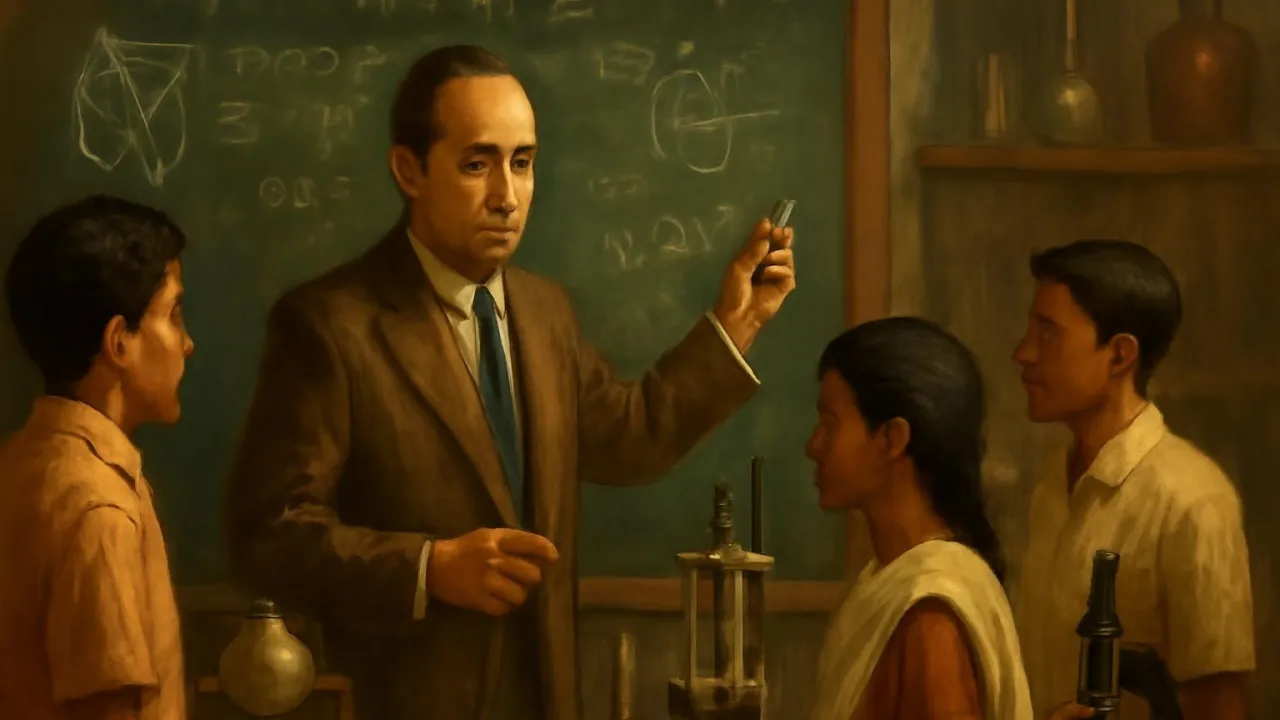
Homi’s favorite subject in school was always physics, the science of energy and matter.
✨ Word Sparks (Grade 2 Glossary)
Tap 🔊 to hear
experiment
A test to learn something new
research
Careful study to find answers
scientist
A person who studies science
🪝
Have you ever wondered what makes up everything around you?
1
Curious About Tiny Things
Young Homi always wondered about the tiniest things in the world. He read science books and watched the sky with his family at night. He wanted to know how the world worked, so he asked many questions and tried little . His curiosity made him want to learn even more about science every day.
2
Learning and Working Hard
Homi studied hard in school and college, always eager to discover new ideas. He liked doing and using new tools in his classroom and at home. He worked with other to learn about atoms and shared his findings with friends. Homi believed that learning together made science even more exciting.
3
A Big Dream for India
Homi wanted India to be great in science and lead the world. He built a special lab for atomic where students and could work together. His work helped India become a leader in science, and he inspired many young people to become scientists too. Homi’s dream made a difference for his whole country.
1. What did Homi often do with his family at night?
2. What was Homi’s big dream for India?
🤯 Mind-Blowing Fact • Grade 3
Homi’s work helped India build its first nuclear reactor, called Apsara.
✨ Word Sparks (Grade 3 Glossary)
Tap 🔊 to hear
particle
A very tiny part of matter
physics
The science of energy and matter
reactor
A machine that controls atomic energy
🪝
Imagine peering through a microscope and discovering a whole new world—what would you find?
1
A Starry-Eyed Dreamer
As a child, Homi J. Bhabha gazed at the night sky, filled with questions about the universe. He loved reading science books and conducting small experiments at home. His curiosity about atoms and energy grew stronger every day. Homi dreamed of making discoveries that could help his country.
2
Journey to Become a Scientist
Homi studied in India and then traveled to England for college. He worked hard in laboratories, learning about and atomic energy. His teachers noticed his dedication and sharp scientific mind. Homi’s perseverance helped him become a respected scientist.
3
Building India’s Science Future
Homi returned to India with a big vision for science. He established the Tata Institute of Fundamental Research, a place for scientists to study atoms. Homi inspired many young people to explore and mathematics. His leadership made India famous for atomic research.
4
Facing Challenges and Inspiring Others
Homi faced many obstacles, like limited resources and new problems. He used creativity and teamwork to solve them. He believed science could make life better for everyone. Today, Homi J. Bhabha is remembered as the father of India’s atomic program.
Homi was nominated for the Nobel Prize in Physics several times for his groundbreaking work.
✨ Word Sparks (Grade 4 Glossary)
Tap 🔊 to hear
cosmic rays
Energy from space that hits Earth
innovation
A new idea or invention
nuclear
Related to the center of an atom
🪝
What if your curiosity could help change the future of an entire country?
1
A Childhood Spark for Science
From a young age, Homi J. Bhabha was fascinated by the mysteries of the universe, spending hours reading about stars and atoms. Growing up in Mumbai during the early 1900s, he was surrounded by family members who encouraged his scientific curiosity. He excelled in school, especially in physics and mathematics, always asking questions and seeking answers. This early passion set him on a path to become one of India’s most important scientists.
2
A Scholar’s Journey Abroad
Homi traveled to England to study at Cambridge University, where he learned from some of the world’s top physicists. He worked on experiments involving and atomic particles, making important discoveries as a young researcher. Despite facing challenges far from home, he earned respect for his intelligence and determination. Homi’s experiences in England shaped his dream of bringing world-class science back to India.
3
Building the Foundation of Indian Science
Returning to India during World War II, Homi saw the need for advanced research in his homeland. He founded the Tata Institute of Fundamental Research in 1945, creating a place where Indian scientists could study atoms and energy. Homi led the team that built India’s first reactor, Apsara, opening new doors for scientific progress. His leadership inspired a generation of Indian researchers and made India a leader in atomic science.
4
Legacy and Global Impact
Homi J. Bhabha’s vision helped transform India into a country known for scientific and discovery. He worked with world leaders and scientists, promoting peaceful uses of atomic energy for medicine and industry. Even after his passing, his ideas and institutions continue to shape science in India and around the world. Homi’s story reminds us that curiosity, hard work, and teamwork can change history.
1. What did Homi create to help Indian scientists?
2. How did Homi’s work help the world?
🤯 Mind-Blowing Fact • Grade 5
Homi’s leadership helped India become the sixth country in the world to build a nuclear reactor.
✨ Word Sparks (Grade 5 Glossary)
Tap 🔊 to hear
subatomic
Smaller than an atom itself
commission
A group leading important work
perseverance
Never giving up, even when hard
🪝
Picture a young thinker, peering at the stars and atoms—how could his curiosity shape a nation’s destiny?
1
Igniting a Passion for Discovery
As a boy in bustling Mumbai, Homi J. Bhabha was endlessly fascinated by the mysteries of science and the universe. He devoured books on physics and astronomy, often conducting small experiments at home to satisfy his curiosity. His family, filled with engineers and scholars, encouraged his questions and scientific explorations. This nurturing environment helped Homi develop a deep love for learning and a desire to use science for the betterment of society. His early fascination with the tiniest building blocks of matter would one day change the course of Indian science.
2
Academic Excellence and International Recognition
Homi’s academic journey took him to Cambridge University, where he studied under some of the world’s most renowned physicists. He made significant contributions to the study of cosmic rays and the behavior of particles, publishing papers that earned him international acclaim. Despite facing the challenges of being far from home and navigating a world at war, Homi’s and brilliance shone through. He was nominated multiple times for the Nobel Prize in Physics, a testament to the global impact of his research. These experiences abroad strengthened his resolve to bring advanced scientific research to India.
3
Architect of India’s Atomic Age
Returning to India during World War II, Homi recognized the urgent need for a strong scientific foundation in his homeland. He founded the Tata Institute of Fundamental Research in 1945, creating India’s first major center for advanced physics and mathematics. Under his leadership, the institute built Apsara, India’s first nuclear reactor, which marked a turning point for atomic research in the country. Homi also led the Atomic Energy , guiding India’s peaceful nuclear program and advocating for the use of atomic energy in medicine, agriculture, and industry. His vision and organizational skills made India a respected leader in global science.
4
Overcoming Challenges and Inspiring a Generation
Homi faced significant obstacles, including limited resources, political uncertainty, and skepticism about atomic research in a newly independent nation. He addressed these challenges by fostering teamwork, encouraging innovation, and building partnerships with scientists around the world. Homi’s charismatic leadership inspired countless young Indians to pursue careers in science and engineering. He believed that scientific progress was essential for national development and worked tirelessly to ensure that India remained at the forefront of research. His emphasis on peaceful uses of atomic energy set a powerful example for responsible scientific advancement.
5
A Lasting Legacy in Science and Society
Today, Homi J. Bhabha is celebrated as the father of India’s atomic program and a pioneer of modern Indian science. His institutions and ideas continue to shape research and education, both in India and globally. Homi’s life demonstrates how curiosity, , and visionary leadership can transform a nation’s future. He promoted international cooperation and peaceful scientific progress, earning respect from leaders and scientists worldwide. Homi’s story encourages young thinkers everywhere to dream big, ask questions, and use science to make the world a better place.