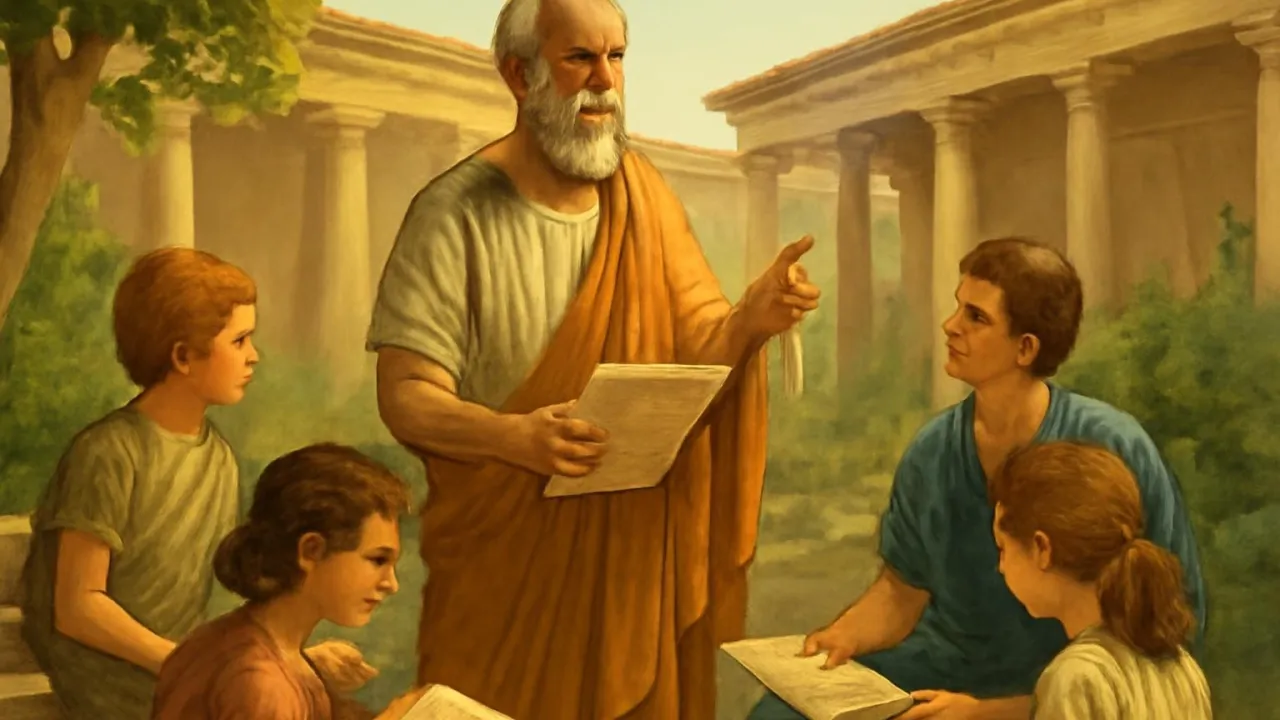
Doctors today still promise to be kind and honest using the Hippocratic Oath.
✨ Word Sparks (Grade 2 Glossary)
Tap 🔊 to hear
oath
A special promise you make
patient
A person who needs a doctor’s help
gentle
Being soft and careful with others
🪝
Have you ever wondered how doctors first learned to help people?
1
Curious About Sickness
As a child, Hippocrates was curious about why people got sick. He watched his father, who was also a doctor, and asked many questions. Hippocrates wanted to help people feel better and stay healthy.
2
Learning and Teaching
Hippocrates studied plants, animals, and the human body to learn more. He believed doctors should observe and listen to their carefully. He taught other doctors to be and wise.
3
A Big Achievement
Hippocrates wrote books about medicine and started new ideas. He is famous for the Hippocratic , which tells doctors to be honest and kind. His ideas are still important for doctors today.
1. What did Hippocrates study to learn about health?
2. What is the Hippocratic Oath?
🤯 Mind-Blowing Fact • Grade 3
Hippocrates believed illness came from nature, not magic—an idea that changed history!
✨ Word Sparks (Grade 3 Glossary)
Tap 🔊 to hear
foundation
The strong base for something important
recovery
Getting better after being sick
respect
Treating someone in a kind way
🪝
Imagine living in ancient Greece—how would you find out why people get sick?
1
A Curious Young Healer
Young Hippocrates often watched his father care for sick neighbors. He grew fascinated by the mysteries of illness and health in his small Greek town. Instead of guessing, he asked questions and carefully observed what happened. His curiosity led him to study nature and the human body.
2
Learning from the World
Hippocrates explored plants, animals, and even the weather to find health clues. He noticed patterns in fevers, wounds, and times, using careful observation. He believed that sickness had natural causes, not magic or angry gods. This was a new idea in ancient Greece.
3
Teaching and Writing
Hippocrates wrote many books about medicine and healing. He taught his students to listen, observe, and treat patients with and kindness. He believed doctors should help, not harm, and always act honestly. His teachings became the of modern medicine.
4
A Lasting Promise
Hippocrates created the Hippocratic Oath, a special promise for doctors. This oath says doctors must care for patients and keep their secrets safe. Today, many doctors around the world still take this oath. Hippocrates’s ideas changed medicine forever.
The Hippocratic Oath, created over 2,000 years ago, is still used by doctors worldwide today.
✨ Word Sparks (Grade 4 Glossary)
Tap 🔊 to hear
symptom
A sign that someone is sick
ethical
Doing what is right and fair
legacy
Something important left behind
🪝
What if you could transform medicine by observing nature and caring for every patient?
1
Ancient Greece: A Place of Discovery
In the bustling markets and sunny courtyards of ancient Greece, Hippocrates grew up surrounded by healers and storytellers. He was deeply curious about why people became ill and how they could recover. Unlike many of his time, he did not believe that angry gods caused sickness. Instead, he watched, listened, and wrote down everything he learned from nature and people.
2
Turning Points in Medicine
Hippocrates introduced the revolutionary idea that diseases had natural causes, not supernatural ones. He carefully observed and recorded his findings, which helped other doctors make better decisions. By teaching his students to use logic and evidence, he set new standards for medical practice. His approach marked a turning point in the history of medicine.
3
Signature Teachings and Techniques
Hippocrates emphasized the importance of diet, rest, and a clean environment for healing. He wrote detailed medical books and encouraged doctors to treat patients with respect and honesty. The Hippocratic Oath, which he created, still guides doctors to act ethically and care for their patients. These teachings became the foundation of modern medical science.
4
A Legacy That Spans the Globe
Today, Hippocrates is remembered as the Father of Medicine, and his influence reaches far beyond Greece. Doctors around the world take the Hippocratic Oath as a promise to help others and do no harm. His belief in careful observation and care changed how people think about health. Hippocrates’s continues to inspire new generations of healers.
1. How did Hippocrates change the way doctors understand illness?
2. Why is the Hippocratic Oath important for doctors?
🤯 Mind-Blowing Fact • Grade 5
Hippocrates’s medical writings and ethical rules have been studied for over 2,400 years by doctors worldwide.
✨ Word Sparks (Grade 5 Glossary)
Tap 🔊 to hear
confidentiality
Keeping private information safe and secret
superstition
A belief not based on science or facts
clinical
Related to the careful study of patients
🪝
How did one ancient Greek’s careful observations and ethical ideas shape the future of medicine forever?
1
A Young Mind in Ancient Greece
On the island of Kos, surrounded by the blue waters of the Aegean Sea, young Hippocrates watched his physician father care for the sick. He was fascinated by the mysteries of the human body and the suffering of his neighbors. Instead of accepting the common belief that angry gods or evil spirits caused disease, Hippocrates asked questions and looked for logical explanations. His early curiosity drove him to study plants, animals, and the environment, searching for clues that could help people heal.
2
Revolutionizing Medical Thought
At a time when most Greeks relied on and magic, Hippocrates introduced the radical idea that diseases had natural causes. He carefully recorded symptoms, patient histories, and outcomes, creating detailed case studies that allowed for comparison and learning. Hippocrates taught his students to observe, reason, and use evidence, laying the groundwork for the scientific method in medicine. His approach helped move healing from guesswork to a systematic, rational practice.
3
Signature Techniques and Lasting Writings
Hippocrates wrote more than 60 medical texts, many of which described treatments based on diet, exercise, and hygiene rather than . He stressed the importance of patient , careful observation, and ethical conduct. The Hippocratic Oath, attributed to him, became a timeless guide for doctors, requiring them to act honestly, protect patient secrets, and do no harm. His teachings on observation and medical ethics are still studied in medical schools today.
4
Historical Impact and Global Legacy
Hippocrates’s ideas spread far beyond Greece, influencing Roman, Islamic, and European medicine for centuries. His insistence on natural causes for disease helped separate medicine from religion and . Today, the Hippocratic Oath is recited by doctors around the world, and his methods form the foundation of modern medical science. Hippocrates is celebrated as the Father of Medicine, and his legacy continues to shape how doctors learn, work, and care for patients.
5
Inspiration for Future Healers
Hippocrates’s life reminds us that asking questions and caring for others can change the world. His commitment to observation, honesty, and kindness set a high standard for doctors everywhere. By rejecting and searching for natural explanations, he helped create a new path for science and health. Students and doctors today are inspired by his example to keep learning, help others, and always do what is right. The story of Hippocrates proves that wisdom and compassion can leave a lasting mark on history.