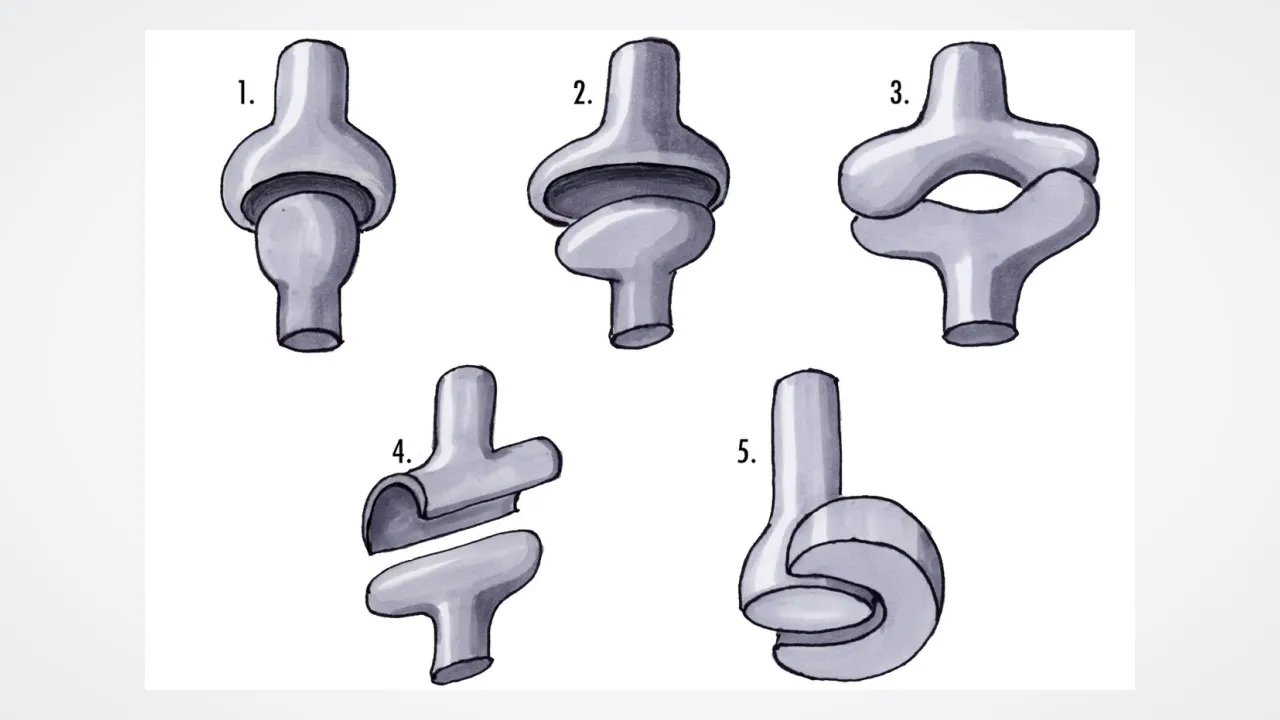
1. How does a hinge joint move compared to a shoulder joint?
2. Which set of body parts all use hinge joints to bend?
🤯 Mind-Blowing Fact • Grade 2
Your knee is the single largest and heaviest hinge-style joint in the entire human body!
✨ Word Sparks (Grade 2 Glossary)
Tap 🔊 to hear
Groove
A smooth curved track guiding another bone
Knuckle
Bending finger joint visible on your hand
Sturdy
Strong and solid without wobbling sideways
🪝
Why is a one-way hinge way better for your knees and elbows than a loose swivel joint?
1
Spool Meets Curved Groove
Look at the metal hinge holding a heavy front door. Because it swings along only one track, the door never sags sideways! Inside a human hinge joint, the rounded spool end of one bone fits neatly into a C-shaped on the next bone.
2
Steady Under Heavy Loads
Imagine trying to stand up if your knees wobbled sideways in every direction like jelly! One-way hinge joints plus strong side ligaments keep your legs and straight while you sprint, skate, or carry a heavy backpack.
3
Tiny Hinges Everywhere
Check your as you curl your fingers and toes—dozens of mini hinge joints fold neatly to grip pencils or push off the ground!
1. Why is it super helpful that your knees work as hinge joints instead of ball-and-socket joints?
2. Which joint is the largest hinge-style joint in your whole body?
🤯 Mind-Blowing Fact • Grade 3
When you straighten your elbow all the way out, the pointy tip of your forearm bone clicks neatly into a matching pocket on the back of your upper arm bone as a built-in stop!
✨ Word Sparks (Grade 3 Glossary)
Tap 🔊 to hear
Flexion
Bending a joint to bring bones closer
Extension
Straightening a joint to open the angle
Collateral Ligaments
Matching side straps preventing sideways joint wobbles
🪝
How do bony C-clamps and side straps keep your elbow and ankle hinges tracking straight?
1
Interlocking Spools and Wrenches
Picture a curved crescent wrench hooking snugly around a smooth wooden spool. That is almost exactly how your elbow hinge is built! At the bottom of your upper arm bone sits a pulley-shaped spool, and your forearm's ulna bone wraps around it in a smooth C-shaped notch.
2
Flexion and Extension
Scientists have two crisp words for hinge movement. Closing the hinge—like curling a dumbbell toward your shoulder or bending your knee—is called . Opening the hinge straight out again—like kicking a ball or reaching forward—is called .
3
Collateral Side Guards
Every hinge joint wears matching strapped tightly along its left and right sides. These twin bands stop sideways wobbles while staying relaxed enough for smooth forward-and-back gliding across slick cartilage.
4
A Modified Hinge at the Knee
While your elbow and finger joints are pure hinges, your knee is actually a 'modified' hinge—when bent, it allows just a tiny twist so you can turn smoothly while walking!
1. What do anatomists call the motion of straightening a hinge joint open?
2. Why do scientists call the human knee a 'modified' hinge joint?
🤯 Mind-Blowing Fact • Grade 4
Carpenters named the ankle's tight three-sided bone socket the 'ankle mortise' because it fits together just like an interlocking mortise-and-tenon wood joint!
✨ Word Sparks (Grade 4 Glossary)
Tap 🔊 to hear
Uniaxial
Moving back and forth around one single axis
Trochlea
Pulley-shaped bone spool inside the elbow hinge
Patella
Kneecap bone boosting leverage across the knee
🪝
How do uniaxial hinge joints multiply muscle speed and protect limbs from sideways shear?
1
Uniaxial Precision: The Ginglymus
Lift a glass of water to your lips or sprint up a stadium staircase. Both actions depend on ginglymus joints—the anatomical name for synovial hinge joints that operate around a single transverse axis. By channeling all motion into one sagittal plane of flexion and extension, hinge joints eliminate energy-wasting sideways wobble and turn long limb bones into high-speed mechanical levers.
2
Inside the Elbow and Finger Hinges
Examine the humeroulnar joint of your elbow: the spool-shaped of the humerus interlocks with the deep trochlear notch of the ulna, stopping neatly when the olecranon process seats into its posterior fossa at 180 degrees. Out in your hands and feet, interphalangeal joints between finger and toe bones copy this twin-groove pulley geometry in miniature, stabilized on both flanks by taut medial and lateral collateral ligaments.
3
The Ankle Mortise and Knee Screw-Home
Down at your ankle, the tibia and fibula form a three-sided carpenter's 'mortise' bracket over the dome of the talus bone, letting your foot dorsiflex (lift toes up) and plantarflex (point toes down). Meanwhile, your knee's modified bicondylar hinge performs an ingenious 'screw-home' rotation during the final degrees of straightening, gently locking the femur onto the tibia so you can stand comfortably with minimal muscle effort.
4
Protected by Sesamoid Pulleys
At the front of the knee hinge sits the (kneecap), a shield-shaped bone embedded inside tendon fibers that increases leverage by holding the tendon farther out from the hinge center!
1. How does your kneecap (patella) help your knee hinge work better when you kick or climb?
2. What happens during the knee's clever 'screw-home' mechanism as you stand all the way straight?
🤯 Mind-Blowing Fact • Grade 5
In 1680, Italian scientist Giovanni Alfonso Borelli became the 'father of biomechanics' when he used physics equations to prove that your elbow hinge works as a high-speed lever!
✨ Word Sparks (Grade 5 Glossary)
Tap 🔊 to hear
Ginglymus
Classical anatomical term for a synovial hinge joint
Third-Class Lever
Lever where muscle pulls between fulcrum and load
Menisci
Curved cartilage shock pads cushioning the knee hinge
🪝
How do third-class skeletal levers and congruent trochlear pulleys convert short muscle contractions into explosive limb speed?
1
Biomechanics of the Ginglymus
Derived from the Greek word for a door hinge, a is a uniaxial synovial joint possessing one primary rotational degree of freedom. By pairing a convex cylindrical or spool-shaped articular surface with a reciprocal concave notch—and reinforcing both margins with taut radial/ulnar or tibial/fibular collateral ligaments—hinge joints resist varus and valgus (sideways bending) torques while channeling muscular force cleanly into flexion and extension.
2
Third-Class Levers Built for Velocity
Most human hinge joints, including the humeroulnar elbow, operate as third-class mechanical levers: the fulcrum sits at the joint axis, the muscle tendon inserts just centimeters away, and the hand or foot travels along a wide outer arc. Although the muscle must pull with several times the weight held in your palm, a two-centimeter biceps contraction whips your hand across forty centimeters in a split second—trading force advantage for dazzling speed and range.
3
True Hinges Versus Modified Compound Hinges
Anatomists distinguish pure ginglymi—the humeroulnar joint and the nineteen interphalangeal joints of each hand-and-foot set—from specialized relatives. The talocrural ankle joint wedges a wider anterior talar dome into the tibiofibular mortise during dorsiflexion for maximum landing stability. Meanwhile, the tibiofemoral knee functions as a modified bicondylar hinge cushioned by C-shaped fibrocartilage , combining rolling-and-gliding femoral condyles with fifteen degrees of axial rotation when flexed.
4
Fluid Film Lubrication Under Load
Enclosed within fibrous joint capsules lined by hyaluronic-secreting synoviocytes, articular cartilage surfaces inside hinge joints utilize elastohydrodynamic fluid films to endure millions of cyclic flexions across a lifetime.
5
Giovanni Alfonso Borelli's Lever Discovery
In his landmark 1680 treatise De Motu Animalium, Italian physicist and mathematician Giovanni Alfonso Borelli first applied Galileo's laws of mechanics to elbow and knee hinges—founding the modern science of biomechanics by calculating exact tendon forces inside living limbs.