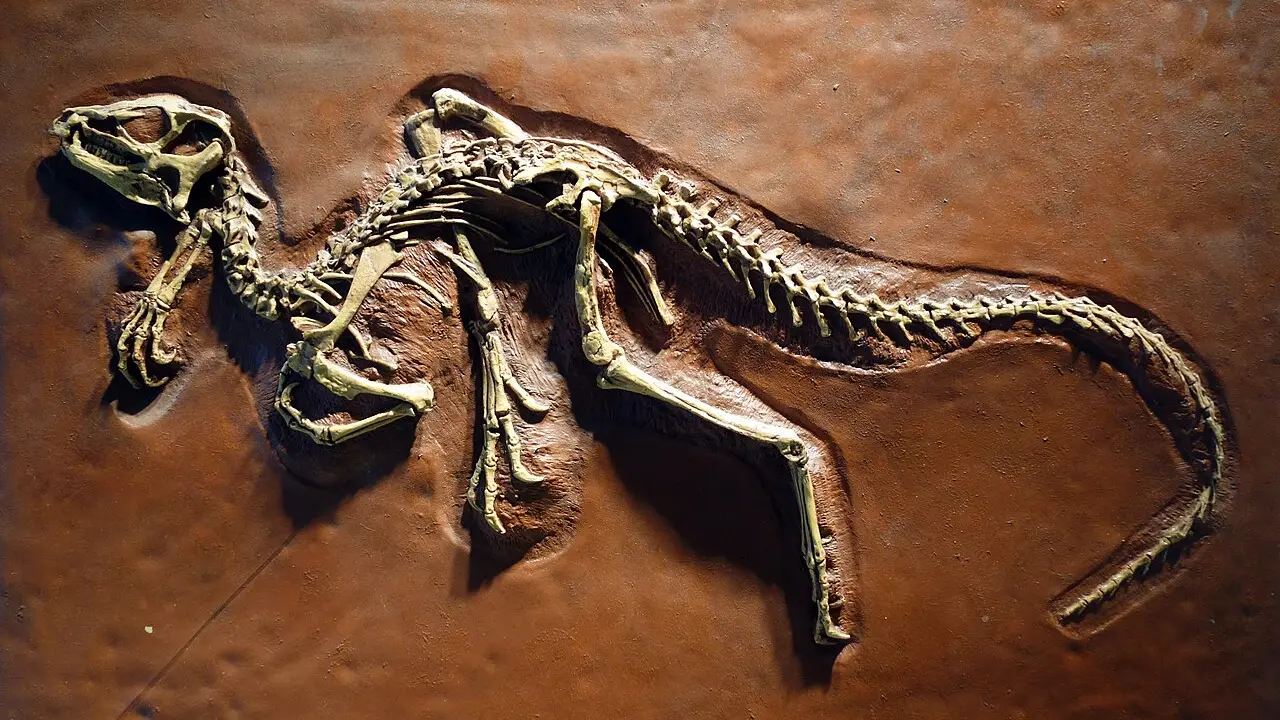
⚡ Survival SuperpowerThree distinct mammal-like tooth types in one jaw, including sharp canine tusks
🤯 Mind-Blowing Fact • Grade 1
Even though Heterodontosaurus had fierce-looking vampire fangs, it mostly munched plants, roots, and maybe crunchy bugs!
✨ Word Sparks (Grade 1 Glossary)
Tap 🔊 to hear
fang
a long, pointed tooth near the front
root
the underground part of a growing plant
nip
to take a quick, small front bite
🪝
Why did a little turkey-sized plant-eater have sharp fangs like a puppy?
1
Surprise Smile!
Open wide! Most dinosaurs had just one shape of tooth. Not Heterodontosaurus! This turkey-sized runner from ancient Africa had three different tooth shapes in one mouth.
2
Beak, Fangs, and Grinders
Small front teeth nipped leaves behind a sharp beak. Long pointy stuck out next, and flat back teeth chewed tough stems.
3
Digging and Dashing
Strong hands dug up tasty while fast legs zipped away from danger!
1. How many different kinds of teeth grew inside a Heterodontosaurus mouth?
2. About how big was Heterodontosaurus?
🤯 Mind-Blowing Fact • Grade 2
When Heterodontosaurus closed its mouth, its lower fangs tucked neatly into special pockets along its upper jaw!
✨ Word Sparks (Grade 2 Glossary)
Tap 🔊 to hear
tusk
an extra-long pointed tooth sticking out
serrated
having tiny saw-like notches along an edge
bristle
a short, stiff hair-like fuzzy fiber
🪝
What happens when you look inside a dinosaur mouth and find teeth shaped like yours?
1
Different-Toothed Lizard
Feel your own teeth with your tongue—you have flat biters in front, pointy corners, and flat grinders in back! Reptiles almost never have mouths like that, yet Heterodontosaurus did 195 million years ago in southern Africa.
2
What Were Those Tusks For?
Right behind its sharp front beak sat four long, —two pointing down and two pointing up! Rather than hunting big animals, it likely flashed those tusks in rival contests, dug up buried roots, or cracked beetle shells.
3
Fuzzy Coat Clue
Fossils of close cousins from China preserve stiff, hair-like fuzz, suggesting Heterodontosaurus wore a bristly coat too!
1. Where did the lower fangs of Heterodontosaurus fit when it shut its mouth?
2. What did fossils of a close cousin in China suggest about Heterodontosaurus skin?
🤯 Mind-Blowing Fact • Grade 3
Heterodontosaurus had fused lower leg and ankle bones just like modern birds, even though it belonged to the opposite branch of the dinosaur family tree!
✨ Word Sparks (Grade 3 Glossary)
Tap 🔊 to hear
omnivore
an animal that eats plants and animals
tuber
a thick underground stem storing plant food
chisel
a flat-edged tool shaped for cutting cleanly
🪝
Why were paleontologists stunned when they chipped rock away from a tiny skull in South Africa in 1961?
1
A Skull Hidden in Red Stone
Imagine carefully scraping hard red sandstone off a fist-sized fossil skull and spotting long, sharp canine fangs right ahead of plant-grinding molars! When scientists Alfred Crompton and Alan Charig revealed Heterodontosaurus tucki from South Africa in 1962, it broke the old rule that reptiles only carry uniform teeth.
2
Built for Tough Dry Seasons
Nearly two hundred million years ago during the Early Jurassic, southern Africa shifted between rainy spells and dusty droughts. When soft ferns dried up, Heterodontosaurus used powerful arms and curved hand claws to dig underground , roots, and burrowing insects.
3
Chewing Like a Champ
High-crowned cheek teeth packed tightly together wore down into flat , letting this small shred tough stems that other early dinosaurs could not digest.
4
Springy Running Legs
Fused ankle and shin bones—much like a modern bird's—helped this agile four-foot dinosaur bound swiftly across rocky stream beds.
1. How did Heterodontosaurus survive dry seasons when soft leaves disappeared?
2. Which leg feature did Heterodontosaurus share with modern birds?
🤯 Mind-Blowing Fact • Grade 4
Super-bright synchrotron X-ray scans revealed delicate, paddle-shaped breathing bones inside Heterodontosaurus rock slabs without scratching a single fossil bone!
✨ Word Sparks (Grade 4 Glossary)
Tap 🔊 to hear
caniniform
shaped like a sharp, pointed canine fang
synchrotron
a machine making ultra-bright X-ray beams
ventilate
to move fresh air into the lungs
🪝
What secret breathing system did high-powered X-rays uncover inside the ribcage of Heterodontosaurus?
1
Early Pioneer of Bird-Hipped Dinosaurs
At the dawn of the Early Jurassic Period roughly 195 million years ago, sand dunes and seasonal streams stretched across South Africa and Lesotho. Darting across these semi-arid plains was Heterodontosaurus tucki, one of the best-preserved early ornithischians—the great dinosaur branch that later produced Triceratops, Stegosaurus, and duck-bills. Despite weighing less than a house cat or small fox, its skeleton held astonishing evolutionary surprises.
2
Mammal-Style Dental Specialization
Behind a sharp keratinous beak, the upper jaw held tiny incisor-like peg teeth for snipping shoots, followed by prominent serrated tusks in both jaws. A toothless gap separated those tusks from tall, closely packed cheek teeth that ground fibrous cycads and roots—and possibly crunched small lizards or beetles for extra protein.
3
X-Ray Discovery of Paddle Ribs
In 2021, paleontologists scanned a complete South African skeleton using a particle-accelerator X-ray beam. Hidden inside the rock were delicate, paddle-shaped chest plates and toothpick-thin belly ribs that expanded and contracted the chest cavity like bellows, revealing a unique way early ornithischians ventilated their lungs!
4
Grappling Hands and Fast Feet
Long five-fingered hands with opposable outer digits let it grasp stems or pry open insect burrows before sprinting away on fused, bird-like hind limbs.
1. What surprising anatomy did 2021 synchrotron X-ray scans find in Heterodontosaurus?
2. Which major dinosaur group counts Heterodontosaurus among its early members?
🤯 Mind-Blowing Fact • Grade 5
Adult Heterodontosaurus slowed its tooth replacement way down compared with other reptiles so its interlocking cheek teeth wouldn't leave gaps while grinding tough desert plants!
✨ Word Sparks (Grade 5 Glossary)
Tap 🔊 to hear
heterodonty
having multiple specialized tooth shapes in jaws
occlusion
precise meeting of upper and lower teeth
integument
outer body covering like skin or fuzz
🪝
Why does four-foot Heterodontosaurus hold critical clues to both fuzzy dinosaur coats and how bird-hipped dinosaurs breathed?
1
A Complete Skeleton From the Cape
First named in 1962 by Alfred Crompton and Alan Charig from a skull recovered in South Africa's Early Jurassic Elliot Formation, Heterodontosaurus tucki gained fame fourteen years later when a spectacularly complete skeleton emerged from overlying Clarens Formation sandstones. Measuring roughly 1.2 to 1.75 meters long and weighing under ten kilograms, this Hettangian-to-Sinemurian survivor sits near the evolutionary base of Ornithischia, illuminating how the entire bird-hipped radiation began.
2
Heterodonty and Slow Tooth Replacement
True to its name, Heterodontosaurus displayed extreme rivaling mammals: premaxillary nipping pegs behind a keratinous rhamphotheca, enlarged serrated caniniform tusks slotted into maxillary diastemata, and high-crowned chisel-shaped cheek teeth. Unlike most reptiles that continuously shed teeth, adult Heterodontosaurus slowed or paused tooth replacement so upper and lower batteries maintained tight, continuous chewing —likely processing tough xerophytic plants alongside opportunistic invertebrates.
3
Synchrotron Tomography and Lung Ventilation
Unlike theropods and sauropods, ornithischians lacked hollow air-sac vertebrae, leaving their breathing mechanics mysterious for decades. In 2021, European Synchrotron Radiation Facility micro-CT scans reconstructed an articulated specimen in three dimensions, unveiling spatulate sternal plates, uncinate-like costal processes, and gastralia. Together with a forward-projecting pelvic pubis process, these structures powered dual chest-and-visceral lung ventilation.
4
Protofeathers Across the Dinosaur Tree
Discovery of filamentous on Chinese heterodontosaurid Tianyulong confuciusi indicates stiff, hollow protofeather bristles likely insulated Heterodontosaurus as well, suggesting ancestral fuzz predated the split between saurischian and ornithischian dinosaurs.
5
Forelimb Dexterity and Cursorial Hindlimbs
Combining robust digging claws on five-digit hands with an avian-style fused tibiotarsus and tarsometatarsus, Heterodontosaurus balanced agile foraging with rapid escape across Early Jurassic southern Gondwana.