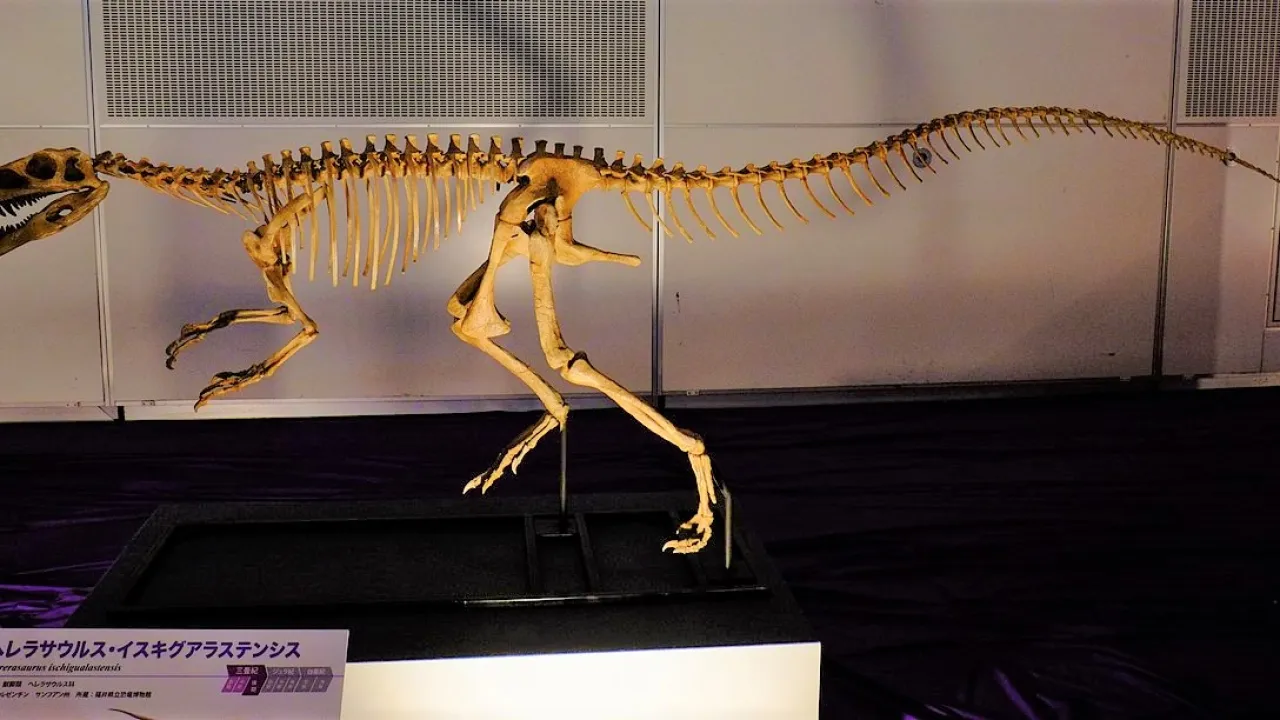
⚡ Survival SuperpowerFlexible sliding hinge in the middle of its lower jaw that locked tightly onto slippery prey
🤯 Mind-Blowing Fact • Grade 1
A goatherd named Victorino Herrera discovered Herrerasaurus while tending his goats in Argentina's rocky Valley of the Moon!
✨ Word Sparks (Grade 1 Glossary)
Tap 🔊 to hear
hinge
a movable joint that lets parts bend
dawn
the very earliest beginning of a time
prey
an animal hunted by another for food
🪝
What looked like one of the very first big meat-eating dinosaurs on Earth?
1
Dawn of the Dinosaurs
Step way back to the very beginning of dinosaur times! Long before Tyrannosaurus lived, swift Herrerasaurus raced across ancient Argentina on two strong legs.
2
Bendy Lower Jaw
Snap! A special right in the middle of its lower jaw bent inward to hold slippery tight.
3
Five-Fingered Hands
Three long curved claws on each hand helped grab food while its stiff tail balanced fast sprints!
1. What special feature sat in the middle of the lower jaw of Herrerasaurus?
2. Who spotted the first Herrerasaurus fossils in Argentina?
🤯 Mind-Blowing Fact • Grade 2
During Herrerasaurus's lifetime, all continents on Earth were joined together into one giant supercontinent called Pangaea!
✨ Word Sparks (Grade 2 Glossary)
Tap 🔊 to hear
supercontinent
one giant landmass joining all continents together
vise
a clamp that holds things super tightly
carnivore
an animal that eats mostly meat
🪝
What was Earth like when dinosaurs were brand-new arrivals instead of the rulers of the land?
1
Valley of the Moon
Imagine a world 231 million years ago where giant crocodile cousins ruled the rivers and dinosaurs made up only a tiny slice of animal life! In rocky valleys of northwestern Argentina—now called the Valley of the Moon—Herrerasaurus sprinted through lush river forests.
2
Double-Grip Bite
For thirty years, scientists had no complete skull of Herrerasaurus. When paleontologists finally unearthed one in 1988, they found a sliding joint halfway along its lower jaw! That flexible hinge acted like a grip, just like some big monitor lizards today.
3
Not Even Top Boss Yet
At up to twenty feet long, Herrerasaurus was fast and fierce, yet it still watched out for even bigger Triassic crocodile-relatives!
1. Did dinosaurs already rule every habitat when Herrerasaurus lived?
2. Which living reptile has a flexible lower jaw hinge similar to Herrerasaurus?
🤯 Mind-Blowing Fact • Grade 3
The 1988 Herrerasaurus skull fossil was so well preserved that even tiny middle-ear bones and delicate eye-socket rings survived intact after 231 million years!
✨ Word Sparks (Grade 3 Glossary)
Tap 🔊 to hear
origin
the starting point where something begins
socket
a rounded hollow where a bone fits
archosaur
ruling reptile group including crocs and dinosaurs
🪝
Why did paleontologists wait thirty years to solve the mystery of where Herrerasaurus fit on the dinosaur tree?
1
A Puzzle in Triassic Rock
Picture paleontology's greatest mystery! After goatherd Victorino Herrera found bones in Argentina's Ischigualasto Formation in 1958, scientist Osvaldo Reig named Herrerasaurus in 1963. Without a skull, however, experts argued for decades over whether it was an ancestor of all dinosaurs, a meat-eating theropod, or not quite a dinosaur at all!
2
Breakthrough Skull of 1988
Everything changed in 1988 when paleontologist Paul Sereno and his team uncovered a crystal-clear, nearly complete Herrerasaurus skull—including tiny ear bones and eye rings! Combined with its open hip , long running shins, and five-fingered grasping hands, the skull confirmed Herrerasaurus stood right near the root of Dinosauria.
3
Built for Speed and Agility
Short thighs, long feet, and overlapping tail bones made this fifteen-foot predator far nimbler than sprawling Triassic reptiles.
4
Life in Volcanic Woodlands
Volcanic ash layers let geologists date these rocks precisely to 231.4 million years ago, capturing the dawn of the Dinosaur Age.
1. What major discovery in 1988 finally revealed how Herrerasaurus looked from head to tail?
2. How old are the volcanic ash layers around Herrerasaurus fossils?
🤯 Mind-Blowing Fact • Grade 4
Healed bite punctures on a fossilized Herrerasaurus skull suggest these early hunters occasionally sparred with rivals of their own species!
✨ Word Sparks (Grade 4 Glossary)
Tap 🔊 to hear
coprolite
fossilized animal droppings preserved as stone
monsoon
seasonal wind bringing heavy summer rainstorms
mandible
the lower jawbone of a vertebrate
🪝
How did upright legs give early dinosaurs like Herrerasaurus a decisive edge on Pangaea?
1
Newcomers in a Crowded World
Step into northwestern Argentina 231 million years ago, when South America and Africa were fused inside the supercontinent Pangaea. Seasonal watered fern-filled river valleys overshadowed by active volcanoes. Surprisingly, dinosaurs represented less than ten percent of land vertebrates here! Giant crocodile-line rauisuchians like Saurosuchus ruled as apex predators, while swift, upright Herrerasaurus carved out a mid-to-large predator niche.
2
Erect Posture and Bipedal Power
Unlike sprawling reptiles whose legs jutted sideways, Herrerasaurus positioned its hindlimbs directly beneath an open hip socket (perforate acetabulum). Running upright on three weight-bearing middle toes freed its muscular forelimbs completely for grasping. Each hand retained five digits: three armed with long, curved, razor-edged claws and two reduced outer stubs.
3
Intramandibular Jaw Mechanics
Its narrow skull combined curved, serrated teeth with a specialized intramandibular joint midway along the lower jaw, allowing the front half of the to flex backward and cinch down on struggling synapsids and rhynchosaurs.
4
Clues from Fossilized Droppings and Bones
Fossilized droppings () found in the same rock layers contain crushed small bones without acid-dissolved edges, suggesting fast digestion of small vertebrates, while healed puncture marks on a Herrerasaurus skull show lively Triassic rivalries! Together, these clues reveal an agile, fast-moving carnivore already testing key dinosaurian survival tools.
1. Why was having legs positioned straight underneath the hips such a big advantage for Herrerasaurus?
2. Who was the even larger non-dinosaur apex predator sharing Argentina with Herrerasaurus?
🤯 Mind-Blowing Fact • Grade 5
Even though Herrerasaurus lived 160 million years before Tyrannosaurus rex, the bottom of its hip pubis bone already ended in a remarkably similar heavy 'boot' shape!
✨ Word Sparks (Grade 5 Glossary)
Tap 🔊 to hear
acetabulum
the cup-shaped hip socket holding the thighbone
digitigrade
walking up on toes with raised heels
convergent
independently evolving similar traits in separate groups
🪝
Why do evolutionary biologists still debate the exact branching point of Herrerasaurus near the origin of Dinosauria?
1
Unearthing the Carnian Dawn in Ischigualasto
Exposed across the stark badlands of Ischigualasto Provincial Park—Argentina's UNESCO-listed Valley of the Moon—Carnian volcaniclastic sandstones preserve Earth's clearest snapshot of dinosaur origins. Discovered by local rancher Victorino Herrera in 1958 and named Herrerasaurus ischigualastensis by Osvaldo Reig in 1963, this three-to-six-meter predator remained anatomically enigmatic until Paul Sereno and Fernando Novas excavated a complete skull and articulated skeleton in 1988 within ash-dated strata 231.4 million years old.
2
A Mosaic of Primitive and Derived Traits
Herrerasaurus fascinates cladists because its skeleton blends classic dinosaurian synapomorphies with archaic archosaur traits. On one hand, a partially to fully perforated hip , inturned femoral head, elongated tibia and metatarsals, and three-toed foot unmistakably reflect upright bipedal dinosaur locomotion, while the pubic bone terminates in a rearward-pointing boot startlingly with later tetanuran theropods. On the other hand, its sacrum incorporates only two vertebrae rather than three, and its skull lacks several pneumatic hollows characteristic of later theropods.
3
Phylogenetic Crossroads
Consequently, modern phylogenetic matrices place Herrerasauridae in one of three neighboring positions: as basalmost saurischians sister to theropods plus sauropodomorphs, as very early branching theropods, or just outside crown-group Eusaurischia—capturing evolution mid-stride as lineages diverged.
4
Cranial Kinesis and Predatory Niche
Armed with large recurved maxillary teeth and a sliding intramandibular hinge analogous to varanid lizards, Herrerasaurus subdued pig-sized rhynchosaurs such as Scaphonyx, cynodont synapsids, and smaller dinosaurs like Eoraptor along seasonal streams.
5
Before the Triassic-Jurassic Takeover
Thriving while pseudosuchian archosaurs like Saurosuchus still dominated terrestrial guilds, Herrerasaurus pioneered the agile bipedal blueprint, rapid metabolic stamina, and grasping forelimb versatility that helped dinosaurs inherit the globe after end-Triassic extinctions.