🧬 HUMAN BODY
🧬 Metalloprotein Tetramer • Circulatory System
VA Science & Health SOL 1.1, 3.1, 4.2, 5.1 (Cells, Organs & Body Systems)
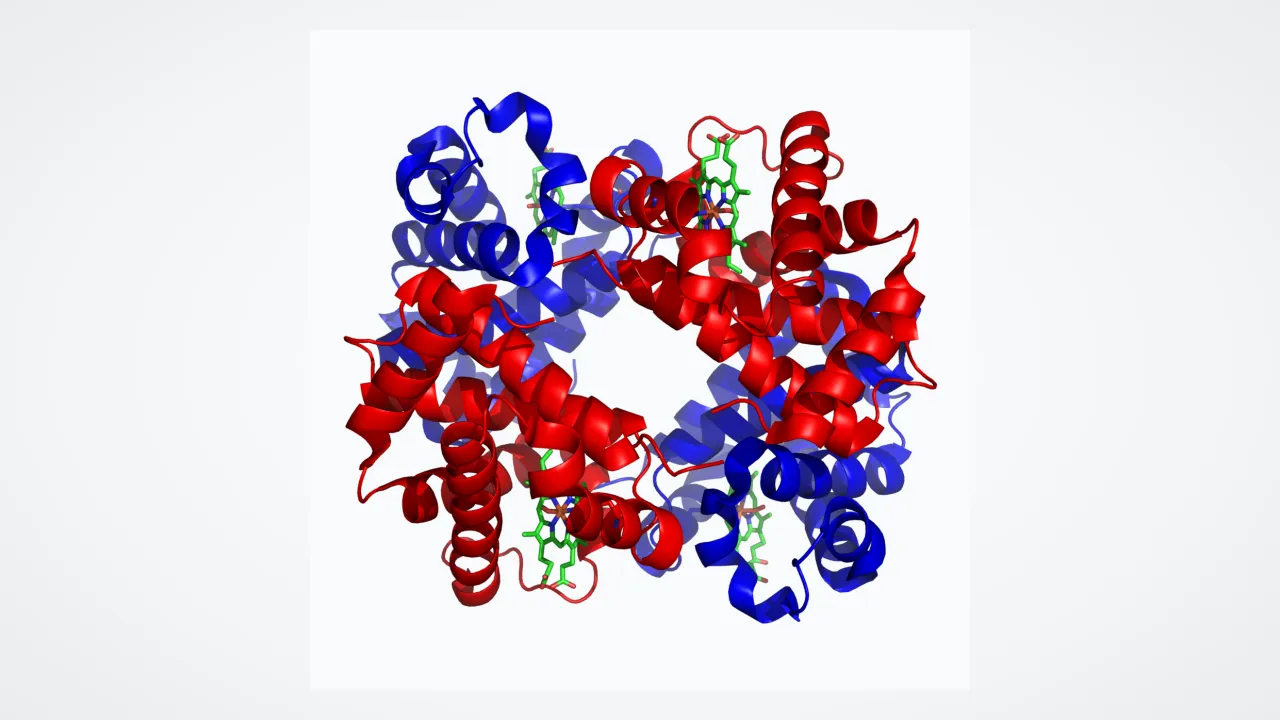
Hemoglobin
Your Blood's Tiny Iron-Powered Oxygen Taxis
Grade 1 • Early Reader • 86 words
🩺 Body System & LocationCirculatory System • Packed inside red blood cells
🔬 Size / Cell Count5.5 nanometers wide • ~270 million molecules per red blood cell
⚙️ Core JobCaptures oxygen in the lungs and delivers it to every body tissue
⚡ Body SuperpowerShifts color to bright crimson the instant four iron atoms lock onto fresh oxygen
🤯 Mind-Blowing Fact • Grade 1
A single tiny red blood cell packs about 270 million hemoglobin molecules inside!
✨ Word Sparks (Grade 1 Glossary)
Tap 🔊 to hear
Oxygen
Invisible gas in air that keeps us alive
Iron
A helpful mineral that helps blood carry air
Lungs
Two spongy chest organs that breathe in air
🪝
Why is your blood bright red instead of clear like water?
1
Tiny Oxygen Taxis
Take a deep breath right now! Fresh air rushes into your . Inside your red blood cells, tiny helpers called hemoglobin wait like little taxis. Each taxi grabs air to share with your body.
2
Iron Makes It Red
Every hemoglobin helper holds tiny bits of . When iron meets fresh , it turns bright cherry red! That is why a drop of blood looks so red.
3
Zooming Everywhere
Your heart pumps those full taxis from head to toe. Hemoglobin drops off so your legs can run and your brain can think.
1. What mineral inside hemoglobin helps give blood its bright red color?
2. Where do hemoglobin helpers live inside your body?
🤯 Mind-Blowing Fact • Grade 2
Each hemoglobin molecule has four iron seats, letting one red blood cell carry over one billion oxygen molecules at once!
✨ Word Sparks (Grade 2 Glossary)
Tap 🔊 to hear
Protein
A tiny building block that does body jobs
Carbon dioxide
Waste gas your body breathes out into air
Molecule
A tiny group of atoms joined tightly together
🪝
How can one microscopic blood cell carry a billion breaths of oxygen?
1
Four Seats Per Taxi
Whoosh! Every time you inhale, fresh oxygen fills your lungs and hunts for a ride. Waiting inside your red blood cells is a special called hemoglobin. Picture each hemoglobin as a four-seat taxi, ready to pick up four oxygen passengers at once.
2
The Secret of Red Blood
Each of those four seats holds one atom of iron. When oxygen snaps onto the iron, the changes shape slightly and glows bright scarlet red. After delivering its oxygen, blood turns a deeper, darker shade of red.
3
Round-Trip Delivery
Once hemoglobin drops off oxygen to hungry muscles, its work is not finished yet! It scoops up waste gas called and rides back to your lungs so you can breathe it out.
1. How many oxygen molecules can a single hemoglobin taxi hold at one time?
2. What waste gas does hemoglobin help carry back to your lungs?
🤯 Mind-Blowing Fact • Grade 3
Contrary to a popular myth, deoxygenated human blood is never blue—its hemoglobin simply shifts from bright cherry red to dark maroon!
✨ Word Sparks (Grade 3 Glossary)
Tap 🔊 to hear
Heme
An iron-holding ring inside every hemoglobin protein
Bone marrow
Spongy tissue inside bones that makes blood cells
Deoxygenated
Having already dropped off its load of oxygen
🪝
Why do doctors tell you to eat spinach and beans to keep your energy high?
1
Packed Inside Red Cells
Imagine shrinking down smaller than a grain of dust to swim through a blood vessel. Around you, millions of disc-shaped red blood cells rush past like rafts. Each cell is stuffed from edge to edge with a folded protein called hemoglobin, leaving almost no room for anything else.
2
Heme Rings and Globin Chains
Even its name reveals how it is built! Hemoglobin combines four folded protein chains, called globins, with four flat chemical rings called groups. Right in the center of every heme ring sits an iron atom that acts like a magnet for oxygen.
3
Smart Pickup and Drop-Off
How does hemoglobin know where to grab oxygen and where to let go? In your lungs, oxygen is crowded, so iron locks onto it tightly. Deep inside hardworking leg muscles, oxygen levels are low, signaling hemoglobin to release its cargo right away.
4
Fueling Healthy Blood
Because iron is the star ingredient, eating iron-rich foods like spinach, lentils, and lean meats helps your build fresh hemoglobin every single day.
1. What are the two main parts that give hemoglobin its name?
2. What color is human blood after hemoglobin drops off its oxygen?
🤯 Mind-Blowing Fact • Grade 4
Without hemoglobin, plain liquid blood plasma could hold so little dissolved oxygen that humans would need over 300 liters of blood circulating at once to survive!
✨ Word Sparks (Grade 4 Glossary)
Tap 🔊 to hear
Subunit
One folded protein piece inside a larger structure
Plasma
The yellowish liquid river that carries blood cells
Spleen
An organ that filters and recycles old blood
🪝
How does a protein with no brain know the exact moment to grip oxygen tightly or let it go?
1
Solving Water's Oxygen Problem
Try dissolving a breath of air into plain water, and almost none of the oxygen stays trapped. If your blood were mostly salty water alone, your heart would have to pump dozens of times faster just to keep your brain awake! Evolution solved this challenge with hemoglobin, boosting blood's oxygen-carrying power roughly seventy times higher than liquid alone.
2
Teamwork Inside a Molecule
Each hemoglobin molecule is a quartet of four globin —two alpha chains and two beta chains—each cradling an iron-centered heme disc. When the very first oxygen molecule binds to one iron atom in the lungs, it tugs gently on the protein frame. That tiny twist opens the remaining three seats, making it much easier for three more oxygen molecules to snap aboard!
3
Listening to Hungry Muscles
When you sprint across a playground, your muscle cells burn fuel rapidly, releasing heat and carbon dioxide that make nearby blood slightly more acidic. Hemoglobin senses both the warmth and acidity, shifting back into a relaxed shape that releases extra oxygen exactly where muscles demand it most.
4
Recycling Precious Iron
After about 120 days of nonstop travel, worn-out red blood cells retire in the and liver. Your body carefully salvages the iron from old hemoglobin to forge brand-new cells, while turning the leftover heme into golden pigments.
1. What happens right after the first oxygen molecule binds to one of hemoglobin's iron seats?
2. Which signals from sprinting muscles tell hemoglobin to release extra oxygen?
🤯 Mind-Blowing Fact • Grade 5
Biochemist Max Perutz analyzed thousands of X-ray diffraction spots for 22 years to map hemoglobin's 10,000 atoms, earning the 1962 Nobel Prize in Chemistry!
✨ Word Sparks (Grade 5 Glossary)
Tap 🔊 to hear
Tetramer
A large protein assembled from four smaller subunits
Allosteric
Changing a protein's shape when a molecule attaches
Erythrocyte
The scientific medical name for a red blood cell
🪝
Why did it take twenty-two years of X-ray beams to map the shape-shifting architecture of a single blood protein?
1
A Molecular Machine in Motion
Deep inside every —the scientific term for a mature red blood cell—roughly 270 million hemoglobin molecules crowd together in a precision-engineered suspension. To maximize storage space for this metalloprotein, developing red blood cells actually eject their own nuclei and mitochondria before entering the bloodstream, transforming themselves into flexible, hemoglobin-filled sacs dedicated entirely to gas transport.
2
Cooperative Binding and the Bohr Effect
Adult hemoglobin (HbA) is a built from two alpha-globin and two beta-globin polypeptide chains, each anchoring a porphyrin heme ring around a ferrous iron ion (Fe2+). Because iron must remain in this +2 state rather than rusting permanently, the surrounding globin pocket shields it from water. When one heme binds oxygen in pulmonary capillaries, an shift switches the tetramer from a tense state to a relaxed state, multiplying oxygen affinity up to three hundredfold. Conversely, in metabolically active tissues, elevated carbon dioxide and hydrogen ions trigger the Bohr effect—stabilizing the tense state so oxygen unloads rapidly while globin chains bind waste protons and CO2.
3
High-Altitude and Fetal Adaptations
Human biology even customizes hemoglobin for changing environments. Unborn babies produce fetal hemoglobin (HbF), which swaps beta chains for gamma chains that grip oxygen more strongly, allowing a fetus to draw oxygen smoothly across the placenta. Meanwhile, mountaineers climbing high peaks produce a molecule called 2,3-BPG that fine-tunes hemoglobin to release oxygen more generously in thin mountain air.
4
Cracking the 3D Crystal Code
In 1959, biochemist Max Perutz culminated twenty-two years of painstaking X-ray crystallography by unveiling the three-dimensional atomic structure of hemoglobin—an achievement that earned the 1962 Nobel Prize in Chemistry and launched modern structural biology.
5
When One Amino Acid Changes
Studying hemoglobin also revealed the first known 'molecular disease': sickle-cell trait, where substituting just one amino acid out of nearly six hundred alters how hemoglobin molecules stack under low oxygen, proving how profoundly atomic geometry governs human health.