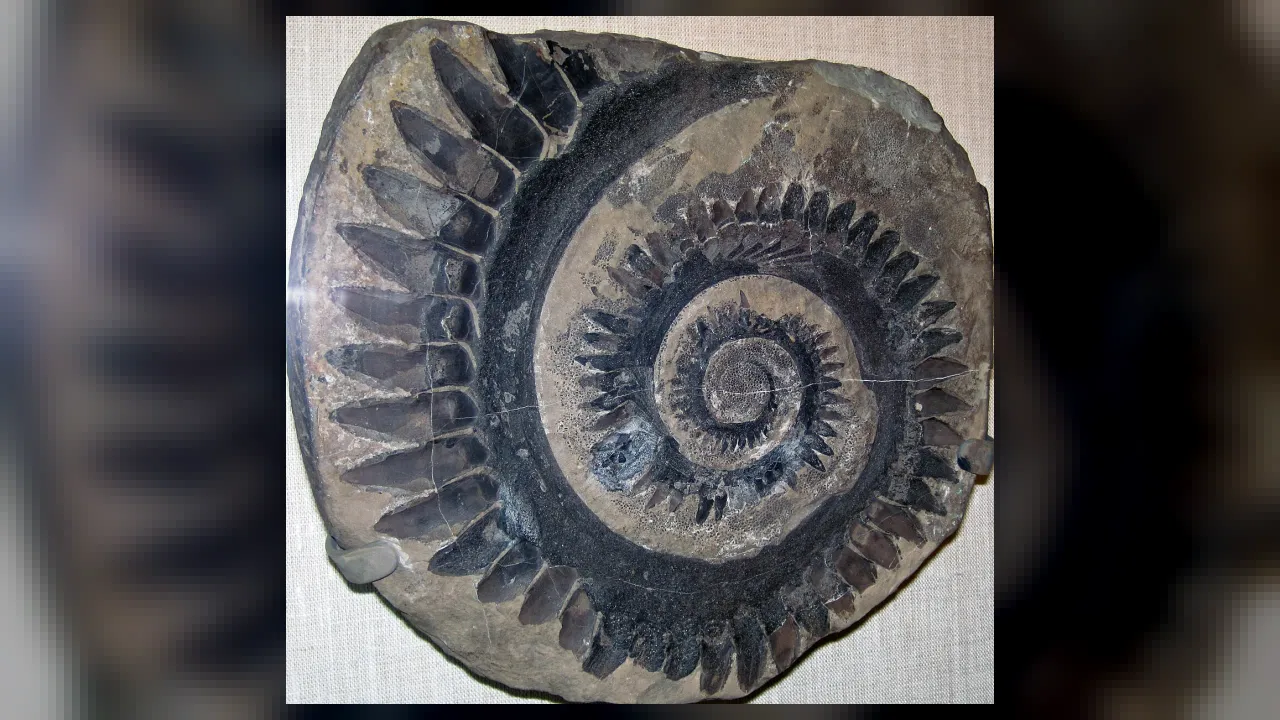
1. Where on Helicoprion's body did its famous spiral of teeth actually sit?
2. What happened to Helicoprion's tiny baby teeth as it grew bigger?
🤯 Mind-Blowing Fact • Grade 2
Over half of all giant Helicoprion tooth spirals ever discovered in the world came from phosphate mines in eastern Idaho!
✨ Word Sparks (Grade 2 Glossary)
Tap 🔊 to hear
CT scan
Special X-ray picture seeing inside solid rock
ratfish
Deep-sea cartilage fish related to sharks
Permian
Time period right before the dinosaur age
🪝
Why did artists spend a century drawing Helicoprion's teeth in all the wrong places?
1
The Case of the Missing Body
Picture finding a stone wheel of jagged teeth as big as a dinner plate—with zero skull bones around it! Because Helicoprion had a soft cartilage skeleton 280 million years ago, only its hard spiral 'tooth whorls' usually turned into fossils.
2
Funny Guesses Before X-Rays
Early scientists drew hilarious pictures putting the tooth wheel curled upward like an elephant trunk, balanced on its back fin, or swinging on its tail! Finally, hospital-style of an Idaho fossil found hidden jaw cartilage wrapped right around the spiral.
3
Cousin to Ghost Sharks
Those scans also showed Helicoprion wasn't a true shark—it was a twenty-five-foot cousin of today's deep-sea , also called ghost sharks!
1. Why did scientists rarely find Helicoprion skulls alongside its tooth spirals?
2. Which living deep-sea animal is Helicoprion's closest cousin?
🤯 Mind-Blowing Fact • Grade 3
Closing its mouth made Helicoprion's spiral blade arc backward automatically, shucking tender squid bodies right out of coiled shells!
✨ Word Sparks (Grade 3 Glossary)
Tap 🔊 to hear
nautiloid
Tentacled sea creature living inside a shell
enamel
Hard, shiny outer layer protecting teeth
midline
An imaginary line dividing left and right
🪝
How could a single spiral blade of teeth pull soft squid right out of coiled shells?
1
Spiral Saw of the Permian Ocean
Swim back 280 million years into the Early Permian Period, long before the first dinosaurs hatched! Gliding through warm seas covering Idaho, Russia, and western Australia was Helicoprion—whose name means 'spiral saw'—stretching over twenty feet from pointed snout to forked tail.
2
Inside Museum Specimen IMNH 37899
In 2013, paleontologist Leif Tapanila and a team at the Idaho Museum of Natural History placed a prized limestone block inside a high-powered CT scanner. Hidden inside the rock sat preserved three-dimensional jaw cartilage! Their scan proved Helicoprion carried one single spiral tooth whorl filling the entire of its skinny lower jaw.
3
How the Tooth Whorl Sliced
Curiously, those fossil teeth almost never show chips or cracks from hitting hard shells! Mechanical models revealed why: Helicoprion grabbed soft squid or tentacles! As its lower jaw closed, the curved spiral rotated backward like a rolling pizza slicer, snagging soft flesh while pushing any hard shell safely outward!
4
An Autobiography Written in Enamel
Because old teeth rolled inward beneath skin gum tissue instead of dropping out, counting over 150 teeth from tiny inner hooklets to five-inch outer blades lets scientists read one fish's entire growth story!
1. Why do Helicoprion's fossil teeth have almost zero chips or broken tips?
2. How did scientists finally see the hidden jaw around Idaho's famous fossil whorl?
🤯 Mind-Blowing Fact • Grade 4
The largest known Helicoprion tooth whorl measures twenty-two inches across—meaning the giant Permian 'buzzsaw fish' that owned it stretched longer than a great white shark!
✨ Word Sparks (Grade 4 Glossary)
Tap 🔊 to hear
logarithmic spiral
Coil growing wider by the same ratio each turn
holocephalan
Cartilage fish group containing chimaeras and ratfish
symphysis
Centerline joint where left and right jaws meet
🪝
How did a phosphate miner's 1950 discovery in Idaho wait sixty years before 3D X-rays solved paleontology's weirdest jaw puzzle?
1
A Century of Wild Reconstructions
When Russian geologist Alexander Karpinsky described the first coiled ribbon of serrated teeth from the Ural Mountains in 1899, he named it Helicoprion ('spiral saw') and sketched it curling upward off the fish's upper snout! Over the next hundred years, bewildered researchers relocated that onto the throat, dorsal fin, and tail tip—because non-mineralized chondrichthyan cartilage vanished in almost every fossil.
2
CT Scanning Unlocks the Holocephalan Link
Hope arrived via 'Idaho #4,' a 270-million-year-old Phosphoria Formation nodule unearthed in 1950 that preserved faint prismatically calcified cartilage around a 23-centimeter whorl. In 2013, high-resolution computed tomography exposed the upper palatoquadrate fused solidly to the braincase—a hallmark proving Helicoprion wasn't a true selachian shark, but an apex eugeneodontid allied to modern deep-sea chimaeras!
3
Symphyseal Saw-And-Shuck Mechanics
Anchored along the mandibular where left and right lower jaws fused into a narrow keel, the whorl closed upward into a toothless, trough-shaped upper palate lined with tiny pavement denticles. Kinematic tests by Joshua Ramsay and Cheryl Wilga showed that anterior teeth hooked soft coleoids or ammonoid heads, middle teeth sliced tissue along an arcing path, and posterior teeth drove prey straight into the esophagus!
4
Colossal Scale in Permian Seas
Largest discovered whorls exceed fifty-six centimeters (twenty-two inches) in diameter! Scaling from complete cranial proportions shows giant Helicoprion individuals reached seven to eight meters—making it the largest Permian marine predator on Earth.
1. What skull feature proved Helicoprion belonged with ratfish (chimaeras) instead of true sharks?
2. What sat inside Helicoprion's upper mouth opposite the lower tooth spiral?
🤯 Mind-Blowing Fact • Grade 5
Mathematicians studying Helicoprion whorls discovered their teeth follow an equiangular logarithmic spiral—the exact same geometric growth curve seen in nautilus shells and spiral galaxies!
✨ Word Sparks (Grade 5 Glossary)
Tap 🔊 to hear
autostylic
Upper jaw fused directly to the braincase
ontogeny
How an organism grows from baby to adult
durophagous
Adapted for crushing hard shells or bones
🪝
How did logarithmic dental geometry and mandibular kinematics turn a single row of fused teeth into a cephalopod-shucking machine?
1
Solving Karpinsky's 1899 Enigma
Few fossils baffled vertebrate paleontologists longer than Helicoprion bessonowi, introduced in 1899 from Cis-Uralian Permian limestones of Russia. Isolated symphyseal whorls—continuous mineralized root shafts bearing up to 180 serrated triangular crowns coiled across three to four revolutions—inspired contradictory reconstructions until synchrotron and industrial X-ray micro-CT scans of Idaho's Phosphoria Formation specimen IMNH 37899 resolved its cranial anatomy in 2013.
2
Holocephalan Phylogeny and Cranial Autostyly
Three-dimensional rendering of calcified tesserae revealed jaw suspension—fusion of the palatoquadrate cartilage directly to the neurocranium—alongside a single gill-arch opercular cover. These synapomorphies placed Helicoprion and fellow eugeneodontids firmly within Euchondrocephali as giant stem-holocephalans (chimaeroids), sister to modern sharks and rays (Elasmobranchii) since their Devonian divergence.
3
Equiangular Spiral Growth Without Shedding
Whereas selachians shed worn labial teeth onto the seafloor, Helicoprion retained every developmental tooth throughout along an equiangular logarithmic spiral. Newly mineralized crowns formed lingually at the rear of Meckel's cartilage, rotating older, smaller juvenile hooklets ventrally until they became encased beneath protective labial gum tissue inside the narrow rostral mandible.
4
Biomechanical Soft-Prey Shearing and Deshelling
Microwear analysis reveals pristine serrated cutting edges devoid of spalling. Biomechanical modeling demonstrates a double-action slicing arc: as the short mandibular joint elevated, anterior teeth snagged protruding cephalopod soft parts, while geometric curvature produced opposing shear forces that wedged coiled ammonoid conchs outward from the gape as middle and posterior crowns drew tender mantle tissue down the pharynx.
5
Apex Reign Across Pangaean Seas
Attaining streamlined torpedo body lengths of six to eight meters—inferred from 56-centimeter giant Phosphoria and Western Australian whorls bearing serrated crowns exceeding ten centimeters in height—Helicoprion dominated Cisuralian through Guadalupian pelagic ecosystems from Boreal Svalbard, Arctic Canada, and Uralian seaways south to Gondwanan Australia for roughly twenty million years, vanishing millions of years before the End-Permian mass extinction reshaped marine life.