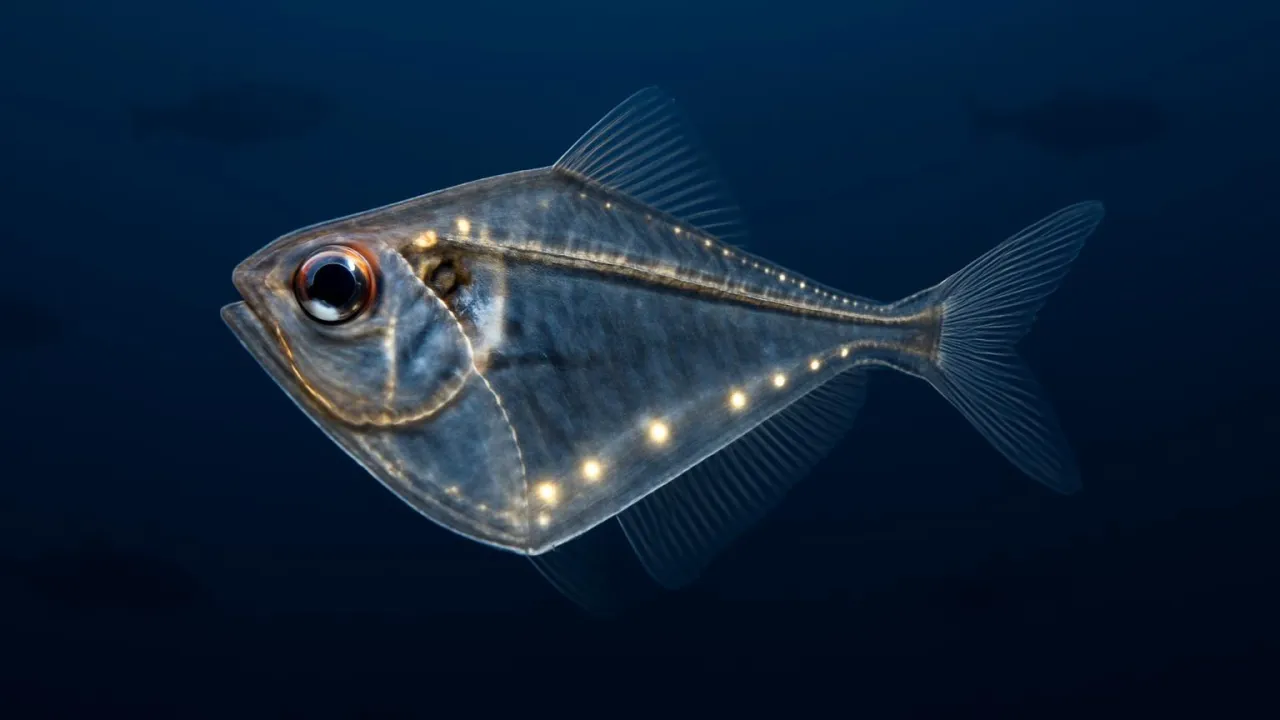
Hatchetfish can turn their belly lights on and off like a flashlight!
✨ Word Sparks (Grade 2 Glossary)
Tap 🔊 to hear
plankton
Tiny living things in water
enemy
Something that wants to hurt them
blend
To mix in and not be seen
🪝
Did you know some fish have see-through bellies that shine?
1
Meet the Hatchetfish
Hatchetfish are small, shiny fish that live in the deep sea. Their bodies look silvery and almost clear, so you can nearly see inside. They swim far below the waves, where it is always dark.
2
Glow for Safety
Hatchetfish have a cool trick to stay safe from enemies. They make their bellies glow with special lights, so they in with the light above. This helps them hide from bigger fish hunting below.
3
What Do They Eat?
Hatchetfish eat tiny animals like shrimp and that float in the water. They use their quick swimming to catch food in the dark. Sometimes, they even eat small fish that swim by.
Hatchetfish can make themselves nearly invisible by matching the exact color of ocean light!
✨ Word Sparks (Grade 3 Glossary)
Tap 🔊 to hear
photophore
A body part that makes light
counter-illumination
Hiding by glowing like the light above
predator
An animal that hunts other animals
🪝
How do deep-sea fish like hatchetfish turn invisible to hungry predators?
1
Life in the Dark
Hatchetfish live far below the ocean’s surface, where sunlight cannot reach. Their world is cold, dark, and full of strange creatures. These fish are small, usually only a few inches long. Their shiny, silver bodies help them blend into the watery darkness.
2
Glowing Bellies: A Clever Adaptation
Hatchetfish have special organs called that make light on their bellies. This glow matches the faint light from above, making them nearly invisible to below. This adaptation is called , and it keeps them safe from being eaten.
3
What’s for Dinner?
Hatchetfish hunt for tiny animals called plankton and small shrimp. At night, some swim closer to the surface to find more food. Their large eyes help them see in the dim light, making it easier to spot prey.
4
A Surprising Shape
Hatchetfish get their name because their flat, thin bodies look like a hatchet blade. Their see-through skin and silvery scales help them hide. This body shape lets them move quickly and escape danger.
Some hatchetfish can adjust their belly lights to match the moon’s brightness above them!
✨ Word Sparks (Grade 4 Glossary)
Tap 🔊 to hear
camouflage
Blending in to avoid being seen
crustacean
A small animal with a hard shell
adaptation
A body change that helps survival
🪝
Imagine a fish that glows to hide in the darkest ocean depths—how does it survive?
1
Masters of the Midnight Zone
Hatchetfish thrive in the ocean’s 'midnight zone,' a region so deep that sunlight never reaches it. These fish are found around the world, usually between 600 and 4,500 feet below the surface. Their bodies are thin, flat, and covered in silvery scales that reflect any bit of available light. This helps them avoid becoming prey in a world full of hungry hunters.
2
How Counter-Illumination Works
Hatchetfish have rows of photophores—tiny organs that produce light—along their bellies. By adjusting the brightness of their glow, they perfectly match the faint light filtering down from above. This clever trick, called counter-illumination, makes them nearly invisible to predators looking up from below. It’s a remarkable for surviving in the deep sea.
3
Feeding in the Deep
Hatchetfish are carnivores, mainly eating plankton, tiny , and small fish. At night, some species swim closer to the surface, following their food as it rises. Their large, upward-facing eyes help them spot prey in the dim, blue light. This feeding strategy allows them to take advantage of the ocean’s daily rhythms.
4
Ecosystem Role and Distribution
Hatchetfish play an important role in deep-sea food webs, serving as both predator and prey. They help control populations of smaller animals and provide food for larger fish, squid, and even some whales. Found in oceans worldwide, their presence shows how life adapts to extreme environments. Human activity, like deep-sea fishing and pollution, can affect their fragile habitat.
Hatchetfish can survive at depths where the water pressure is over 2,000 pounds per square inch!
✨ Word Sparks (Grade 5 Glossary)
Tap 🔊 to hear
mesopelagic
The ocean’s twilight zone, 650–3,300 feet deep
bioluminescence
Light made by living things
photophore
A body part that makes glowing light
🪝
What if you could turn invisible by glowing—would you survive the deep sea like a hatchetfish?
1
Taxonomy and Adaptation
Hatchetfish belong to the family Sternoptychidae, a group of deep-sea ray-finned fishes distributed in oceans around the globe. These fish have evolved a suite of physiological adaptations for life in the and bathypelagic zones, where light is minimal and pressure is immense. Their laterally compressed, hatchet-shaped bodies minimize their silhouette when viewed from below, aiding in camouflage. Hatchetfish are further distinguished by their transparent tissues and reflective scales, which scatter any available light. This unique body plan is a remarkable evolutionary response to the challenges of deep-sea survival.
2
Physiology of Bioluminescence
Hatchetfish possess rows of —specialized light-producing organs—along their ventral surfaces. These photophores emit blue-green bioluminescent light, which is produced through a chemical reaction involving luciferin and the enzyme luciferase. By modulating the intensity and pattern of their glow, hatchetfish achieve counter-illumination, making them nearly invisible to upward-looking predators. Some species can even adjust their photophores to match the brightness of moonlight or starlight above, demonstrating an extraordinary level of environmental sensitivity. This is not only used for camouflage but may also play a role in communication and mate attraction.
3
Feeding Strategies and Vertical Migration
Hatchetfish are opportunistic carnivores, primarily consuming zooplankton, copepods, amphipods, and small fish. At night, many species undertake diel vertical migration, ascending hundreds of meters toward the surface to exploit abundant prey. Their large, tubular eyes are highly sensitive to low light, enabling them to detect faint movements in the dark. This nightly migration helps them avoid daytime predators while maximizing feeding opportunities. Hatchetfish can consume prey nearly half their own body length, making them efficient hunters in a challenging environment.
4
Ecosystem Impact and Human Influence
Hatchetfish occupy a critical niche in deep-sea ecosystems, serving as both mid-level predators and prey for larger animals such as squid, dragonfish, and deep-diving mammals. Their population dynamics influence the abundance of planktonic organisms and help transfer energy up the food web. Human activities, including deep-sea trawling, pollution, and climate change, threaten the stability of their fragile habitats. Because hatchetfish are sensitive to changes in water temperature and chemistry, they are considered important indicators of ocean health. Ongoing scientific research aims to understand their ecological role and ensure their conservation.
5
Quantitative Comparisons and Scientific Discovery
Hatchetfish typically measure between 1 and 6 inches (2.5–15 centimeters) in length, making them small but significant members of the zone. Their can produce light with an intensity as low as 0.01 lux, similar to the brightness of a starry night sky. Some species have been recorded at depths exceeding 4,500 feet (1,370 meters), enduring pressures over 2,000 psi—more than 130 times the air pressure at sea level. The first deep-sea hatchetfish were described scientifically in the 19th century, and new species are still being discovered today. Their remarkable adaptations continue to inspire research in fields ranging from marine biology to biomimetic engineering.