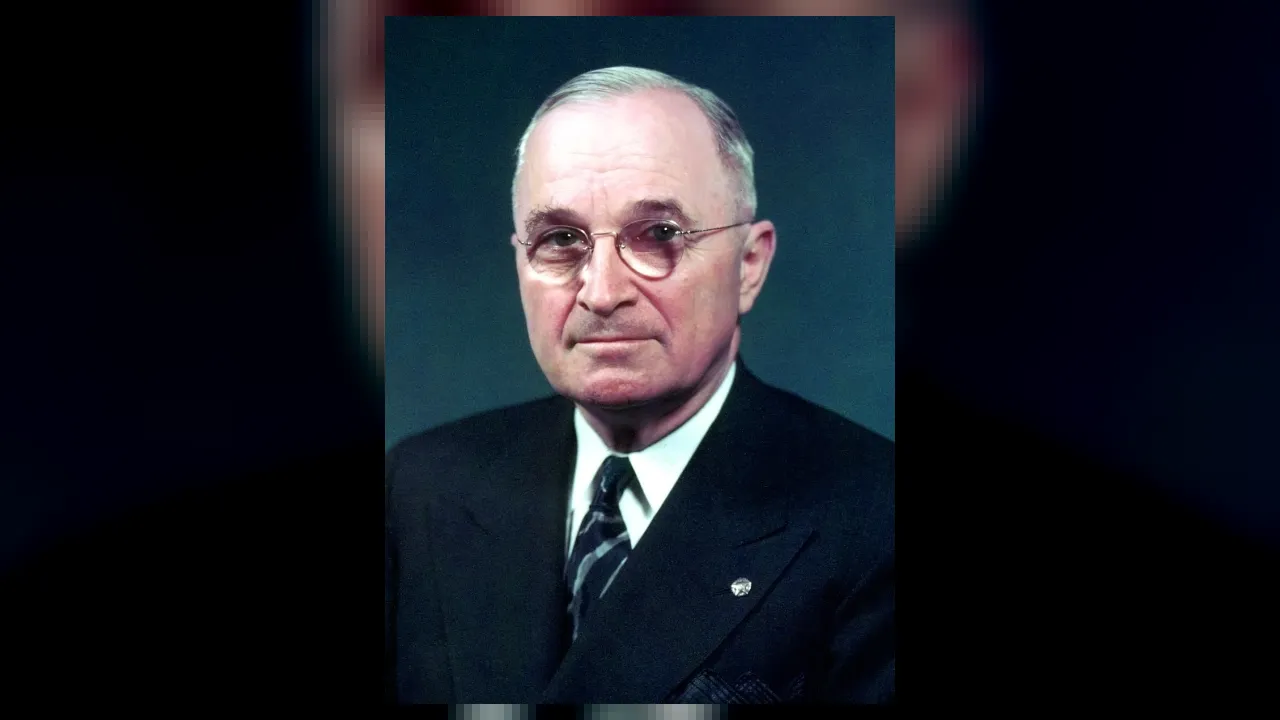
⚡ Historical SparkDesegregated the U.S. military in 1948 and rebuilt postwar Europe in peace
🤯 Mind-Blowing Fact • Grade 1
The 'S' in Harry S. Truman did not stand for a single word—his parents chose just the letter 'S' to honor both of his grandfathers, Shipp and Solomon!
✨ Word Sparks (Grade 1 Glossary)
Tap 🔊 to hear
responsibility
Doing your duty and owning your choices
cargo
Food, fuel, or goods carried by planes or ships
eyeglass
Lenses worn on your face to see clearly
🪝
What did the wooden sign on the thirty-third president's desk mean?
1
Taking Responsibility
Tap, tap! Right on the Oval Office desk sat a small sign reading, 'The Buck Stops Here!' That meant our thirty-third president never blamed others for tough choices.
2
From Missouri Farm to Leader
Growing up in Missouri, Harry wore thick , practiced piano early each morning, and plowed family fields. When President Roosevelt died in 1945, Harry stepped up bravely!
3
Airplanes Bringing Food
After World War II ended, a big city called Berlin ran out of food and coal. President Truman sent airplanes flying in supplies every few minutes!
1. What did the famous sign 'The Buck Stops Here' on Truman's desk mean?
2. What did the middle initial 'S' in Harry S. Truman stand for?
🤯 Mind-Blowing Fact • Grade 2
During Truman's 1948–1949 Berlin Airlift, American pilot Gail Halvorsen and fellow crews dropped more than twenty tons of chocolate and gum attached to tiny cloth handkerchiefs for Berlin's children!
✨ Word Sparks (Grade 2 Glossary)
Tap 🔊 to hear
charter
A founding written plan that starts an organization
airlift
Flying urgently needed supplies into an isolated place
desegregate
To end unfair separation and bring people together
🪝
How did a Missouri farmer who never graduated from college guide the world at the end of World War II?
1
Books, Piano, and Hard Work
Plink, plunk, plink! Every morning at five o'clock, young Harry Truman practiced the piano in Independence, Missouri, and read every history book in his town library! Before entering politics, he worked on his family's farm and served bravely in World War I.
2
Stepping Into Giant Shoes
Just eighty-two days after becoming vice president in 1945, Truman suddenly became our thirty-third president when Franklin D. Roosevelt died. Within months, World War II ended and Truman helped welcome fifty nations to sign the United Nations .
3
Fairness and the Berlin Airlift
In 1948, Truman signed a landmark order ending racial segregation in the U.S. military so all service members served equally. That same year, when roads into West Berlin were blocked, his Berlin flew food, fuel, and tiny candy parachutes to families!
1. What historic step for civil rights did President Truman take in 1948?
2. How did President Truman keep two million residents of West Berlin fed without starting a war when roads were blocked?
🤯 Mind-Blowing Fact • Grade 3
On the morning after the 1948 election, a beaming Harry S. Truman held up an early Chicago Daily Tribune newspaper mistakenly headlined 'DEWEY DEFEATS TRUMAN' in one of history's most famous photographs!
✨ Word Sparks (Grade 3 Glossary)
Tap 🔊 to hear
blockade
Closing roads and rails to cut off a city
alliance
A group of nations promising to defend each other
pollster
Someone who surveys voters to predict election winners
🪝
Why did newspapers print the wrong headline—'Dewey Defeats Truman'—during one of the biggest election surprises in U.S. history?
1
The Plainspoken Man From Missouri
Picture waking up to see a newspaper front page announcing you lost the presidential election—when you actually won! Born in Missouri in 1884, Harry S. Truman was the only twentieth-century U.S. president without a college degree, yet his honesty and lifelong reading earned deep respect in the U.S. Senate.
2
Ending World War II and Rebuilding Peace
Becoming thirty-third president in April 1945, Truman faced enormous choices as Germany surrendered in May and Japan surrendered in August after atomic bombings ended the Pacific war. Determined to prevent another global conflict, Truman signed the United Nations Charter and backed the Marshall Plan—named for Secretary of State George C. Marshall—to rebuild hungry European towns.
3
The Berlin Airlift and NATO
As the Cold War competition with the Soviet Union began, Soviet forces blockaded West Berlin in 1948. Truman ordered the heroic Berlin Airlift, delivering over two million tons of food and coal by air, and joined democratic allies in forming NATO.
4
Whistle-Stop Courage and Civil Rights
In 1948, Truman courageously issued Executive Order 9981 desegregating the U.S. Armed Forces. Riding a train 22,000 miles to speak from the back platform, he stunned by winning reelection over Thomas E. Dewey!
1. What did the Marshall Plan do after World War II?
2. How did Truman campaign across America to win his surprise 1948 election victory?
🤯 Mind-Blowing Fact • Grade 4
After leaving the White House in 1953, Harry and Bess Truman bought no bodyguards or chauffeurs—they packed their own 1953 Chrysler sedan and drove themselves nearly a thousand miles home to Independence, Missouri!
✨ Word Sparks (Grade 4 Glossary)
Tap 🔊 to hear
artillery
Large heavy cannons used by an army
containment
Preventing authoritarian rule from spreading to free nations
integrity
Strong moral honesty even when choices are unpopular
🪝
How did Harry S. Truman lay the pillars of postwar peace, democratic alliances, and military civil rights?
1
Farmer, Artillery Captain, and Senator
Unable to attend West Point because of poor eyesight, young Harry S. Truman memorized the eye chart to join the Missouri National Guard and commanded an battery bravely in France during World War I. Later elected U.S. Senator from Missouri, he chaired the bipartisan 'Truman Committee,' saving taxpayers billions of dollars by uncovering waste and faulty equipment in World War II defense factories.
2
Sudden Presidency and Postwar Choices
When Franklin D. Roosevelt died on April 12, 1945, Truman told reporters he felt as if 'the moon, the stars, and all the planets had fallen on me.' Within four months, Allied forces celebrated Victory in Europe Day, delegates in San Francisco signed the United Nations Charter, and Truman made the momentous decision to authorize atomic weapons at Hiroshima and Nagasaki to end the Pacific war quickly without a costly mainland invasion.
3
The Truman Doctrine, Marshall Plan, and Berlin
Rather than retreating into isolationism as America had after World War I, Truman shaped a bipartisan strategy to protect free nations during the early Cold War. Through the Truman Doctrine (1947) and the $13 billion Marshall Plan (1948), the United States helped rebuild Western Europe's shattered economies. When Soviet authorities cut land routes into West Berlin in 1948–1949, 277,000 Allied flights sustained two million citizens peacefully, followed by the creation of the North Atlantic Treaty Organization (NATO)—America's first peacetime defense alliance.
4
Civil Rights Milestone and Plainspoken Integrity
Domestically, Truman became the first president to address the NAACP at the Lincoln Memorial and issued Executive Orders 9980 and 9981 in July 1948, desegregating both the federal workforce and the U.S. Armed Forces. After leaving office in 1953 following tough years during the Korean War, Truman drove himself and his wife Bess back home to Missouri in their own family car!
1. How did U.S. foreign policy after World War II under Truman differ from U.S. policy after World War I?
2. What did Truman's Executive Orders 9980 and 9981 accomplish in July 1948?
🤯 Mind-Blowing Fact • Grade 5
When Harry S. Truman retired to Missouri in 1953, U.S. presidents received zero presidential pension—his sole government income was his $112.56 monthly World War I army pension, inspiring Congress to pass the Former Presidents Act in 1958!
✨ Word Sparks (Grade 5 Glossary)
Tap 🔊 to hear
nonpartisan
Fair and objective without favoring any political party
sorties
Individual flights flown by aircraft on a mission
auspices
Official guidance, backing, and authority of an organization
🪝
Why do presidential historians rank Harry S. Truman—once underestimated by contemporaries—among America's most consequential institutional builders?
1
Missouri Roots and the Truman Committee
Imagine stepping into the Oval Office in April 1945 without even having been told about the top-secret Manhattan Project! Born in Lamar, Missouri, in 1884 and raised in Independence, Harry S. Truman forged his leadership as Captain of Battery D in France's Meuse-Argonne offensive (1918) and later as U.S. Senator. Chairing the Senate Special Committee to Investigate the National Defense Program during World War II, his oversight saved roughly $15 billion and thousands of soldiers' lives, earning him the 1944 vice-presidential nomination.
2
Crucible of 1945 and the Postwar Order
Thrust into the presidency upon Franklin D. Roosevelt's death on April 12, 1945, Truman navigated history's hinge months: Germany's surrender in May, founding of the United Nations in June, the Potsdam Conference in July, and the agonizing August decision to employ atomic weapons to end the Pacific war with Japan. Determined not to repeat post-1919 punitive mistakes or American withdrawal, Truman championed constructive reconstruction alongside the National Security Act of 1947, reorganizing defense coordination.
3
Bipartisan Statecraft: Marshall Plan, Berlin, and NATO
Facing postwar economic collapse across Europe and Soviet expansion across Eastern Europe, Truman partnered across party lines with Republican Senate Foreign Relations Chairman Arthur Vandenberg and Virginia-educated Secretary of State George C. Marshall. Together they enacted the Truman Doctrine (1947) and the European Recovery Program—the Marshall Plan (1948–1952)—channeling over $13 billion to revive European democracies. When Stalin blockaded West Berlin in June 1948, Truman rejected both retreat and rash combat, sustaining two million Berliners via 277,000 airlift and anchoring transatlantic collective defense through NATO in April 1949.
4
Executive Courage on Civil Rights and 1948 Upset
Appalled by postwar violence against Black World War II veterans, Truman appointed a President's Committee on Civil Rights (To Secure These Rights, 1947), became the first president to address the NAACP, and issued Executive Order 9981 on July 26, 1948, mandating 'equality of treatment and opportunity for all persons in the armed services.' Despite party splits in three directions, his 21,928-mile whistle-stop rail campaign carried him to a stunning 1948 victory.
5
Korea, Civilian Supremacy, and Humble Retirement
Truman's turbulent second term confronted North Korea's June 1950 invasion of South Korea under United Nations and upheld the constitutional principle of civilian control of the military when he relieved General Douglas MacArthur in 1951 to prevent wider global war. Retiring quietly to Missouri in 1953 on his $112.56 monthly army pension—prompting Congress to pass the Former Presidents Act in 1958—Truman modeled plainspoken republican virtue.