🎵 INSTRUMENTS
🎶 Plucked Box Zither with Keyboard (Chordophone) • Keyboard / Strings
VA Music, Fine Arts & Sound Physics SOL 5.5
Harpsichord
Silvery Plucked Strings Behind Royal Baroque Keys
Grade 2 • Developing • 122 words
🎶 Instrument Family & OriginKeyboard string family • Late 14th-century Europe, thriving across Renaissance and Baroque eras
🪵 Materials & RangeWing-shaped painted wood case, spruce soundboard, brass/iron wires, and quill plectra • 4 to 5 octaves
🔊 How Sound Is MadePressing a key lifts a wooden jack whose tiny quill or Delrin plectrum plucks a stretched wire string
⚡ Signature Sound SparkTurns keyboard fingerwork into a sparkling, guitar-crisp cascade of silvery plucked notes
🤯 Mind-Blowing Fact • Grade 1
Hundreds of years ago, harpsichord builders cut tiny string-plucking picks from real crow and raven feathers!
✨ Word Sparks (Grade 1 Glossary)
Tap 🔊 to hear
pluck
Pull and release a string so it snaps
quill
Hollow stiff shaft of a bird feather
wire
Thin metal thread stretched tight for music
🪝
What happens if you hide a shiny harp inside a keyboard case and pluck every string?
1
Twang, Zing, Sparkle!
Twang, zing, plink! Crisp silver notes dance out like a royal feast. Press a key, and a tiny pick a string! Meet the glittering harpsichord.
2
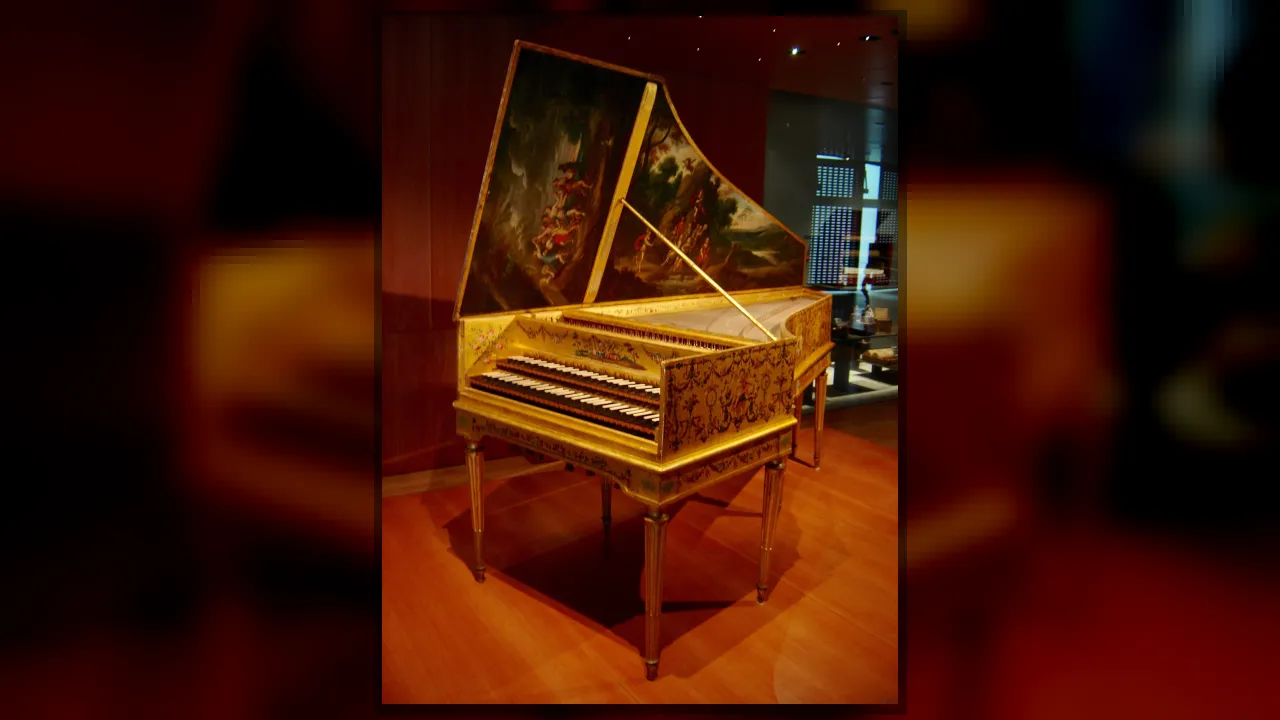
Looks Like a Piano
Its long wooden body curves like a bird wing. Many harpsichords even stack two rows of keys! Sometimes the long keys are dark and the short keys are white.
3
Pluck, Don't Hammer
Pianos hit strings with soft hammers. Harpsichords strings for a bright, zippy snap!
1. How does a harpsichord make its strings sound when you press a key?
2. What bird part did early builders trim to make tiny plucking picks inside harpsichords?
🤯 Mind-Blowing Fact • Grade 2
Flemish harpsichord makers in the 1600s painted colorful flowers, butterflies, birds, and Latin mottoes right onto the wooden soundboard underneath the strings!
✨ Word Sparks (Grade 2 Glossary)
Tap 🔊 to hear
jack
Thin wooden strip that lifts up to pluck
soundboard
Thin wooden sheet that boosts string vibrations
palace
Grand home of kings, queens, or nobles
🪝
Why doesn't pressing a harpsichord key harder make the note any louder?
1
The Superstar Before the Piano
Zing-plink-twang! Step back three hundred years into a candlelit where composers like Bach and Handel are performing! Long before pianos existed, the harpsichord ruled concert rooms with its bright, glittering voice.
2
Little Jumping Jacks
Inside its painted wooden case stretch dozens of thin brass and iron strings. When your finger presses a key, the back end tips up and lifts a slender wooden stick called a . Sticking out from that jack is a tiny pointed pick that plucks the string cleanly on the way up!
3
Same Volume, Clever Tricks
Whether you tap a key gently or slam it down hard, the tiny pick bends the exact same amount—so the loudness barely changes! Instead, players switch between two keyboards to sound extra sets of strings at once.
1. What happens if you press a harpsichord key much harder with your finger?
2. What is the slender jumping wooden stick inside a harpsichord called?
🤯 Mind-Blowing Fact • Grade 3
On French and German Baroque harpsichords, the keyboard colors were often reversed from modern pianos—dark ebony wood covered the long natural keys while pale bone topped the raised sharp keys!
✨ Word Sparks (Grade 3 Glossary)
Tap 🔊 to hear
chordophone
Any instrument making sound with stretched vibrating strings
plectrum
Small pointed pick that plucks a string
Baroque
Ornate European music era from 1600 to 1750
🪝
When you let go of a harpsichord key and the pick drops back down, why doesn't it pluck the string a second time?
1
Silver Sparks From Baroque Courts
Trill-zing-sparkle! Few sounds transport listeners straight back to the age of powdered wigs and candlelit ballrooms faster than a harpsichord! Classified as a keyboard , its crisp plucked voice keeps busy melodies crystal clear even when four musical lines weave together at once.
2
The Clever Secret of the Escaping Tongue
Pressing a key lifts a slim pearwood jack holding a tiny carved from bird quill or flexible Delrin plastic. On the way up, the plectrum plucks the stretched wire string cleanly. What happens when you release the key and the jack falls? The plectrum sits on a tiny hinged wooden tongue backed by a bristle spring! As the jack drops, the tongue tilts backward so the pick slips silently past the string while a felt damper hushes the note.
3
Stacking Choirs of Strings
Although finger pressure cannot swell loudness like a piano, large harpsichords hold two or three full sets—or choirs—of strings, including a high 'four-foot' set tuned an octave higher for dazzling brilliance!
4
Centuries of Rebirth
Flourishing from the 1500s through the late 1700s in works by Scarlatti, Couperin, Handel, and Bach, the harpsichord faded behind the louder piano before enjoying a thrilling revival in the twentieth century.
1. What keeps the harpsichord's plectrum from plucking the string loud again when the jack falls back down?
2. How do harpsichordists make a grand final section sound much fuller and brighter without touch dynamics?
🤯 Mind-Blowing Fact • Grade 4
Smaller rectangular or triangular cousins of the harpsichord called virginals and spinets placed their strings sideways or at an angle so royalty like Queen Elizabeth I could play in cozy palace chambers!
✨ Word Sparks (Grade 4 Glossary)
Tap 🔊 to hear
counterpoint
Weaving independent melodies together in harmony
tension
Tightness or pulling force along a stretched string
pizzicato
Crisp sound of strings plucked rather than bowed
🪝
Why do thin, low-tension harpsichord strings sparkle with bright metallic harmonics while thick piano strings sound round and booming?
1
Clarity Built for Counterpoint
Listen closely to Johann Sebastian Bach's Goldberg Variations on a historical harpsichord: every rapid ornament, trill, and crisscrossing bass line gleams like cut crystal without turning muddy! That razor-sharp transparency comes directly from the physics of plucking ultra-thin wire.
2
Sharp Kinks, Thin Wire, and Spruce Soundboards
Compared with a modern grand piano—whose heavy steel strings pull on an iron frame with twenty tons of —a harpsichord strings thin brass and iron wires at remarkably light tension inside an all-wooden wing-shaped case. When a narrow quill or Delrin plectrum hooks a thin wire and releases it, it bends the string into a sharp V-shaped corner. In string physics, a sharp corner excites a rich spray of high harmonic overtones all the way up the spectrum, whereas a wide, padded piano hammer creates a smooth curve that emphasizes lower fundamentals! Those bright vibrations race across a curved hardwood bridge into a thin spruce soundboard barely three millimeters thick.
3
Buff Stops, Couplers, and Terraced Dynamics
Two-manual French and Flemish harpsichords let players contrast silvery solo lines on the upper manual against rich coupled chords below—a style called terraced dynamics. Sliding a 'buff' or 'lute' stop presses tiny pads of soft leather lightly against one choir of strings, transforming its bright zing into a warm, harp sound!
4
Italian Speed vs. Franco-Flemish Richness
Documented as early as 1397 in Padua, Italy, harpsichord making split into distinct national voices: crisp, lightweight cypress-cased Italian instruments built for fiery rhythm, and deeper, resonant Antwerp and Paris double-manuals built by dynasties like the Ruckers and Taskin families.
1. Why does plucking a thin wire with a narrow plectrum produce so many bright upper harmonics?
2. What does engaging the 'buff' or 'lute' stop do inside a harpsichord?
🤯 Mind-Blowing Fact • Grade 5
Because Baroque harpsichords are often tuned to historical pitch around A=415 Hz—nearly a half-step lower than modern orchestra pitch A=440 Hz—many modern concert harpsichords have 'transposing keyboards' that slide sideways by one key at the flip of a wooden block!
✨ Word Sparks (Grade 5 Glossary)
Tap 🔊 to hear
agogic
Expressive emphasis made by lingering slightly in time
temperament
System of fine-tuning intervals across keyboard octaves
disposition
Specific set of string choirs inside a harpsichord
🪝
How do pluck-point geometry, wild-boar-bristle escapement springs, and historic unequal temperaments unlock the expressive rhetoric of the Baroque harpsichord?
1
Rhetoric Through Articulation Rather Than Volume
How can a keyboard instrument whose individual jack action allows minimal dynamic variation by key velocity project gripping emotional drama? In the hands of a Baroque master, the harpsichord replaces forceful volume swells with microsecond control of note duration, staggered arpeggiation, timing, and shimmering overtone clarity.
2
String Scaling, Pluck-Point Harmonics, and Case Acoustics
Classified in Hornbostel-Sachs organology as a plucked box zither with keyboard (314.122-4-8), an eighteenth-century Franco-Flemish double harpsichord typically spans five octaves from FF (43.65 hertz, or ~41 hertz at Baroque pitch A=415 Hz) to f3 (698.5 hertz). Low-carbon iron strings in the treble follow Pythagorean scaling—doubling in length for each descending octave—before transitioning to denser yellow and red brass in the bass to keep case length near 2.3 meters. Where the jack's crow-quill or polyacetal (Delrin) plectrum plucks along the string profoundly shapes timbre: plucking close to the nut ('nasal' or lute register) suppresses low modes and accentuates biting upper partials, whereas plucking farther toward mid-string yields rounder vocal fullness. With total string tension under 800 kilograms—a fraction of a modern grand piano—a thin, ribbed Sitka or European spruce soundboard (2.5 to 3.5 millimeters thick) encloses a fully closed resonant bentside box that blossoms instantaneously at the lightest pluck.
3
Jack Escapement and Dispositions (2×8', 1×4')
Each pearwood or servicewood jack houses a pivoted holly tongue tensioned by a single wild-boar bristle or brass leaf spring. Sliding wooden registers shift entire jack rails millimeters sideways to engage or disengage two unison 8-foot choirs and a 4-foot octave choir, joined across upper and lower manuals by a shove coupler.
4
Articulative Touch and Historic Temperaments
Because crisp upper partials expose beating intervals vividly, historical harpsichords shine in meantone or well- (such as Werckmeister or Vallotti), giving each musical key signature its own distinct harmonic color and poignant tension.
5
From Arnaut de Zwolle to the Historical Performance Revival
First sketched mechanically by Henri Arnaut de Zwolle around 1440 and perfected by Italian, Antwerp (Ruckers), French (Blanchet, Taskin), German (Mietke, Hass), and English (Kirckman) workshops—inspiring Byrd, Frescobaldi, Couperin, Rameau, Domenico Scarlatti, Handel, and J.S. Bach—the harpsichord re-emerged in twentieth-century concert life through pioneers Wanda Landowska, Frank Hubbard, William Dowd, and Gustav Leonhardt, plus modernist scores by Poulenc, Falla, and Ligeti.