🧬 HUMAN BODY
🧬 Amphiphilic Surfactant Micellization • Public Health & Biochemistry
VA Science & Health SOL 1.1, 3.1, 4.2, 5.1 (Cells, Organs & Body Systems)
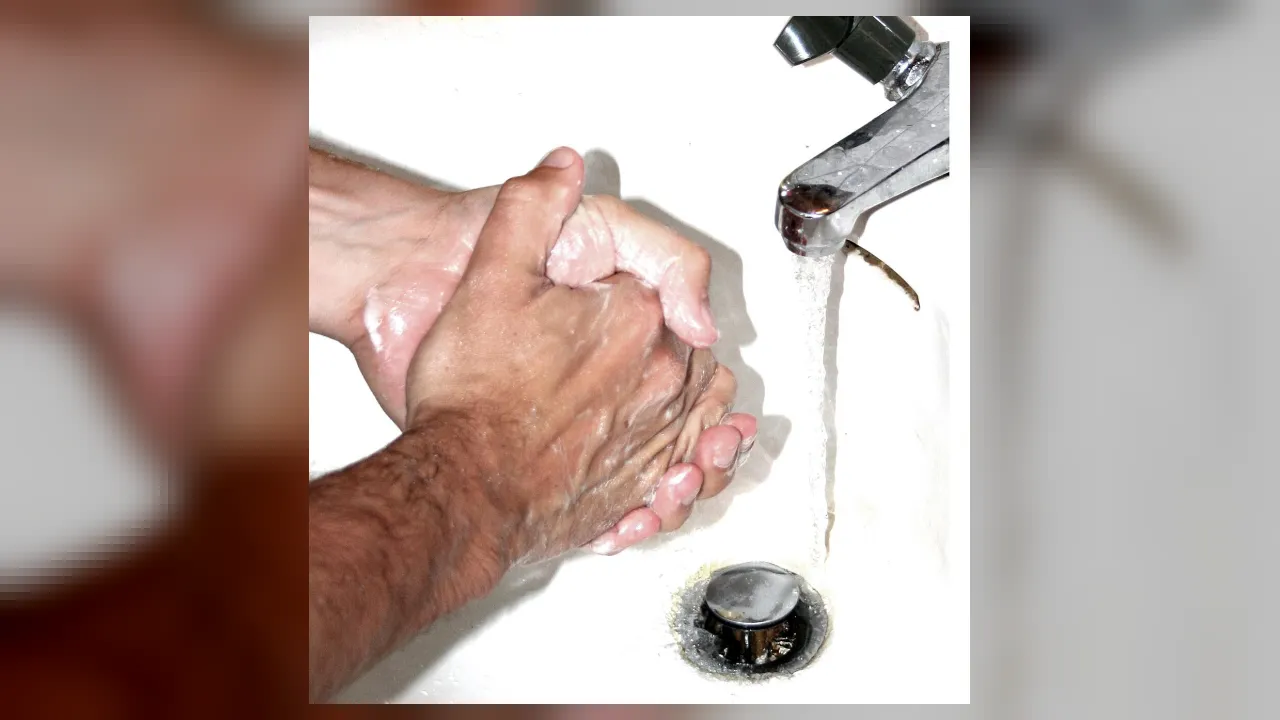
Handwashing & Soap Chemistry
Two-Sided Molecules That Pry Germs Off Your Skin
Grade 1 • Early Reader • 68 words
🩺 Body System & LocationIntegumentary Hygiene & Molecular Chemistry • Epidermal Skin Surface
🔬 Size / Cell Count20 seconds of scrubbing • Millions of pin-shaped surfactant molecules per drop
⚙️ Core JobLifts oils, dirt, and germs into microscopic bubbles and pries apart viral coats
⚡ Body SuperpowerOne molecular end grabs water while the other grabs grease and germ shells
🤯 Mind-Blowing Fact • Grade 1
Singing the 'Happy Birthday' song twice in your head takes right around twenty seconds—the exact time soap needs to trap germs!
✨ Word Sparks (Grade 1 Glossary)
Tap 🔊 to hear
lather
Fluffy bubbles made by rubbing soap
scrub
Rub hands firmly together to clean
rinse
Wash soap and dirt away with water
🪝
Why does plain water slide right over messy hands while soap washes dirt right off?
1
Oil and Water Don't Mix!
Rub-a-dub, bubble up! Touch greasy butter or garden mud, then with plain water. Water slides right off because skin oils hold germs tight!
2
Two-Handed Soap Helpers
Add a drop of soap and magic happens! Each tiny soap helper has two ends: one holds water, and one grabs sticky grease!
3
Sing for Twenty Seconds!
backs, thumbs, and nails while singing 'Happy Birthday' twice! Warm rinsing sweeps every soapy bubble and germ down the drain.
1. Why isn't a quick splash of plain water enough to wash away germs?
2. About how long should you scrub soapy hands before rinsing?
🤯 Mind-Blowing Fact • Grade 2
Washing hands regularly with soap and water cuts school tummy bugs and colds by up to forty percent!
✨ Word Sparks (Grade 2 Glossary)
Tap 🔊 to hear
molecule
Tiny group of atoms bonded together
foam
Cluster of tiny soap bubbles trapping air
hygiene
Everyday clean habits keeping bodies healthy
🪝
How does a tiny soap molecule look like a tadpole with two opposite superpowers?
1
Meet the Soap Tadpole!
Squirt liquid soap onto wet palms and rub until snowy appears! If you could zoom in millions of times, every soap looks like a tiny tadpole or lollipop with a round head and a long wiggly tail.
2
Water Lover Meets Grease Grabber
Those two ends have opposite personalities! The round head loves water, while the long tail hates water and loves oil and grease. When you scrub, thousands of tails dive into oily dirt and surround trapped germs.
3
Bubble Cages Down the Drain
All those soap form tiny round cages around dirt and germs with water-loving heads pointing outward! When tap water rushes over your hands, the water pulls those cages—germs and all—straight down the sink.
1. What do the two opposite ends of a tadpole-shaped soap molecule love?
2. Which sneaky spots on your hands do people forget to scrub most often?
🤯 Mind-Blowing Fact • Grade 3
Archaeologists found the earliest known soap recipe carved into clay tablets in ancient Babylon nearly 4,800 years ago—mixed from water, wood ashes, and plant oil!
✨ Word Sparks (Grade 3 Glossary)
Tap 🔊 to hear
hydrophilic
Attracted strongly to water molecules
hydrophobic
Repelled by water while attracted to oils
micelle
Microscopic sphere of soap trapping oily dirt
🪝
How does ordinary bar soap actually pop open cold and flu viruses like tiny crowbars?
1
Hydrophilic Heads, Hydrophobic Tails
Pour vegetable oil into a jar of water and watch the oil float separately on top! Chemists call soap a surfactant, and its molecules use two cool Greek words: a ('water-loving') head paired with a ('water-fearing,' oil-loving) tail.
2
Prying Open Viral Coats
Soap doesn't just trap dirt—it also dismantles many viruses and bacteria! Cold, flu, and coronavirus particles wrap their genetic code inside a fatty outer shell called a lipid envelope. soap tails wedge straight into that fatty shell like tiny crowbars and pry it apart!
3
Wrapping Debris in Micelles
Once broken bits of virus, bacteria, and skin oils float loose, soap molecules surround them in microscopic spheres called . Because the outer surface of every micelle is covered in water-loving heads, rinse water sweeps them away effortlessly.
4
Soap Beats Sanitizer on Dirty Hands
Alcohol hand sanitizer works great on clean hands when no sink is nearby, but sanitizer cannot wash away sticky mud, food grease, or tough stomach-bug germs the way soap, friction, and water do!
1. How do hydrophobic soap tails destroy many respiratory viruses?
2. When is soap and water much better than alcohol hand sanitizer?
🤯 Mind-Blowing Fact • Grade 4
Microbiology tests show damp hands pick up and spread bacteria up to 1,000 times faster than thoroughly dried hands—making clean towel drying a secret superpower!
✨ Word Sparks (Grade 4 Glossary)
Tap 🔊 to hear
amphiphilic
Molecule having both water-loving and oil-loving parts
surfactant
Compound lowering water surface tension for cleaning
lipid envelope
Fatty outer membrane surrounding many viruses
🪝
Why did doctors in the 1840s laugh at the pioneer who first proved handwashing saves lives?
1
Ignaz Semmelweis's Lifesaving Discovery
Step back to a Vienna hospital in 1847, decades before anyone knew microscopic germs caused infections! Hungarian physician Ignaz Semmelweis noticed patients stayed far healthier when midwives washed up than when doctors walked straight between wards with unwashed hands. When Semmelweis required doctors to scrub in chlorinated lime solution, infection deaths plummeted by ninety percent! Sadly, colleagues doubted him until Louis Pasteur and Joseph Lister later proved the germ theory of disease.
2
Amphiphilic Chemistry and Surface Tension
Chemists describe soap molecules as —possessing both polar (hydrophilic) carboxylate heads and nonpolar (hydrophobic) hydrocarbon chains. Plain water has high surface tension, beading up on waxy skin sebum instead of spreading into microscopic fingerprint valleys. slash water's surface tension so liquid penetrates every crease while hydrophobic tails wedge into lipid membranes and lift grime into spherical micelles.
3
Why Plain Soap Matches 'Antibacterial' Soap
Public health tests by the FDA proved household 'antibacterial' chemical additives clean no better than plain soap—because physical friction plus micelle formation already strips away transient microbes without encouraging antibiotic-resistant superbugs!
4
Don't Skip Drying Your Hands!
Wet hands transfer bacteria up to 1,000 times more easily than dry hands! Patting thoroughly dry with a clean towel completes the hygiene victory.
1. What happened in 1847 when Dr. Ignaz Semmelweis required Vienna hospital doctors to scrub their hands?
2. Why is drying your hands thoroughly with a clean towel so important right after rinsing?
🤯 Mind-Blowing Fact • Grade 5
Unlike alcohol sanitizers, soapy handwashing defeats tough non-enveloped stomach bugs like norovirus by stripping away the oily sebum glue holding their protein shells to your skin!
✨ Word Sparks (Grade 5 Glossary)
Tap 🔊 to hear
saponification
Chemical reaction turning fats and alkali into soap
phospholipid bilayer
Double-layered fatty membrane surrounding cells and viruses
commensal flora
Friendly resident microbes protecting healthy human skin
🪝
How does saponification forge amphiphilic carboxylate salts—and why does non-covalent entropy allow ordinary soap to shatter enveloped viruses while leaving bacterial endospores for mechanical friction?
1
Saponification and Amphiphilic Architecture
Mix plant triglycerides or animal tallow with an alkaline hydroxide base such as sodium hydroxide (lye), and an ancient ester-hydrolysis reaction called yields glycerol plus fatty-acid carboxylate salts—true soap! Each resulting molecule—such as sodium stearate—pairs an anionic, polar carboxylate head (-COO⁻Na⁺) capable of ion-dipole bonding with water alongside a 12-to-18-carbon nonpolar hydrocarbon tail driven by van der Waals interactions to shun water and seek lipids.
2
Thermodynamics of Critical Micelle Concentration
Pure water forms a tight hydrogen-bonded lattice whose high surface tension (~72 mN/m) beads up atop hydrophobic epidermal sebum. Dissolving soap lowers surface tension by two-thirds so water wets every dermal furrow! Once surfactant concentration crosses the Critical Micelle Concentration (CMC), the hydrophobic effect—driven by the entropic liberation of ordered water cages—spontaneously self-assembles 50 to 100 soap monomers into nanoscale spherical micelles with greasy debris sequestered inside a nonpolar core and hydrophilic heads facing outward.
3
Supramolecular Disruption of Enveloped Pathogens
Enveloped viruses—including influenza, SARS-CoV-2, RSV, and herpesviruses—hold their RNA or DNA and spike glycoproteins together inside a non-covalently self-assembled stolen from host cells. Because soap's hydrocarbon tails closely mimic membrane phospholipids, twenty seconds of mechanical shear lets surfactant monomers intercalate directly into the viral bilayer, solubilizing membrane lipids and dissociating spike proteins into harmless micellar fragments!
4
Non-Enveloped Capsids vs. Alcohol Sanitizers
Crucially, naked non-enveloped viruses like norovirus and rhinovirus—as well as hardy Clostridioides difficile bacterial spores—lack a lipid envelope, allowing them to shrug off 60–70% ethanol hand sanitizers! Soap and running water still defeat them not by chemical lysis, but by emulsifying skin sebum so mechanical friction and turbulent rinsing physically detach and flush the particles away.
5
Protecting the Resident Microbiome and Acid Mantle
Healthy stratum corneum maintains a mildly acidic pH (4.5–5.5) populated by beneficial like Staphylococcus epidermidis that crowd out invaders—which is why dermatologists pair thorough 20-second plain-soap handwashing with gentle moisturizers rather than harsh triclosan antiseptics.