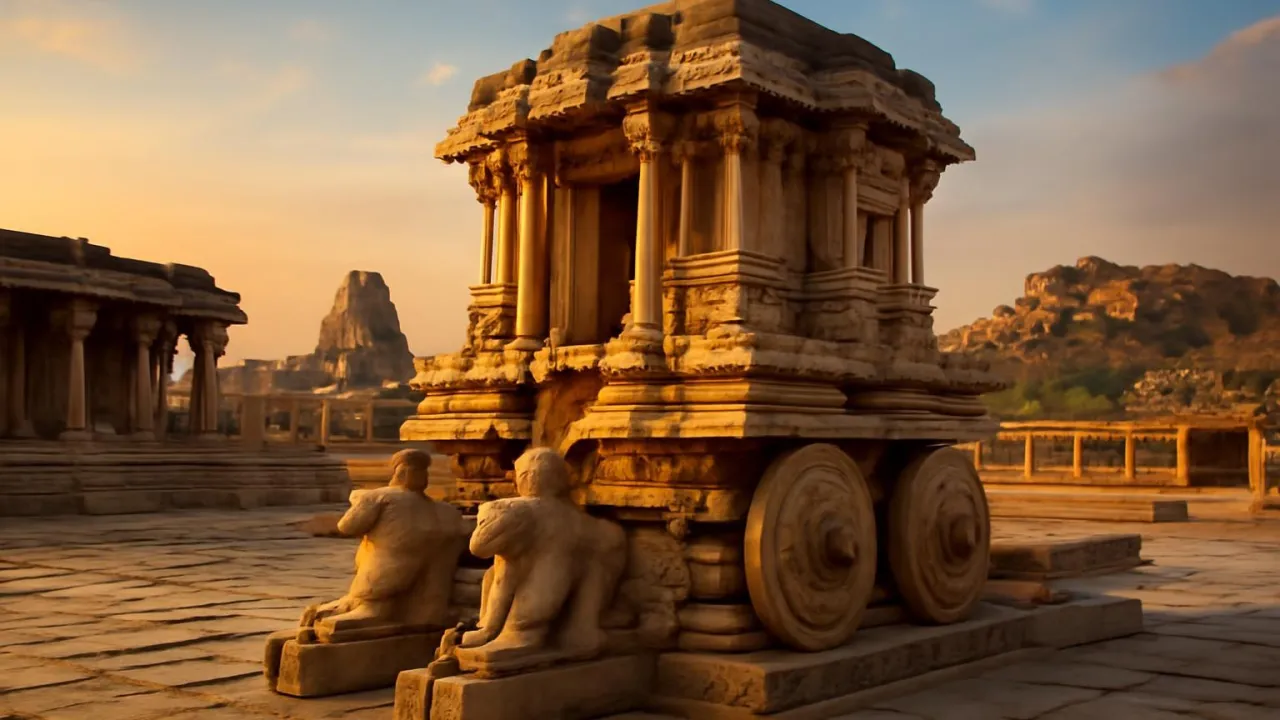
Can you imagine a giant stone cart that looks ready to roll?
1
The Stone Chariot’s Secret
The Hampi Stone Chariot looks just like a real cart, but it is made from hard . Its wheels seem ready to turn, but the chariot cannot move. People come from all over to see this amazing .
2
Animals and Art
Two carved elephants stand in front of the chariot. There are detailed pictures of animals and flowers on the sides. Visitors love to look at all the tiny designs and shapes.
3
Ruins of a Lost City
The chariot stands among old temples and broken walls. These ruins are from the city of Hampi. Today, people explore the area and imagine how it looked long ago.
1. What animals are carved in front of the chariot?
2. Where is the stone chariot found?
🤯 Mind-Blowing Fact • Grade 3
The chariot’s wheels once really spun, surprising visitors with their clever design!
✨ Word Sparks (Grade 3 Glossary)
Tap 🔊 to hear
granite
A tough rock used in buildings
vibration
A quick back-and-forth movement
erosion
Slow wearing away by wind or water
🪝
What if you could build a cart so strong, it lasted for centuries?
1
A Marvel Carved from Granite
The Hampi Stone Chariot looks like a real wooden cart, but it is carved entirely from . Granite is a very strong rock that can last for thousands of years. Skilled artists carefully shaped each piece to fit together perfectly. The chariot’s wheels are round and detailed, making it seem ready to roll.
2
Wheels That Almost Turn
The chariot’s wheels are carved separately and were once able to spin. This clever design creates a sense of and movement, even though the chariot stays in place. Visitors are amazed to see how the wheels look so real. Today, the wheels are fixed to protect the monument.
3
Stories in Stone
The chariot is covered in carvings of animals, flowers, and mythological stories. Two elephants stand as if pulling the cart, adding to the monument’s realism. These carvings show the artistic skills of the Vijayanagara Empire. Exploring the ruins, people find many more stone sculptures and temple pillars.
4
A City of Wonders
Hampi’s ruins spread across a rocky landscape filled with ancient temples and monuments. The chariot stands in front of the grand Vittala Temple, famous for its musical stone pillars. and time have worn down some stones, but the chariot still stands strong. People visit Hampi to learn about India’s rich history and see its wonders.
The Hampi Stone Chariot inspired the design of India’s 50-rupee banknote!
✨ Word Sparks (Grade 4 Glossary)
Tap 🔊 to hear
canopy
A roof or cover over something
joint
Where two parts fit together
conservation
Protecting something from harm or damage
🪝
If you walked through Hampi at sunrise, would you hear ancient wheels turning in the stone?
1
Engineering a Granite Wonder
The Hampi Stone Chariot is a remarkable example of medieval Indian engineering, carved entirely from massive blocks of granite. Each part, including the wheels, base, and , was sculpted separately and assembled with precise . Granite’s hardness made the carving process slow and required specialized tools and skilled artisans. The chariot’s wheels were engineered to rotate on stone axles, creating the illusion of motion.
2
Symbolism and Sacred Art
The chariot is not just a monument; it also represents a sacred vehicle for the Hindu god Garuda. Intricate carvings of mythological scenes, animals, and floral patterns cover its surfaces, showing the artistic mastery of the Vijayanagara period. Two granite elephants, added later, stand as if pulling the chariot forward. These carvings tell stories from ancient Indian legends and religious traditions.
3
Ruins of the Vijayanagara Empire
The chariot stands within the Vittala Temple complex, surrounded by other spectacular ruins. Hampi was once the capital of the powerful Vijayanagara Empire, which flourished in southern India during the 14th to 16th centuries. Over time, erosion and invasions caused many buildings to crumble, but the chariot remains a symbol of the city’s former glory. Today, Hampi is a UNESCO World Heritage Site recognized for its cultural and architectural significance.
4
Legacy and Global Fascination
Tourists and historians from around the world visit Hampi to study its unique stone monuments. The chariot’s design has inspired artists, architects, and even modern currency, appearing on Indian banknotes. efforts help protect the chariot from further erosion and damage. Its blend of engineering, artistry, and sacred meaning makes it a lasting wonder of the ancient world.
1. What does the chariot symbolize in Hindu tradition?
2. Why is Hampi a UNESCO World Heritage Site?
🤯 Mind-Blowing Fact • Grade 5
The chariot’s granite wheels were once fully functional and could actually rotate on stone axles.
✨ Word Sparks (Grade 5 Glossary)
Tap 🔊 to hear
mortise-and-tenon
A way to fit two parts together tightly
bas-relief
Carvings that stick out a little from stone
modular
Made of parts that fit together
🪝
If you traced your fingers along the Hampi Stone Chariot’s carvings, could you unlock the secrets of its ancient builders?
1
Granite Engineering: Mastery in Stone
The Hampi Stone Chariot stands as a masterpiece of medieval Indian engineering, constructed during the reign of King Krishnadevaraya around 1520 CE. Artisans quarried enormous blocks of locally sourced granite, a rock known for its density and resistance to weathering, and meticulously carved each segment using iron chisels and hammers. The chariot’s wheels, base, and superstructure were engineered as interlocking components, assembled with joints that provided both stability and the illusion of mobility. The wheels, originally designed to rotate on stone axles, showcased a sophisticated understanding of mechanical principles rarely seen in stone monuments.
2
Sacred Symbolism and Artistic Brilliance
The chariot is not merely an architectural feat; it is a sacred symbol representing the celestial vehicle of Garuda, the eagle mount of the Hindu god Vishnu. Every surface is adorned with intricate carvings depicting mythological narratives, floral motifs, and legendary animals, reflecting both religious devotion and artistic innovation. The granite elephants positioned at the front were added in later centuries, replacing the original horses, and serve to enhance the monument’s sense of grandeur and movement. These carvings offer valuable insight into the iconography and spiritual beliefs of the Vijayanagara Empire.
3
The Ruins of Hampi: A Lost Capital
The chariot resides within the Vittala Temple complex, surrounded by a sprawling landscape of ruined halls, pillared corridors, and ceremonial gateways. Hampi, once the capital of the Vijayanagara Empire, was a thriving metropolis renowned for its wealth, trade, and cultural achievements. The city’s decline began in the late 16th century following invasions, leading to the gradual erosion and collapse of its monumental architecture. Despite centuries of exposure to monsoon rains and wind, the chariot endures as a testament to the era’s engineering prowess and artistic legacy.
4
Conservation and Global Recognition
Today, the Hampi Stone Chariot is protected as part of a UNESCO World Heritage Site, drawing scholars, architects, and tourists from across the globe. Conservationists employ advanced techniques such as chemical treatments, structural reinforcements, and environmental monitoring to preserve the monument’s integrity. The chariot’s image is so iconic that it appears on India’s 50-rupee banknote and in countless works of art and literature. Its preservation is essential for understanding the technological and cultural advancements of medieval South India.
5
Legacy of Innovation and Inspiration
The Hampi Stone Chariot continues to inspire modern architects and engineers with its blend of form, function, and symbolism. Its construction demonstrates an early grasp of design, allowing for both durability and artistic flexibility. The chariot’s enduring presence amidst the ruins of Hampi offers a tangible link to the past, inviting new generations to explore the mysteries of ancient craftsmanship. As a symbol of resilience and creativity, it stands as one of the world’s most celebrated stone monuments.