2. What did Halszkaraptor use its flat, wing-like arms for in the pond?
🤯 Mind-Blowing Fact • Grade 2
Halszkaraptor is named in honor of pioneering Polish paleontologist Halszka Osmólska, who led famous dinosaur expeditions in Mongolia!
✨ Word Sparks (Grade 2 Glossary)
Tap 🔊 to hear
Scanner
Machine that takes detailed pictures inside objects
Sandstone
Layered rock formed from pressed ancient sand
Expedition
Organized journey made for scientific discovery
🪝
Why did scientists scan this strange dinosaur inside a giant X-ray machine before believing it was real?
1
Too Strange to Believe
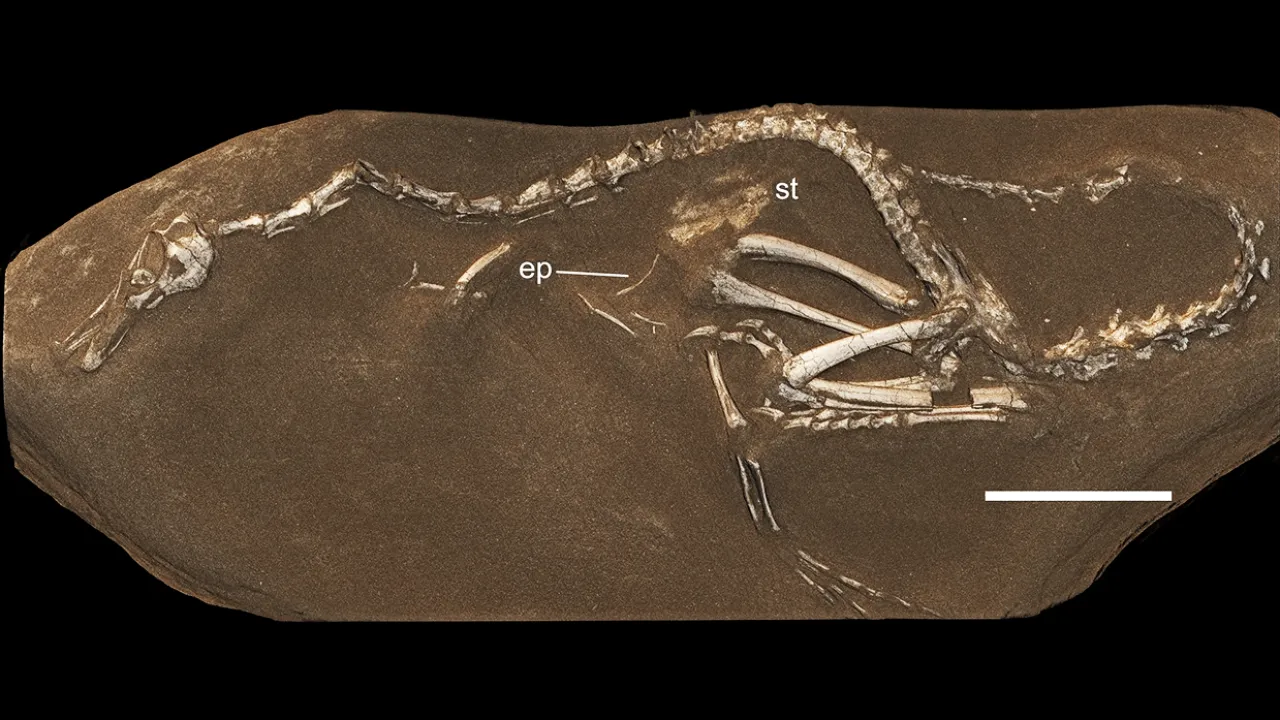
Imagine finding a fossil in Mongolia with a duck's flat snout, a swan's long neck, penguin-style flippers, and Velociraptor toe claws! When paleontologists first saw Halszkaraptor, it looked so unusual they wondered if someone had glued different fossils together.
2
X-Ray Proof
Scientists took the orange block to a powerful X-ray in France. Peeking right inside the solid rock without breaking a single bone, they proved the whole skeleton belonged to one amazing animal!
3
Built for Land and Water
Living beside desert streams seventy-two million years ago, Halszkaraptor ran on two long legs ashore and paddled smoothly after fish.
1. How did scientists prove Halszkaraptor's unusual fossil was completely genuine?
2. Who was Halszkaraptor named after?
🤯 Mind-Blowing Fact • Grade 3
Inside Halszkaraptor's snout, synchrotron scans uncovered tiny sensory chambers that helped it feel the ripple of a swimming fish in murky water!
✨ Word Sparks (Grade 3 Glossary)
Tap 🔊 to hear
Vibration
Tiny rapid movement felt through water or air
Proportionally
Compared in size to the whole body
Piscivore
Animal whose diet consists mostly of fish
🪝
How did a close cousin of Velociraptor trade dry desert chases for fishing in oasis rivers?
1
An Oasis Surprise
Picture the red sand dunes of Mongolia's Gobi region seventy-two million years ago. Winding rivers and cool lakes cut right across the dry landscape. Wading into the shallows comes Halszkaraptor escuilliei, a two-foot feathered raptor adapted for life both on shore and in water!
2
Sensory Snout and Swan Neck
Halszkaraptor's neck stretched half the length of its entire body—longer than any other raptor's! Inside its flattened snout, X-ray scans revealed branching nerve tunnels just like those crocodiles use to feel tiny water from hidden fish.
3
Flippers Meets Sickle Claws
Its flattened forearm and hand bones formed stiff paddles similar to penguins and merganser ducks. Yet on land, its shifted hip joints and upright posture allowed it to walk comfortably on two legs, complete with curved raptor claws on its second toes.
4
Rescued for Science
Poachers originally dug up the fossil illegally, until fossil dealer François Escuillié recognized its importance in 2015 and arranged its safe return to Mongolian scientists.
1. What hidden feature inside Halszkaraptor's snout worked like a crocodile's underwater sensor?
2. Why does the species name escuilliei honor François Escuillié?
🤯 Mind-Blowing Fact • Grade 4
Scientists scanned Halszkaraptor with synchrotron X-rays 100 billion times brighter than hospital X-rays, mapping teeth and nerve canals hidden deep inside solid rock!
✨ Word Sparks (Grade 4 Glossary)
Tap 🔊 to hear
Semiaquatic
Spending time living in water and ashore
Synchrotron
Ring machine creating ultra-bright X-ray beams
Cervical
Relating to the vertebrae of the neck
🪝
How did synchrotron particle-accelerator scans unlock an amphibious branch of the raptor family tree?
1
Rethinking What Dinosaurs Could Do
For over a century, paleontologists viewed non-avian dinosaurs almost exclusively as land dwellers, aside from giant spinosaurids wading along riverbanks. Then in 2017, Andrea Cau and an international team unveiled Halszkaraptor escuilliei from the 75-to-71-million-year-old Djadochta Formation at Ukhaa Tolgod, Mongolia—revealing a mallard-sized dromaeosaurid built for hunting.
2
Anatomy of a Reptilian Waterfowl
Measuring roughly 60 centimeters (2 feet) long and weighing around 1.5 kilograms, Halszkaraptor blended traits from surprisingly different animals. Ten elongated vertebrae formed a flexible S-curved neck accounting for 50 percent of its snout-to-hip length. By keeping its body still and snapping its long neck sideways or forward, it ambushed fast darting fish and aquatic invertebrates.
3
Forelimb Paddles and Upright Balance
Because its long neck shifted its center of mass forward, Halszkaraptor's hip socket angled upward so it stood upright like a duck when walking ashore. Meanwhile, flattened ulna and outer hand bones closely matched wing-propelled diving birds, letting its feathered forelimbs steer and stroke underwater.
4
Inside the Synchrotron Beam
To verify that the extraordinary skeleton was not a composite fake, researchers scanned it for over a hundred hours at the European Radiation Facility in Grenoble, France. Micron-scale 3D images traced unbroken bones deep inside the sandstone, revealing packed premaxillary needle teeth and crocodile-like neurovascular snout canals.
1. Why did Halszkaraptor stand with a more upright, duck-like posture on land than typical raptors?
2. How did Halszkaraptor's long S-curved neck help it catch slippery aquatic prey?
🤯 Mind-Blowing Fact • Grade 5
Most meat-eating theropods have only four teeth in each premaxilla bone at the tip of the upper jaw, whereas Halszkaraptor packed eleven slender fish-gripping teeth into each side!
✨ Word Sparks (Grade 5 Glossary)
Tap 🔊 to hear
Convergent
Unrelated species evolving similar body traits independently
Repatriated
Returned safely to its rightful home country
Microtomography
Ultra-detailed 3D imaging using X-ray slices
🪝
What happens when paleontologists test a semiaquatic dinosaur hypothesis with 3D synchrotron tomography and comparative biomechanics?
1
Wetlands Amid the Cretaceous Dunes
Although Mongolia's Campanian Djadochta Formation (~75 to 71 million years ago) is famed for windblown eolian sand dunes that buried Velociraptor and Protoceratops, ancient alluvial fans and seasonal oasis lakes threaded right through the arid basin. Patrolling those freshwater margins was Halszkaraptor escuilliei, eponymous member of the subfamily Halszkaraptorinae—a clade of basal dromaeosaurids including Mahakala and Hulsanpes that diverged dramatically from classic terrestrial raptors.
2
Synchrotron Microtomography Against Forgery
Illicitly excavated from Ukhaa Tolgod before being to the Mongolian Academy of Sciences, the holotype posed an immediate scientific challenge: its mosaic of traits—platyrostral snout, hyper-elongated neck, paddle-like forelimbs, and sickle-clawed feet—initially resembled an artificial chimaera. Researchers led by Andrea Cau subjected the slab to propagation phase-contrast synchrotron at the ESRF in Grenoble, resolving structures at four-micron resolution and proving anatomical continuity between exposed and buried elements.
3
Convergent Evolution with Diving Birds and Crocodilians
Internal scans revealed remarkable adaptations. Each premaxilla housed eleven closely packed, weakly serrated teeth—more than twice the typical theropod count of four—forming a fish-snaring basket. Running through the flattened snout was a complex neurovascular plexus comparable to pressure-sensitive mechanoreceptors in crocodylians and probing shorebirds.
4
Debating Forelimb Propulsion and Ecology
Halszkaraptor's flattened radius, ulna, and third metacarpal mirror proportions seen in wing-propelled divers like penguins and sawbill ducks. While subsequent biomechanical reviews in 2022 debated whether Halszkaraptor dove fully underwater or hunted primarily by wading like a heron, all studies agree its anatomy represents an extraordinary ecological experiment among paravian dinosaurs.
5
Ethical Science and Fossil Repatriation
Beyond reshaping dinosaur ecology, Halszkaraptor set a milestone for paleontological ethics: ensuring poached specimens return permanently to Ulaanbaatar so Mongolian and global researchers can study them openly.