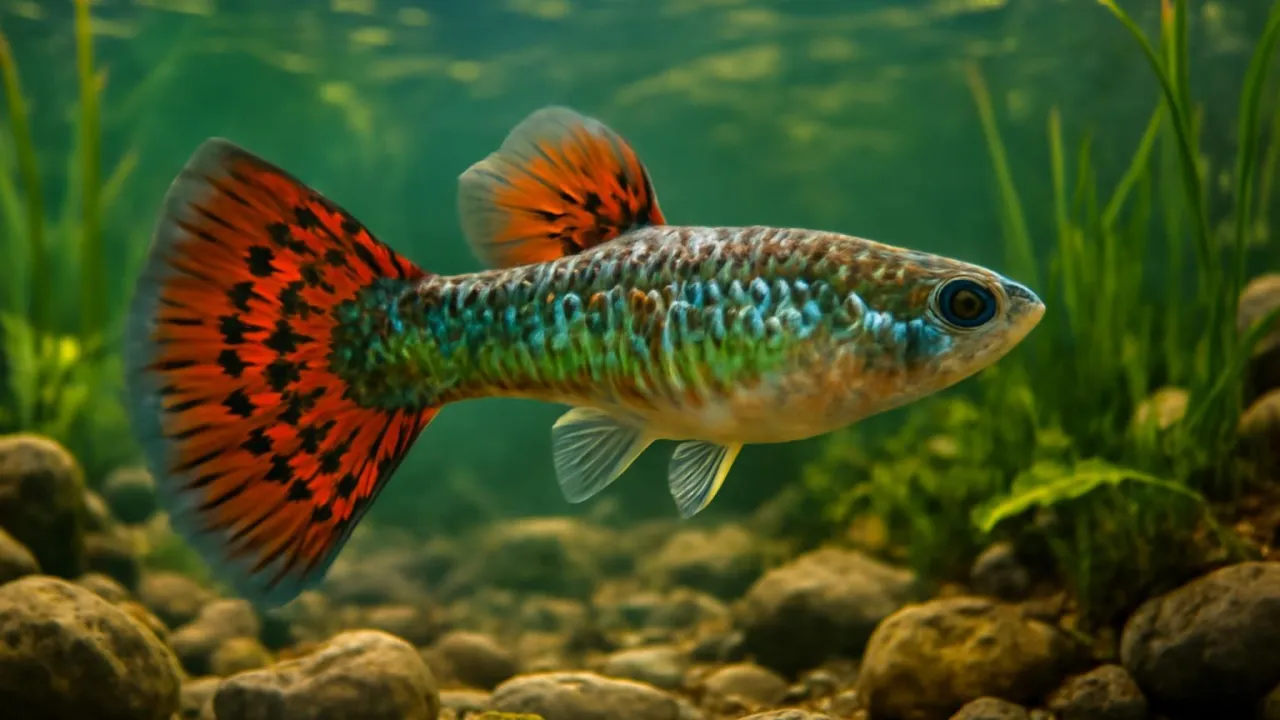
Male guppies flash bright colors to attract females and avoid predators!
✨ Word Sparks (Grade 2 Glossary)
Tap 🔊 to hear
predators
Animals that hunt other animals to eat
algae
Tiny green plants that grow in water
crustaceans
Small water animals with shells, like tiny crabs
🪝
Have you ever seen a tiny fish that glows with many colors?
1
Colorful Fish Friends
Guppies are small fish that live in warm, fresh water rivers and streams. They have bright colors that help them find mates and scare away danger. Male guppies are usually more colorful than females. Their shiny scales sparkle in the sunlight.
2
Where Guppies Live
These fish like to swim in slow-moving water with lots of plants. The plants give guppies places to hide from . Guppies come from South America, but people keep them in fish tanks all over the world. They can live in many warm places.
3
What Guppies Eat
Guppies eat small insects, , and tiny water animals called . They use their small mouths to catch food floating in the water. Guppies need clean water to stay healthy and grow. Their diet helps them stay strong and colorful.
Guppies are livebearers, giving birth to tiny swimming babies instead of laying eggs!
✨ Word Sparks (Grade 3 Glossary)
Tap 🔊 to hear
camouflage
Colors or shapes that help animals hide
larvae
Baby insects that live in water
livebearers
Animals that give birth to live babies
🪝
How do tiny guppies use color and speed to survive in the wild?
1
Guppy Colors and Camouflage
Guppies have bright colors that help them attract mates during breeding season. Their colorful scales also provide among plants to hide from predators. This adaptation helps them survive in their natural habitat. Males are usually more colorful than females.
2
Habitat and Ecosystem Role
Guppies live in freshwater streams and rivers in South America, where water flows slowly. They use plants and rocks for shelter from predators like larger fish. Guppies help control insect populations by eating and small insects. They are an important part of the food web.
3
Diet and Nutrition
Guppies eat algae, tiny crustaceans, and insect to get nutrients for growth. Their small mouths allow them to pick food particles from plants and water surfaces. Eating a varied diet helps guppies stay healthy and reproduce successfully. They also help keep their environment clean.
4
Reproduction and Growth
Guppies give birth to live young instead of laying eggs, which is unusual for many fish. Females can store sperm to fertilize multiple batches of babies. Fry grow quickly and hide among plants to avoid predators. This reproductive strategy helps guppies maintain their populations.
Guppies help control mosquitoes by eating their larvae, protecting humans from disease!
✨ Word Sparks (Grade 4 Glossary)
Tap 🔊 to hear
natural selection
How animals change to survive better
biodiversity
Many different kinds of living things
invasive species
Animals or plants that harm new habitats
🪝
Why do guppies’ colors and behaviors play key roles in their survival and ecosystem?
1
Color Patterns and Survival
Guppies display a wide range of color patterns that vary depending on their environment and predators. Bright colors attract mates but can also increase risk from predators, so guppies balance these traits carefully. This cause-and-effect relationship influences in their populations. Their ability to adapt colors helps them survive in diverse habitats.
2
Ecosystem Roles and Food Web
Guppies serve as both predator and prey within freshwater ecosystems, eating insect larvae and algae while feeding larger fish. Their feeding habits help control insect populations, benefiting water quality and plant health. Guppies also provide food for birds and larger fish, making them a crucial link in the food web. Their presence supports in their habitats.
3
Geographic Distribution and Habitat
Native to northeastern South America, guppies have been introduced worldwide as aquarium pets and mosquito control agents. They thrive in warm, slow-moving freshwater streams with abundant vegetation. Human activities have spread guppies beyond their native range, sometimes impacting local ecosystems. Their adaptability allows them to survive in various freshwater environments.
4
Human Impact and Conservation
While guppies are common in the pet trade, habitat pollution and water quality decline threaten wild populations. Conservation efforts focus on maintaining clean freshwater habitats and controlling . Guppies’ role in mosquito control highlights their importance to human health. Protecting their ecosystems benefits many other aquatic species as well.
1. How do guppies help control mosquito populations?
2. What can threaten wild guppy populations?
🤯 Mind-Blowing Fact • Grade 5
Guppies are used worldwide to control mosquitoes, reducing disease spread in many countries!
✨ Word Sparks (Grade 5 Glossary)
Tap 🔊 to hear
sexual dimorphism
Males and females look different in size and color
chromatophores
Skin cells that create colors and patterns
gestation
Time a baby grows inside its mother
🪝
How do guppies’ biology and ecology reveal their importance in freshwater ecosystems worldwide?
1
Scientific Classification and Evolution
Guppies belong to the family Poeciliidae and genus Poecilia, with the scientific name Poecilia reticulata. They evolved in northeastern South America’s freshwater systems and have diversified into many color morphs. Their genetic variation allows rapid adaptation to environmental pressures such as predation and habitat changes. Guppies are model organisms for studying natural selection and sexual selection in evolutionary biology.
2
Physiological Adaptations and Behavior
Guppies possess specialized in their skin that produce vibrant colors used in mate attraction and camouflage. They exhibit , with males being smaller and more colorful than females. Guppies have a high reproductive rate, with females capable of storing sperm to fertilize multiple broods. Their quick swimming ability, reaching speeds up to 2.5 body lengths per second, helps them evade predators.
3
Reproductive Strategy and Life Cycle
Unlike many fish, guppies are livebearers that give birth to fully formed fry after about 21 to 30 days of . Females can store sperm from multiple males, allowing genetic diversity within broods. Fry grow rapidly, reaching maturity in 2 to 3 months, which supports population resilience. This reproductive strategy is advantageous in fluctuating environments with high predation.
4
Conservation and Human Interaction
Guppies are widely used in mosquito control programs because they consume larvae of disease-carrying insects. However, their introduction outside native ranges can disrupt local ecosystems by competing with native species. Conservation efforts focus on protecting freshwater habitats from pollution and invasive species. The aquarium trade also raises awareness about guppy biodiversity and responsible pet ownership.
5
Quantitative Comparisons and Environmental Tolerance
Adult guppies typically measure between 1.5 and 2.5 inches (4 to 6 centimeters) in length and weigh less than 0.1 ounces (3 grams). They tolerate water temperatures from 72 to 82 degrees Fahrenheit (22 to 28 degrees Celsius) and prefer slightly acidic to neutral pH levels. Guppies can swim at speeds up to 2.5 body lengths per second, which is fast for their size. Their adaptability to diverse water conditions contributes to their global success.