Gregor Mendel
The Curious Monk Who Solved Plant Mysteries
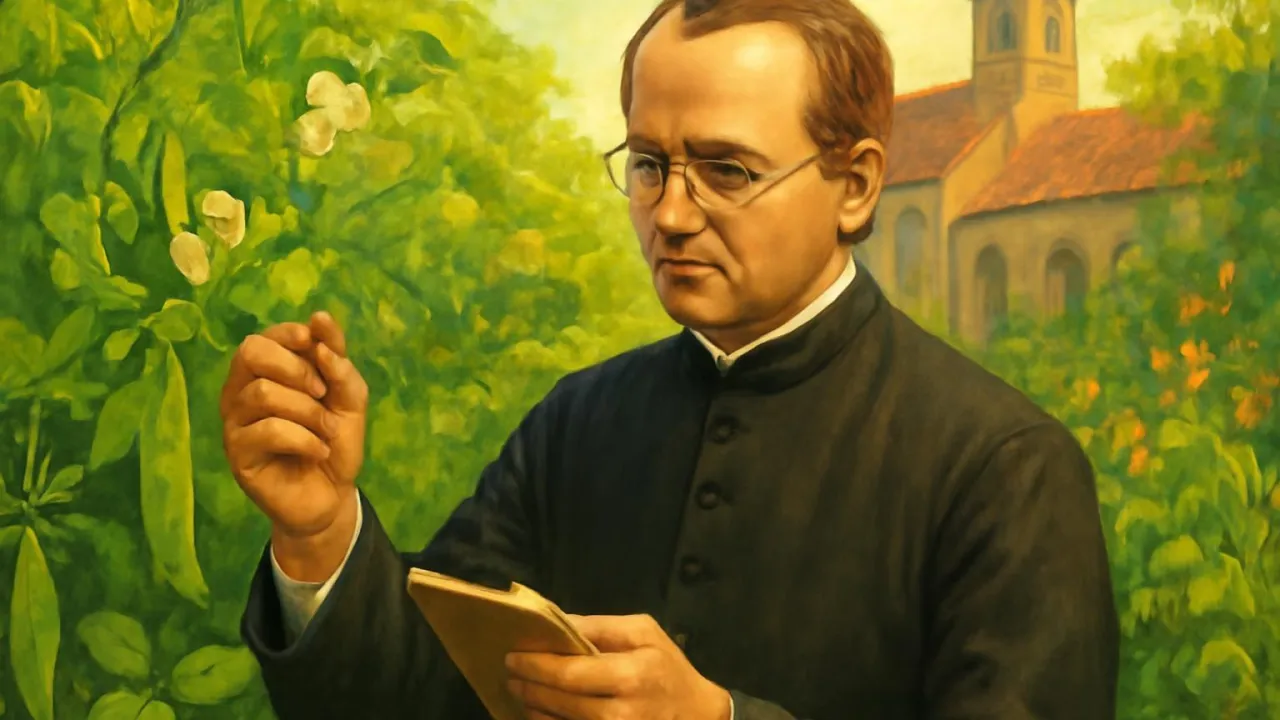
Mendel’s laws of inheritance help scientists solve mysteries in agriculture, medicine, and even crime labs today!
1 A Childhood of Wonder and Learning
Long before he became a scientist, young Gregor Mendel spent his days exploring the fields and gardens of his rural village. He was fascinated by the plants and insects he observed, always asking questions about why some flowers were purple while others were white. As he grew older, Mendel’s curiosity led him to study science and mathematics at the University of Vienna, where he learned to think deeply about patterns in nature. His education prepared him for a life of careful observation and experimentation. When Mendel joined the monastery in Brno, he finally found the peaceful garden where his greatest discoveries would begin.
2 Inventing the Science of Genetics
In the monastery garden, Mendel designed controlled experiments using pea plants with distinct traits, such as seed color, flower color, and pea shape. He cross-pollinated plants by hand, carefully transferring pollen from one flower to another, and kept meticulous records of every result. Over eight years, he grew and analyzed more than 28,000 pea plants, tracking how traits appeared in each new generation. Mendel noticed that some traits, like yellow peas, were dominant, while others, like green peas, were recessive and could disappear for a generation before reappearing. His mathematical approach allowed him to uncover the basic laws of heredity.
3 Publishing Discoveries and Facing Doubt
In 1866, Mendel published his findings in a scientific journal, describing what we now call the and the . These laws explained how traits are inherited independently and in predictable ratios, using what he called 'factors'—now known as genes. Unfortunately, most scientists of his time did not understand the significance of his work, and it was largely ignored for over thirty years. Mendel continued his research and became abbot of his monastery, but he never saw his discoveries recognized during his lifetime.
4 Rediscovery and Lasting Legacy
Around 1900, several scientists independently confirmed Mendel’s results, realizing that his experiments explained the hidden rules of heredity. Mendel’s principles became the foundation of modern genetics, influencing biology, medicine, agriculture, and even forensic science. His methods—careful observation, detailed record-keeping, and mathematical analysis—are still used by scientists today. The study of genes has led to breakthroughs like mapping the human genome and understanding inherited diseases. Mendel’s work showed that patient, thoughtful science can have a global impact, even if recognition comes much later.
5 Inspiration for Future Scientists
Gregor Mendel’s journey reminds us that great discoveries often begin with simple questions and careful observation. His legacy encourages young scientists to be curious, persistent, and precise in their work. By following patterns and testing ideas, Mendel unlocked secrets that changed how we understand life itself. Today, he is celebrated as the 'Father of Genetics,' and his story inspires people everywhere to keep asking questions about the world around them. Whether in a garden or a laboratory, Mendel’s spirit of discovery lives on.
1. How many years did Mendel spend studying pea plants?
2. Why are Mendel’s discoveries still important today?