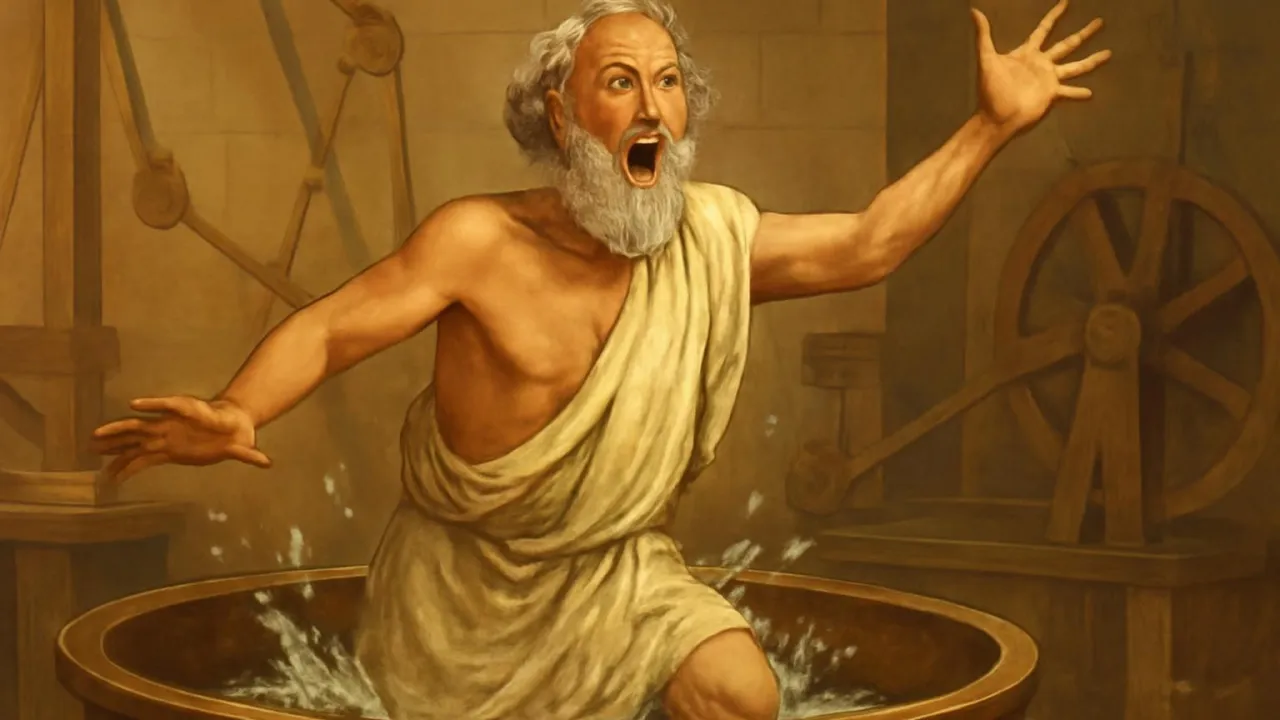
Archimedes invented a screw that lifts water to help farmers!
✨ Word Sparks (Grade 2 Glossary)
Tap 🔊 to hear
pulley
A wheel that helps lift things.
experiment
A test to learn something new.
crown
A shiny hat for a king or queen.
🪝
Have you ever wondered why things float or sink?
1
Curious About Water
Archimedes was curious about water in his bath. He noticed his body made the water rise. He wondered if this could help him solve problems. He liked to ask questions and test his ideas.
2
Inventing with Levers
He invented machines using levers and to lift heavy things. Archimedes showed people how a small force could move big objects. He worked hard and loved to with simple tools. His inventions helped many people in his city.
3
A Famous Discovery
One day, he realized how to tell if a was real gold. He shouted, “Eureka!” and ran to share his discovery. Archimedes became famous for his clever thinking. He showed how science could solve real problems.
Archimedes wrote important math books that scientists still study today!
✨ Word Sparks (Grade 3 Glossary)
Tap 🔊 to hear
buoyancy
Why things float or sink in water.
law of the lever
How levers help lift heavy things.
inventor
A person who creates new things.
🪝
Can you imagine inventing a tool that makes lifting heavy things easy?
1
The Boy Who Loved Questions
As a child, Archimedes was always asking questions about how things worked. He loved watching objects float or sink in the water and wondered why. His curiosity led him to study math and science in ancient Syracuse. He believed every problem had a clever solution.
2
The Power of Levers and Pulleys
Archimedes invented machines using levers and pulleys to move heavy objects. He explained that a lever could lift something much heavier than yourself. This idea, called the , changed how people built things. His inventions made work easier for builders and farmers.
3
Eureka! The Buoyancy Discovery
One day, while bathing, Archimedes realized how to test if a crown was pure gold. He noticed that his body pushed water out of the tub, showing the idea of . Excited, he ran through the streets shouting, “Eureka!” meaning, “I have found it!” His discovery helped solve a royal mystery.
4
Lasting Legacy
Archimedes’ ideas are still taught in science and engineering today. His inventions, like the Archimedes screw, help move water for farming. He showed that careful observation and experiments can lead to amazing discoveries. Archimedes inspired others to keep asking questions and searching for answers.
Archimedes’ principle of buoyancy is still used to design ships and submarines today!
✨ Word Sparks (Grade 4 Glossary)
Tap 🔊 to hear
displace
To push something out of the way.
principle
A basic rule or idea in science.
engineer
A person who designs and builds things.
🪝
What would you shout if you solved a centuries-old science puzzle?
1
A Curious Mind in Ancient Syracuse
Growing up in the bustling city of Syracuse, Archimedes was fascinated by numbers, shapes, and the mysteries of the natural world. He would spend hours experimenting with objects in water, noticing how some floated while others sank. His deep curiosity led him to study in Alexandria, Egypt, where he learned from the greatest mathematicians of his time. This early education set the stage for his future as a legendary inventor and scientist.
2
The Law of the Lever and Ingenious Machines
Archimedes developed the law of the lever, explaining how a long stick could lift a heavy weight with little effort. He designed clever machines like pulleys and the Archimedes screw, which helped move water uphill for farming. These inventions were revolutionary for builders and in ancient Greece. His ideas about force and balance are still used in modern science and engineering.
3
The Eureka Moment and Buoyancy Principle
The famous Eureka story began when Archimedes was asked to check if a king’s crown was pure gold. While taking a bath, he noticed the water level rise as he got in, leading him to discover the of buoyancy. He realized that objects their own weight in water, which could reveal if the crown was fake. Archimedes’ joyful shout of 'Eureka!' became a symbol of sudden scientific discovery.
4
A Legacy That Changed the World
Archimedes’ writings on mathematics, physics, and engineering became the foundation for later scientists. His inventions improved daily life in ancient times and inspired future generations to explore science. Even today, and mathematicians study his work to solve modern problems. Archimedes’ legacy reminds us that curiosity and careful observation can change the world.
Archimedes calculated pi more accurately than anyone before him, using a 96-sided polygon!
✨ Word Sparks (Grade 5 Glossary)
Tap 🔊 to hear
mechanical advantage
Making work easier using tools or machines.
treatise
A long, important writing about science or math.
irrigation
Moving water to help plants grow.
🪝
How did an ancient thinker’s bathtub discovery change science forever?
1
A Young Mind Drawn to Discovery
In the ancient Greek city of Syracuse, Archimedes was captivated by the world’s mysteries from an early age. He spent his childhood experimenting with objects in water, observing how they floated or sank, and sketching shapes in the sand. His father, an astronomer, encouraged his curiosity, which led Archimedes to study advanced mathematics and science in Alexandria, the greatest learning center of the ancient world. This foundation shaped his unique approach to solving the puzzles of nature.
2
Inventing the Law of the Lever and Simple Machines
Archimedes’ fascination with mechanics led him to formulate the law of the lever, stating that a small force, applied at the right distance, could move enormous weights. He famously declared, 'Give me a place to stand, and I will move the Earth.' Archimedes invented compound pulleys and the Archimedes screw, a spiral device for raising water, which revolutionized farming and engineering. His understanding of force, balance, and remains central to physics and engineering today.
3
The Eureka Principle: Buoyancy and Scientific Method
The legendary 'Eureka!' moment occurred when Archimedes was tasked with determining whether a gold crown had been secretly mixed with silver. While lowering himself into a bath, he noticed the water level rise, realizing that the volume of water displaced equaled the volume of his body. This insight led to the principle of buoyancy, which states that an object immersed in fluid is buoyed up by a force equal to the weight of the fluid displaced. Archimedes’ experiment became a classic example of scientific observation and reasoning.
4
Mathematical Mastery and Lasting Scientific Legacy
Archimedes wrote groundbreaking on geometry, calculating the value of pi and the area of circles with remarkable precision. He invented methods for finding the volume of irregular objects and laid the groundwork for calculus nearly two thousand years before it was formally developed. His writings, preserved by scholars in the Middle East and Europe, influenced mathematicians and physicists for centuries, shaping the scientific revolution.
5
Inspiration Across the Ages
Archimedes’ blend of curiosity, creativity, and rigorous experimentation changed how people understood the physical world. His principles of levers and buoyancy are still taught in classrooms and used in engineering today. The Archimedes screw continues to move water in modern systems, and his mathematical discoveries remain foundational in science. Archimedes inspires us to question, observe, and imagine new solutions—reminding every young scientist that a single moment of insight can echo through history.