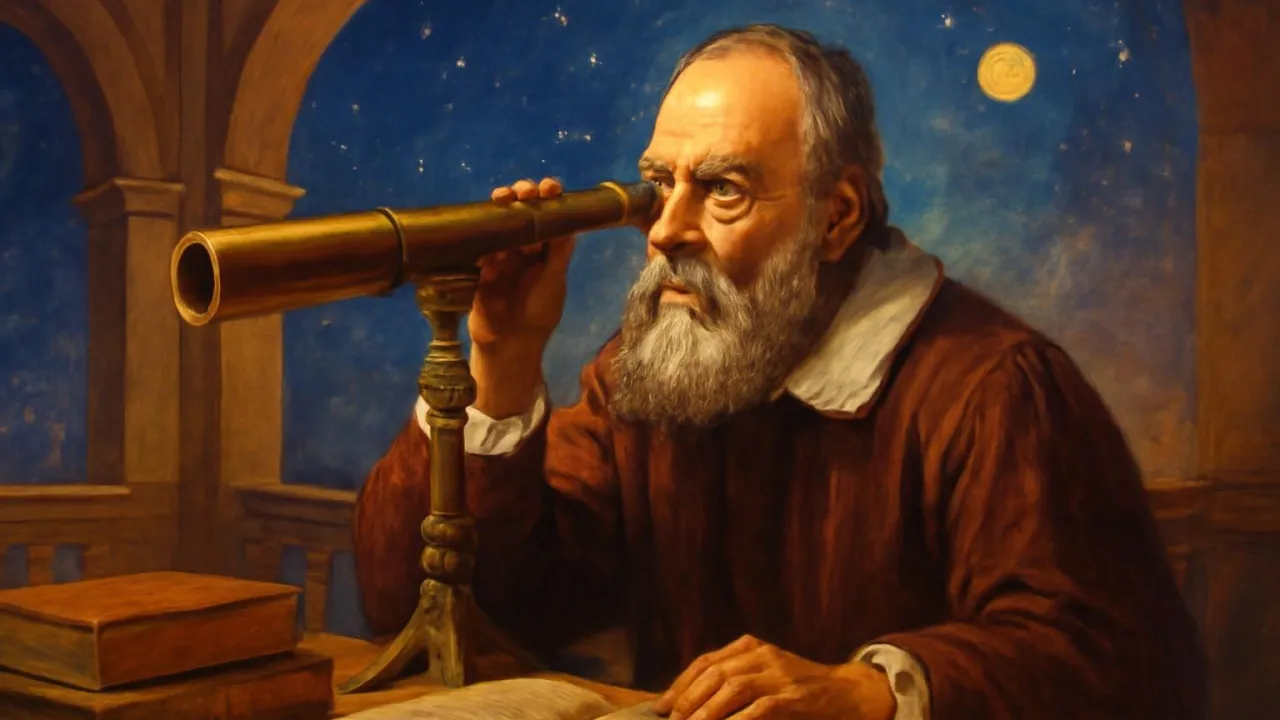
Galileo’s telescope could make faraway stars look much closer.
✨ Word Sparks (Grade 2 Glossary)
Tap 🔊 to hear
lens
A clear piece that helps you see
planet
A big round object in space
discover
To find something new
🪝
Have you ever wondered what secrets the night sky is hiding?
1
Curious About the Sky
Galileo was a curious boy who loved to watch the stars. He asked questions about the moon and the . He wanted to know how things moved in the sky.
2
Building and Testing
Galileo worked hard to build a better telescope. He spent many nights testing it and looking at the stars. He was amazed by what he saw through the .
3
A Discovery That Changed Everything
One night, Galileo discovered four moons circling Jupiter. He wrote about his discovery and shared it with others. People started to see the universe in a new way.
Galileo’s telescope was only about as long as your arm, but it changed science forever.
✨ Word Sparks (Grade 3 Glossary)
Tap 🔊 to hear
orbit
To travel around something in space
crater
A big hole on a planet or moon
evidence
Clues that help prove something is true
🪝
Imagine peering through a long tube and spotting moons no one else has ever seen—what would you do?
1
A Boy With Big Questions
Young Galileo was fascinated by the way things moved and fell. He loved to watch the stars and wondered why the moon changed shapes. He often asked questions that no one could answer. His curiosity made him want to learn more about the universe.
2
Inventing and Improving
Galileo heard about a new tool called a telescope. He worked hard to make his own, using special lenses and careful hands. His telescope could make things in the sky look much closer. Galileo’s invention helped him see what others could not.
3
Discoveries in the Night Sky
Through his telescope, Galileo discovered four moons orbiting Jupiter. He also saw mountains and on the moon’s surface. These discoveries challenged old ideas about space. Galileo wrote books to share what he found with the world.
4
Changing How People Think
Many people were surprised by Galileo’s discoveries and did not believe him at first. He used and careful observation to prove his ideas. Galileo’s work changed how scientists studied the sky. Today, he is remembered as the father of modern science.
Galileo’s discoveries helped prove that Earth moves around the sun, not the other way around.
✨ Word Sparks (Grade 4 Glossary)
Tap 🔊 to hear
pendulum
A swinging weight used to study motion
phases
The different shapes of the moon we see
scientific method
A way to test and prove ideas
🪝
What if a simple homemade telescope could reveal secrets that would change our understanding of the universe forever?
1
Curiosity in the Renaissance
During the Renaissance, Galileo’s fascination with the sky set him apart from others who simply accepted old ideas. He questioned why objects fell at different speeds and how planets moved across the night sky. Galileo’s determination to seek answers led him to experiment with and falling objects. His early curiosity laid the foundation for his future scientific breakthroughs.
2
Building a Better Telescope
When Galileo heard about the telescope invented in the Netherlands, he set out to build his own improved version. He carefully shaped and polished glass lenses, making a telescope much stronger than any before. With his invention, Galileo could see the craters on the moon and the of Venus. His observations challenged the old belief that everything in the sky was perfect and unchanging.
3
Revealing New Worlds
Galileo’s most famous discovery came when he spotted four moons orbiting Jupiter, proving that not everything revolved around Earth. He also observed sunspots and wrote detailed notes about his findings. These discoveries provided strong evidence for the idea that the planets move around the sun. Galileo’s work inspired other scientists to question and test old ideas using experiments and observation.
4
A Legacy of Scientific Courage
Although some people resisted Galileo’s discoveries, he bravely defended his evidence and ideas. His —careful observation, experimentation, and logical reasoning—became the foundation of modern science. Today, Galileo is celebrated as a pioneer who changed our view of the universe. His courage and curiosity continue to inspire scientists around the world.
1. What did Galileo use to make his telescope stronger?
2. Why was Galileo’s discovery of Jupiter’s moons important?
🤯 Mind-Blowing Fact • Grade 5
Galileo’s careful observations helped prove that Earth orbits the sun, changing science forever.
✨ Word Sparks (Grade 5 Glossary)
Tap 🔊 to hear
heliocentric
The idea that planets orbit the sun
magnification
How much bigger something looks through a lens
hypothesis
A smart guess you can test with experiments
🪝
How did a curious thinker with a homemade telescope spark a revolution that changed how humanity sees the universe?
1
A Childhood Fueled by Questions
Galileo Galilei’s fascination with nature began as a child in Pisa, Italy, where he observed swinging lamps and wondered about their motion. His early experiments with pendulums led him to question why objects of different weights fell at the same speed, challenging the accepted ideas of his time. Galileo’s relentless curiosity drove him to study mathematics and physics, setting him on a path toward groundbreaking discoveries. He believed that careful observation and experimentation could reveal the true workings of nature. This mindset became the foundation for his future scientific achievements. Galileo’s early life shows how asking questions can lead to remarkable discoveries.
2
Inventing and Innovating in the Renaissance
During the Renaissance, Galileo learned about a Dutch invention called the telescope and immediately sought to improve it. He crafted lenses with greater , creating a telescope that could make distant objects appear up to thirty times closer. With this powerful tool, Galileo observed mountains and craters on the moon, the phases of Venus, and countless stars invisible to the naked eye. His discoveries contradicted the ancient belief that celestial bodies were perfect and unchanging. By documenting his findings with detailed sketches and notes, Galileo set new standards for scientific observation. His innovations in optics and astronomy paved the way for future scientists.
3
Revolutionizing Our View of the Cosmos
Galileo’s most famous achievement was his discovery of four moons orbiting Jupiter, which he named the Medicean Stars. This finding provided strong evidence that not everything in the universe revolved around Earth, supporting the theory proposed by Copernicus. Galileo also observed sunspots and the changing brightness of Saturn, further challenging traditional ideas. His willingness to publish his results, even when they went against powerful authorities, demonstrated his commitment to scientific truth. Galileo’s discoveries marked a turning point in astronomy and inspired generations of scientists to question old beliefs. His work helped shift humanity’s understanding of our place in the cosmos.
4
Facing Opposition and Defending Science
Galileo’s revolutionary ideas were not always welcomed by the leaders of his time, who believed the Earth was the center of the universe. Despite facing criticism and even trial, Galileo courageously defended his evidence and continued to teach his findings. He used the scientific method—combining observation, , and experimentation—to prove his claims. Galileo’s insistence on using facts over tradition became a model for modern science. Although he spent his later years under house arrest, his writings and discoveries continued to influence scientists across Europe. Galileo’s bravery in the face of opposition made him a symbol of intellectual freedom.
5
A Lasting Legacy of Curiosity and Courage
Galileo Galilei is remembered as the father of modern science, whose work changed the way people study the universe. His improvements to the telescope, discoveries of celestial bodies, and use of the scientific method set new standards for research and critical thinking. Today, spacecraft and astronomers continue to build on Galileo’s legacy, exploring the solar system with powerful telescopes and advanced technology. His story teaches us the importance of curiosity, perseverance, and standing up for the truth, even when it is difficult. Galileo’s impact on science and human knowledge remains one of the most important in history. His courage and discoveries continue to inspire students and scientists around the world.