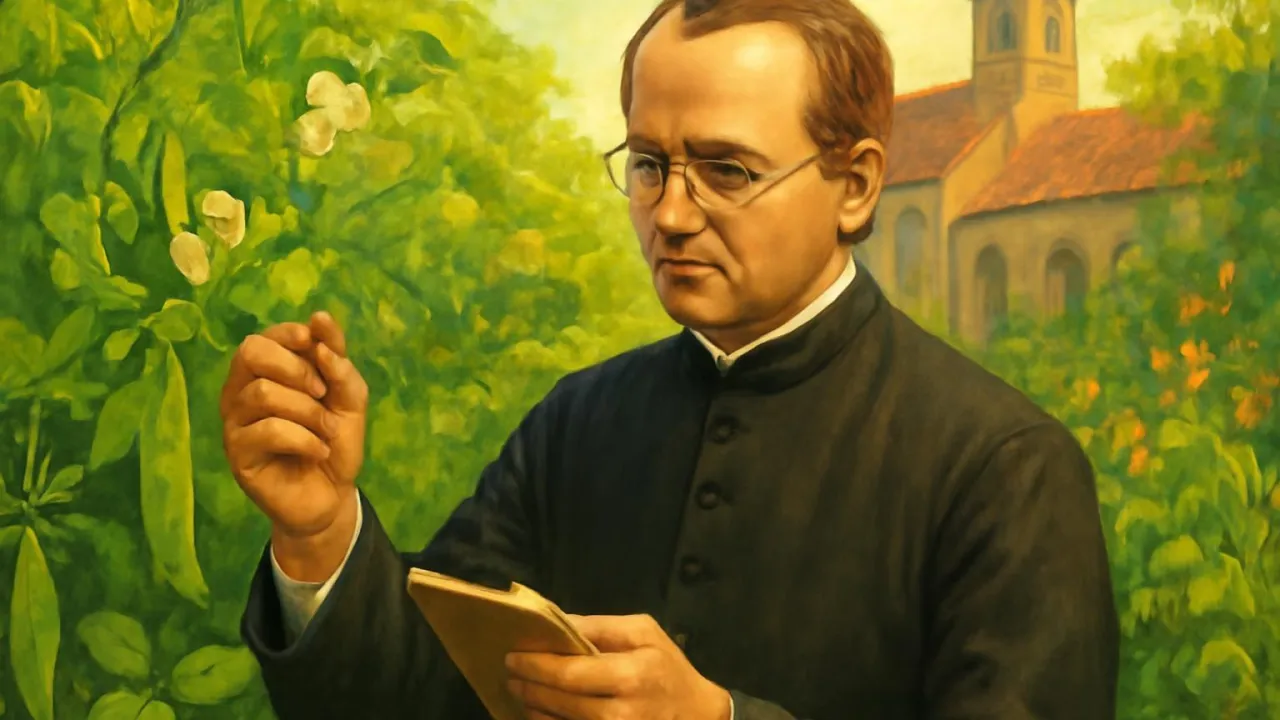
Mendel’s pea plant experiments took him over 8 years to finish!
✨ Word Sparks (Grade 2 Glossary)
Tap 🔊 to hear
trait
A special feature, like color or size
genetics
The science of how traits are passed
monk
A man who lives and works in a monastery
🪝
Have you ever wondered why plants look different?
1
Watching the Peas
Gregor spent hours in the garden, watching his pea plants grow tall and strong. He noticed that some plants had yellow peas, but others had green peas. Gregor was curious about why this happened.
2
Testing His Ideas
He carefully planted different seeds and wrote notes about each plant. Gregor mixed seeds to see what would happen, and he repeated his experiments many times. He wanted to find out the rules behind plant colors.
3
A Big Discovery
After years of hard work, Gregor found patterns in how plants changed. He learned that plants pass to their children, like color or shape. Gregor’s discovery helped start the science of .
Gregor Mendel’s pea plant data filled over 300 pages in his notebook!
✨ Word Sparks (Grade 3 Glossary)
Tap 🔊 to hear
heredity
How traits pass from parent to child
cross-pollinate
Mixing pollen from two different plants
gene
A tiny part that carries a trait
🪝
Why do some plants have round peas while others have wrinkled ones?
1
A Curious Mind in the Monastery
Young Gregor Mendel loved exploring the gardens at his monastery, always asking questions about nature. He wondered why some pea plants had purple flowers while others were white. His curiosity led him to start careful experiments with his plants. Gregor believed that hidden rules might explain these differences.
2
Careful Experiments with Pea Plants
Mendel planted thousands of pea plants, choosing ones with different traits like color and shape. He cross-pollinated the plants and kept detailed notes in his journal. Each season, he counted the number of plants with each trait. These careful records helped him spot important patterns.
3
Discovering the Rules of Heredity
Gregor noticed that certain traits showed up in predictable ways from one generation to the next. He called these hidden factors 'elements,' which we now call . His work showed that traits are passed from parents to children in set patterns.
4
Changing Science Forever
Although few people noticed his work at first, Mendel’s discoveries became the foundation for modern genetics. Scientists later used his experiments to understand how all living things inherit traits. Today, we remember Gregor Mendel as the 'Father of Genetics.'
1. What did Mendel call the hidden factors he discovered?
2. Why is Mendel called the 'Father of Genetics'?
🤯 Mind-Blowing Fact • Grade 4
Mendel’s work was ignored for over 30 years before scientists realized its importance!
✨ Word Sparks (Grade 4 Glossary)
Tap 🔊 to hear
dominant
A trait that shows up most often
recessive
A trait that can hide in a generation
generation
All the people or plants born at the same time
🪝
How did a quiet monk unlock the code of how living things inherit traits?
1
A Life of Curiosity and Care
In a peaceful monastery garden, Gregor Mendel spent years observing the smallest details of his pea plants. He noticed that some plants produced smooth, yellow peas while others had wrinkled, green ones, and he wondered why these differences appeared. Mendel’s early interest in nature and mathematics helped him design careful experiments. His patient, thoughtful approach set him apart from other scientists of his time.
2
Designing Groundbreaking Experiments
Mendel chose pea plants because they grew quickly and had clear, easy-to-see traits. He cross-pollinated plants with different characteristics and tracked the results over several , keeping precise notes. By counting hundreds of plants, Mendel noticed that certain traits followed mathematical patterns. This methodical approach allowed him to discover the basic rules of heredity.
3
Revealing the Laws of Genetics
Gregor Mendel realized that traits are passed down in predictable ways, which he described as and . He published his findings in 1866, but few people understood how important they were at the time. Decades later, scientists rediscovered Mendel’s work and recognized its huge impact on biology. His experiments became the foundation for the science of genetics.
4
A Legacy That Changed Science
Today, Mendel’s laws help us understand everything from plant breeding to human heredity. His discoveries have shaped medicine, agriculture, and our knowledge of how life works. Gregor Mendel’s careful experiments and love of patterns continue to inspire scientists around the world. He proved that even quiet, patient work can change the world forever.
1. Why did Mendel use pea plants for his experiments?
2. What happened to Mendel’s work after he published it?
🤯 Mind-Blowing Fact • Grade 5
Mendel’s laws of inheritance help scientists solve mysteries in agriculture, medicine, and even crime labs today!
✨ Word Sparks (Grade 5 Glossary)
Tap 🔊 to hear
Law of Segregation
How traits separate when passed on
Law of Independent Assortment
Traits are passed in different combinations
factor (gene)
A tiny instruction that controls a trait
🪝
Imagine discovering the invisible rules that decide how every living thing looks and grows—how would you even begin?
1
A Childhood of Wonder and Learning
Long before he became a scientist, young Gregor Mendel spent his days exploring the fields and gardens of his rural village. He was fascinated by the plants and insects he observed, always asking questions about why some flowers were purple while others were white. As he grew older, Mendel’s curiosity led him to study science and mathematics at the University of Vienna, where he learned to think deeply about patterns in nature. His education prepared him for a life of careful observation and experimentation. When Mendel joined the monastery in Brno, he finally found the peaceful garden where his greatest discoveries would begin.
2
Inventing the Science of Genetics
In the monastery garden, Mendel designed controlled experiments using pea plants with distinct traits, such as seed color, flower color, and pea shape. He cross-pollinated plants by hand, carefully transferring pollen from one flower to another, and kept meticulous records of every result. Over eight years, he grew and analyzed more than 28,000 pea plants, tracking how traits appeared in each new generation. Mendel noticed that some traits, like yellow peas, were dominant, while others, like green peas, were recessive and could disappear for a generation before reappearing. His mathematical approach allowed him to uncover the basic laws of heredity.
3
Publishing Discoveries and Facing Doubt
In 1866, Mendel published his findings in a scientific journal, describing what we now call the and the . These laws explained how traits are inherited independently and in predictable ratios, using what he called 'factors'—now known as genes. Unfortunately, most scientists of his time did not understand the significance of his work, and it was largely ignored for over thirty years. Mendel continued his research and became abbot of his monastery, but he never saw his discoveries recognized during his lifetime.
4
Rediscovery and Lasting Legacy
Around 1900, several scientists independently confirmed Mendel’s results, realizing that his experiments explained the hidden rules of heredity. Mendel’s principles became the foundation of modern genetics, influencing biology, medicine, agriculture, and even forensic science. His methods—careful observation, detailed record-keeping, and mathematical analysis—are still used by scientists today. The study of genes has led to breakthroughs like mapping the human genome and understanding inherited diseases. Mendel’s work showed that patient, thoughtful science can have a global impact, even if recognition comes much later.
5
Inspiration for Future Scientists
Gregor Mendel’s journey reminds us that great discoveries often begin with simple questions and careful observation. His legacy encourages young scientists to be curious, persistent, and precise in their work. By following patterns and testing ideas, Mendel unlocked secrets that changed how we understand life itself. Today, he is celebrated as the 'Father of Genetics,' and his story inspires people everywhere to keep asking questions about the world around them. Whether in a garden or a laboratory, Mendel’s spirit of discovery lives on.