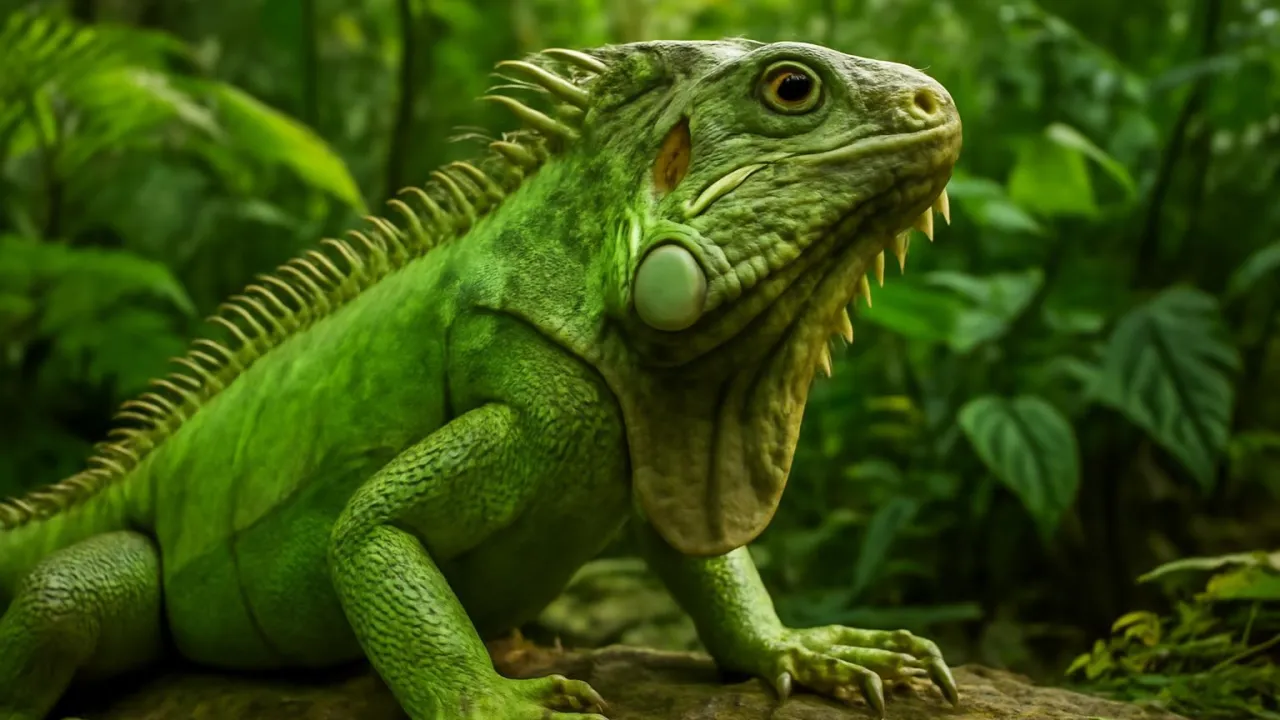
Green iguanas can drop their tails to escape from danger!
✨ Word Sparks (Grade 2 Glossary)
Tap 🔊 to hear
herbivore
An animal that only eats plants.
predator
An animal that hunts other animals.
canopy
The top layer of trees in a forest.
🪝
Have you ever seen a lizard climb a tall tree very fast?
1
Amazing Climber
Green iguanas are excellent climbers and can scale tall trees quickly. Their strong legs and sharp claws help them hold tight. They use their long tails for balance when climbing. This skill helps them escape from .
2
What They Eat
Green iguanas mostly eat leaves, flowers, and fruits from trees. They do not eat meat because they are . They need sunlight to help digest their food properly. Water is also important for their survival.
3
Where They Live
These iguanas live in tropical rainforests in Central and South America. They enjoy warm and humid places with lots of trees. They spend most of their time in the forest . This helps them stay safe from on the ground.
Green iguanas can regrow their tails if they lose them to escape danger!
✨ Word Sparks (Grade 3 Glossary)
Tap 🔊 to hear
camouflage
Colors that help animals hide in nature.
thermoregulation
How animals use heat to stay healthy.
adaptation
A body change that helps animals survive.
🪝
Did you know green iguanas use their tails to escape predators?
1
Climbing Experts
Green iguanas are expert climbers with sharp claws and strong legs. Their long tails help them balance while moving through trees. This allows them to escape predators quickly. They live mostly in the forest canopy where they find food and safety.
2
Plant Eaters
As herbivores, green iguanas eat leaves, flowers, and fruits from many plants. They use their sharp teeth to tear leaves into small pieces. Their diet provides nutrients needed to stay healthy and grow. Sunlight helps them digest food through a process called .
3
Staying Safe
Green iguanas use to blend into green leaves and avoid predators. When threatened, they can drop their tail to distract attackers. This tail will grow back over time. Their ability to stay still also helps them avoid being seen.
4
Where They Live
These iguanas live in tropical rainforests across Central and South America. They prefer humid, warm environments with dense tree cover. The forest canopy provides food and protection from ground predators. Their habitat is important to their survival.
Green iguanas use their dewlap to show other iguanas and control body heat!
✨ Word Sparks (Grade 4 Glossary)
Tap 🔊 to hear
ecosystem
All plants and animals living together in one place.
deforestation
Cutting down many trees in a forest.
dewlap
A skin flap under the throat used to communicate.
🪝
How do green iguanas use their dewlap to survive in the rainforest?
1
Tail and Climbing Skills
The green iguana’s long tail helps it balance while climbing tall trees in its rainforest home. When threatened by predators, it can drop its tail to distract them and escape safely. This tail will eventually regrow, showing an amazing cause-and-effect survival strategy. Their sharp claws and strong legs also allow them to move swiftly through the forest canopy.
2
Role in the Ecosystem
Green iguanas play an important role as herbivores by eating leaves, flowers, and fruits, which helps plants spread seeds and grow. They also serve as prey for larger predators, creating a balanced food web. Their presence supports forest health and biodiversity. Humans sometimes keep iguanas as pets, but habitat loss threatens their wild populations.
3
Habitat and Distribution
These iguanas are native to tropical rainforests in Central and South America, including countries like Brazil and Costa Rica. They prefer warm, humid climates with dense tree cover and plenty of sunlight. and urbanization reduce their natural habitats, affecting their survival. Conservation efforts focus on protecting these forests and their inhabitants.
4
Physical Adaptations
Green iguanas have sharp teeth to tear plant material and strong jaws for chewing tough leaves. Their skin color provides camouflage, blending with green leaves to avoid predators. Their , a flap of skin under the throat, helps with communication and temperature regulation. These adaptations make them well suited for life in the rainforest.
2. Why is habitat loss a problem for green iguanas?
🤯 Mind-Blowing Fact • Grade 5
Green iguanas can regenerate their tails after losing them to escape predators, a rare reptile ability!
✨ Word Sparks (Grade 5 Glossary)
Tap 🔊 to hear
autotomy
When an animal drops a body part to escape danger.
thermoregulation
How animals control their body temperature using sunlight.
herbivory
Eating only plants like leaves and fruits.
🪝
What makes the green iguana’s tail an extraordinary tool for survival in its environment?
1
Scientific Classification and Habitat
The green iguana, scientifically named Iguana iguana, belongs to the family Iguanidae and inhabits tropical rainforests across Central and South America. It thrives in humid, warm climates with dense tree canopies, which provide abundant food and shelter. Its distribution includes countries such as Brazil, Costa Rica, and Panama. Habitat loss due to deforestation poses significant threats to its populations.
2
Physiological Mechanics and Adaptations
This iguana’s long, muscular tail serves multiple functions, including balance during arboreal movement and defense through , where the tail detaches to distract predators. The tail can regenerate fully over several months. Its sharp, serrated teeth and strong jaw muscles enable efficient by tearing tough leaves and fruits. Additionally, the dewlap under its throat aids in and social signaling.
3
Ecological Role and Conservation
Green iguanas play a critical role as primary consumers in their ecosystems, facilitating seed dispersal and contributing to plant community dynamics. They are prey for birds of prey, snakes, and mammals, thus integral to food webs. Conservation efforts focus on habitat protection and regulating the pet trade, as illegal capture threatens wild populations. Awareness programs aim to reduce human impacts on their natural habitats.
4
Botanical and Behavioral Insights
Interestingly, green iguanas are strictly herbivorous, feeding mainly on leaves, flowers, and fruits, which supply essential nutrients and fiber. They rely on basking in sunlight to regulate body temperature and aid digestion, a process known as . Their ability to remain motionless and use camouflage helps avoid predation. Behavioral adaptations include territorial displays using their dewlap and body posture.
5
Quantitative Comparisons and Unique Traits
Adult green iguanas can reach lengths up to 6.5 feet (2 meters) and weigh between 8 to 17 pounds (3.5 to 7.7 kilograms). They can drop their tails to escape predators, a process called , with tail regeneration taking up to six months. Their climbing speed allows them to ascend trees rapidly, sometimes reaching speeds of 15 feet (4.5 meters) per second. These remarkable traits highlight their evolutionary success in rainforest environments.