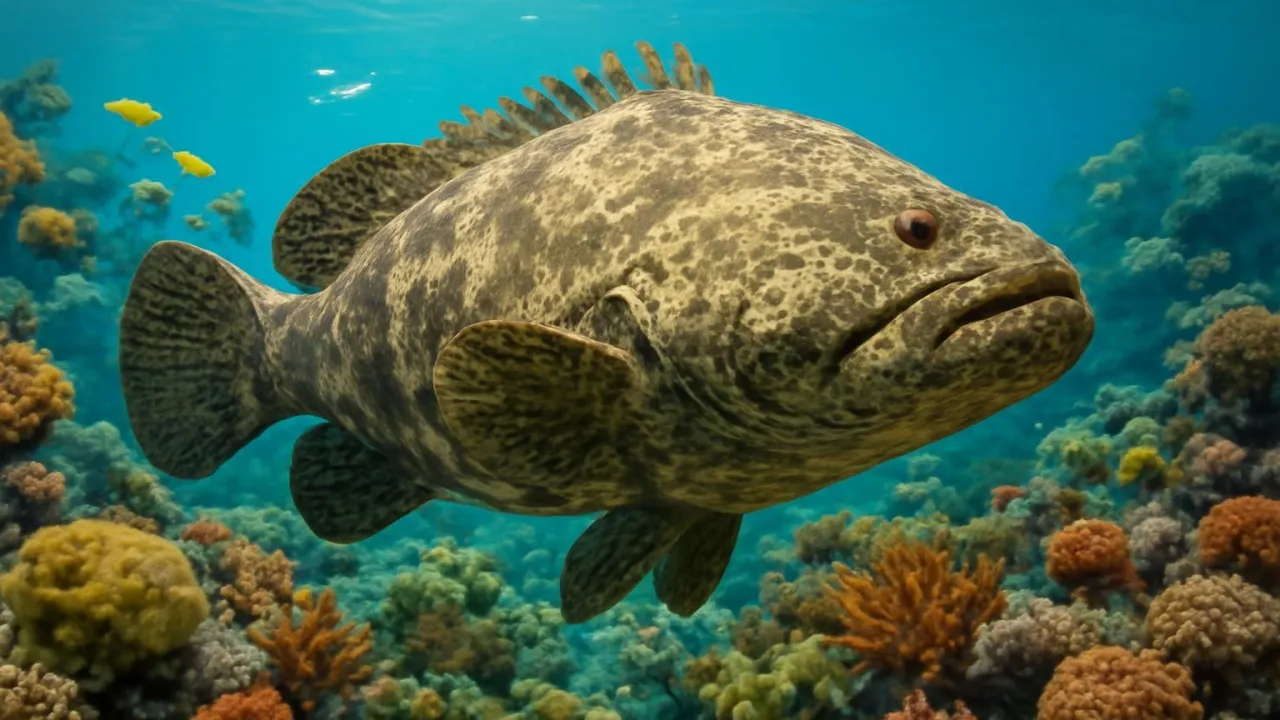
1. What does the goliath grouper use to catch food?
2. Where does the goliath grouper like to live?
🤯 Mind-Blowing Fact • Grade 2
Goliath groupers can weigh over 800 pounds, as heavy as a small car!
✨ Word Sparks (Grade 2 Glossary)
Tap 🔊 to hear
prey
Animals that other animals eat for food
coral reef
Underwater home made of tiny sea animals' skeletons
swallow
To take food into the mouth and down the throat
🪝
Have you ever seen a fish as big as a small car swimming underwater?
1
The Giant Fish
The goliath grouper can grow up to eight feet long and weigh a lot. It has a huge mouth that helps it eat. This fish moves slowly but looks very strong and big.
2
Home in the Ocean
It lives near in warm ocean water where it hides in caves. The coral reef is like a busy city for sea animals. The grouper stays close to rocks and reefs to stay safe.
3
Eating Big Meals
It eats fish, crabs, and octopuses by swallowing them whole. Its big mouth opens wide to catch quickly. This helps it get a good meal without much effort.
Goliath groupers can weigh more than 800 pounds, making them ocean giants!
✨ Word Sparks (Grade 3 Glossary)
Tap 🔊 to hear
camouflage
Colors or patterns that help animals hide
predator
An animal that hunts other animals for food
adaptation
A special body feature that helps survival
🪝
Did you know the goliath grouper uses its huge mouth to swallow prey whole?
1
A Giant Fish with a Big Mouth
The goliath grouper is one of the largest fish in coral reef habitats. It can grow up to eight feet long and weigh over 800 pounds. Its huge mouth helps it swallow prey whole without chewing. This allows it to eat large fish and crustaceans easily.
2
Living Among Coral Reefs
Goliath groupers live near coral reefs in warm, shallow waters of the western Atlantic Ocean. Coral reefs provide shelter and from . The grouper’s mottled skin helps it blend with the rocky reef environment. This camouflage protects it from threats and helps it ambush prey.
3
Feeding and Survival
This fish is a top that eats fish, crabs, and octopuses. Its strong jaws and large mouth allow it to catch prey quickly. By swallowing prey whole, it avoids injuries from sharp spines or claws. This feeding method helps the grouper survive in a competitive ecosystem.
4
Life Cycle and Growth
Goliath groupers grow slowly and can live for many years. They start life as small juveniles hiding in mangroves or seagrass beds. As they grow, they move to coral reefs and become larger adults. This growth pattern helps them avoid and find food.
1. Why does the goliath grouper’s skin help it survive?
2. How does swallowing prey whole help the grouper?
🤯 Mind-Blowing Fact • Grade 4
Goliath groupers can create a suction strong enough to pull prey into their mouths instantly!
✨ Word Sparks (Grade 4 Glossary)
Tap 🔊 to hear
ecosystem
A community of plants and animals living together
predator
An animal that hunts other animals for food
conservation
Protecting animals and their homes from harm
🪝
How does the goliath grouper’s huge mouth give it an advantage in the ocean?
1
Massive Size and Powerful Feeding
The goliath grouper can grow up to eight feet long and weigh over 800 pounds, making it one of the largest reef fish. Its enormous mouth allows it to create a strong suction to swallow prey whole, which helps it capture fast-moving fish and crustaceans. This powerful feeding method reduces the chance of prey escaping and increases its hunting success.
2
Role in the Coral Reef Ecosystem
As a top , the goliath grouper helps maintain balance in coral reef food webs by controlling populations of smaller fish and invertebrates. It often shares its habitat with other large predators, creating a complex with many interactions. Healthy grouper populations support reef biodiversity and contribute to ecosystem stability.
3
Habitat and Geographic Range
Goliath groupers inhabit warm, shallow waters of the western Atlantic Ocean, including the Gulf of Mexico and Caribbean Sea. They prefer coral reefs, rocky ledges, and shipwrecks where they can find shelter and ambush prey. Human activities like fishing and habitat loss have impacted their populations in some areas.
4
Conservation and Human Impact
Due to overfishing, goliath groupers were once endangered but have made a slow recovery thanks to fishing regulations and protected areas. efforts focus on protecting habitats and limiting harvest to allow populations to grow. Educating people about their ecological role helps promote their protection.
1. Why is the goliath grouper important to coral reefs?
2. What helped goliath grouper populations recover?
🤯 Mind-Blowing Fact • Grade 5
Goliath groupers can generate suction pressures over 70 kilopascals to swallow prey whole instantly!
✨ Word Sparks (Grade 5 Glossary)
Tap 🔊 to hear
taxonomy
The science of naming and classifying living things
ambush
To hide and quickly attack prey by surprise
ontogenetic
Changes animals go through as they grow up
🪝
What unique adaptations allow the goliath grouper to dominate coral reef food webs?
1
Taxonomy and Scientific Classification
The goliath grouper, scientifically named Epinephelus itajara, belongs to the family Serranidae. This family includes many large reef-dwelling groupers known for their robust bodies and powerful jaws. It is the largest member of its genus and is often studied for its ecological importance in tropical marine environments. Understanding its helps scientists track its evolutionary relationships and conservation needs.
2
Physiological Mechanics and Feeding Strategy
Goliath groupers possess an extraordinarily large mouth and strong jaw muscles that enable rapid expansion to create suction feeding. This mechanism allows them to engulf prey whole by pulling water and prey into their mouths instantly. Their slow swimming speed is compensated by this technique, which requires minimal energy but high precision. This feeding adaptation is crucial for capturing elusive prey like fish and crustaceans in complex reef habitats.
3
Growth, Life Cycle, and Habitat Use
These groupers exhibit slow growth rates and can live up to 50 years or more, reaching lengths of up to eight feet and weights exceeding 800 pounds. Juveniles inhabit mangrove forests and seagrass beds, which provide shelter and abundant food resources. As they mature, adults migrate to coral reefs and rocky substrates where they establish territories. This habitat shift reduces predation risk and supports population sustainability.
4
Conservation Status and Human Impact
Once heavily overfished, goliath grouper populations declined drastically, leading to their listing as a threatened species under the U.S. Endangered Species Act. Conservation measures, including fishing bans and marine protected areas, have facilitated gradual population recovery. However, habitat degradation and illegal fishing still pose threats. Ongoing research and public education are vital to ensure their long-term survival.
5
Quantitative Comparisons and Ecological Role
Adult goliath groupers can weigh up to 800 pounds and reach lengths of 8 feet, making them some of the largest reef fish globally. They can generate suction pressures exceeding 70 kilopascals to capture prey efficiently. Their slow swimming speed, around 1 mile per hour, is offset by their hunting style. As apex predators, they regulate prey populations, maintaining coral reef ecosystem health and biodiversity.