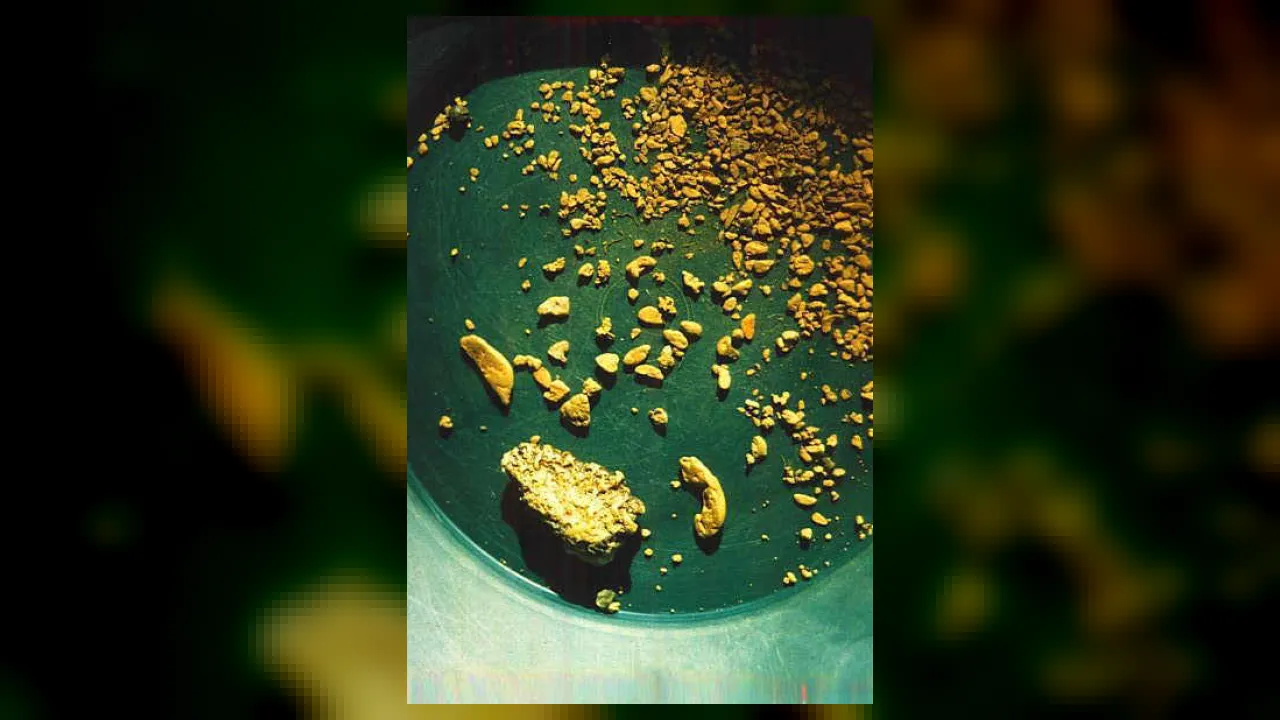
1. Why does a gold nugget stay in a miner's pan when sand and water slosh out?
2. What happens to pure gold if it sits underwater for a thousand years?
🤯 Mind-Blowing Fact • Grade 2
Before California's famous 1849 Gold Rush, thousands of miners panned gold nuggets along Virginia's Gold-Pyrite Belt from the Potomac River down through Spotsylvania and Buckingham counties!
✨ Word Sparks (Grade 2 Glossary)
Tap 🔊 to hear
gold leaf
Gold hammered into paper-thin shiny sheets
panning
Swirling stream gravel with water for gold
tarnish
To lose shine and turn dull dark
🪝
How thin can a single tiny gold nugget be hammered without tearing?
1
Born Inside White Quartz
Before a gold nugget ever tumbles down a mountain stream, it grows deep underground! Super-hot water pushes dissolved gold and silica into rock cracks, locking bright gold seams inside white quartz veins.
2
Tumbled Smooth by Rivers
Over millions of years, wind and rain crumble the mountain rock away. Because gold is soft—about as soft as your fingernail—bouncing boulders hammer sharp gold flakes into smooth, rounded nuggets!
3
Stretchy Champion of Metals
Gold is Earth's easiest metal to flatten. Craftspeople can hammer one marble-sized nugget into thin golden sheets covering a whole bedroom floor!
1. Which white mineral rock do gold veins most often grow inside underground?
2. What shapes rough underground gold into smooth, rounded river nuggets?
🤯 Mind-Blowing Fact • Grade 3
The giant hexagonal mirrors of NASA's James Webb Space Telescope are coated with a microscopic layer of pure gold—using less than two golf-balls' worth of gold across the whole 21-foot mirror!
✨ Word Sparks (Grade 3 Glossary)
Tap 🔊 to hear
native element
Mineral made of one pure uncombined element
neutron star
An ultra-dense collapsed core of giant star
conductor
Material that carries electricity or heat easily
🪝
Where in outer space were the gold atoms inside every nugget on Earth actually made?
1
Stardust Heavyweight
Hold a gleaming gold nugget and you are holding ancient space treasure! Even blazing stars cannot fuse atoms heavy enough to make gold during normal life. Astronomers discovered that gold forms when super-dense dead stars called smash together in cosmic explosions—scattering gold dust that later built planet Earth!
2
Native Element Number 79
Most metals combine with oxygen or sulfur into dull rocky ores. Gold is a '' (chemical symbol Au) that refuses to rust or tarnish, so it sits in nature as pure shiny metal.
3
Australia's 'Welcome Stranger'
In 1869, two prospectors in Victoria, Australia, struck a giant root-tangled lump just inches below the soil. Named the 'Welcome Stranger,' Earth's biggest recorded alluvial gold nugget weighed more than 158 pounds!
4
Shielding Astronaut Visors
Because gold reflects blistering infrared heat and conducts electricity without corroding, NASA coats astronaut helmet visors and the James Webb Space Telescope's giant mirrors in ultra-thin pure gold!
1. Why does NASA coat astronaut visors and the James Webb Space Telescope mirrors with thin gold?
2. What was the name of the famous 158-pound gold nugget found just inches underground in Australia in 1869?
🤯 Mind-Blowing Fact • Grade 4
In 1804, President Thomas Jefferson wrote one of early America's first scientific reports on a four-pound gold nugget discovered near Virginia's Rappahannock River!
✨ Word Sparks (Grade 4 Glossary)
Tap 🔊 to hear
placer deposit
Heavy minerals concentrated by gravity in streambeds
lode
Original hard-rock vein holding metal ore underground
ductile
Able to stretch into ultra-thin unbroken wires
🪝
How do earthquakes help pump dissolved gold out of deep rocks to build giant veins?
1
Flash-Boiled by Earthquakes!
Deep along fault zones miles underground, superheated water under immense pressure dissolves trace gold, silica, and sulfur. When an earthquake suddenly cracks a fault wide open, pressure inside that cavity drops in a split second! Just like popping the cap off a soda bottle, the fluid flash-boils into steam—instantly dumping quartz and pure gold along the fault walls. Repeated quakes build thick '' veins!
2
Lode Veins Become Placer Nuggets
Earth science students trace nuggets through erosion and deposition: once uplift exposes quartz-gold to weather, quartz shatters into sand while malleable gold (Mohs 2.5–3) bends without breaking. Weighing 19.3 times more than an equal volume of water, nuggets lodge behind bedrock riffles and inside river bends as 'placer' deposits.
3
Virginia's Historic Gold-Pyrite Belt
In 1804, Thomas Jefferson described a four-pound gold lump found along Virginia's Rappahannock River! Stretching from Fairfax County southwest to Buckingham County, Virginia's Gold-Pyrite Belt hosted scores of 19th-century gold mines long before California's 1849 rush.
4
Inside Every Smartphone
Tiny corrosion-proof gold wires connect microchips inside phones, computers, and hospital heart monitors so critical signals never fail. Because gold is extraordinarily , engineers can draw a single ounce of pure gold into a continuous hair-thin wire stretching more than fifty miles without snapping!
1. How can sudden fault earthquakes trigger gold veins to form deep underground?
2. Why are tiny gold wires used inside smartphones, satellites, and medical devices?
🤯 Mind-Blowing Fact • Grade 5
Einstein's theory of relativity explains why gold is yellow: gold's heavy nucleus whips electrons around at over half the speed of light, shifting orbital energies so blue light is absorbed instead of reflected!
✨ Word Sparks (Grade 5 Glossary)
Tap 🔊 to hear
siderophile
Iron-loving element that sinks into planetary cores
electrum
Natural metallic alloy combining gold and silver
relativistic
Physics effects happening near the speed of light
🪝
Why does almost every natural river gold nugget wear an ultra-pure 24-karat golden skin over a silver-rich core?
1
Siderophile Chemistry and Planetary Differentiation
Chemically designated Au (from Latin 'aurum,' shining dawn), atomic number 79 is a classic '' or iron-loving element. When newborn Earth melted 4.5 billion years ago, over 98 percent of our planet's gold sank with liquid iron straight into the metallic core—enough gold down there to coat Earth's entire land surface knee-deep! Much of the accessible gold mined in Earth's crust today arrived later aboard heavy meteorite bombardment ('the Late Veneer') around 3.9 billion years ago.
2
Piezoelectric Quartz Earthquakes and Giant Nuggets
For decades geologists puzzled over how scattered dissolved gold parts-per-billion could concentrate into massive hundred-pound nuggets inside quartz veins rather than dispersing as tiny specks. Recent laboratory experiments revealed a stunning feedback loop: seismic stress squeezing piezoelectric quartz veins generates localized electric voltages across quartz surfaces—electrochemically plating dissolved gold directly onto existing gold grains so nuggets grow larger with every earthquake!
3
Electrum Cores and Microbial Rim Purification
Slice open a natural alluvial gold nugget and electron microprobes reveal an alloy core containing 5 to 20 percent silver (natural '') wrapped inside a porous outer rim of nearly 99.9 percent pure gold! In stream gravels, groundwater chemicals and specialized biofilms of metallophilic bacteria such as 'Cupriavidus metallidurans' selectively leach away silver and re-precipitate bacterioform nanoparticulate pure gold onto the nugget's skin.
4
Extreme Malleability and Relativistic Color
Why is gold yellow while neighboring silver and platinum look white? Gold's heavy 79-proton nucleus accelerates inner electrons past half the speed of light! Einsteinian contraction shifts electron orbital energies so gold absorbs blue wavelengths—reflecting warm golden light.
5
Global Recycling Efficiency
All the gold ever mined in human history—roughly 212,000 metric tons—would fit inside a single cube just 22 meters on each side, and because gold never degrades, nearly all of it remains in circulation today!