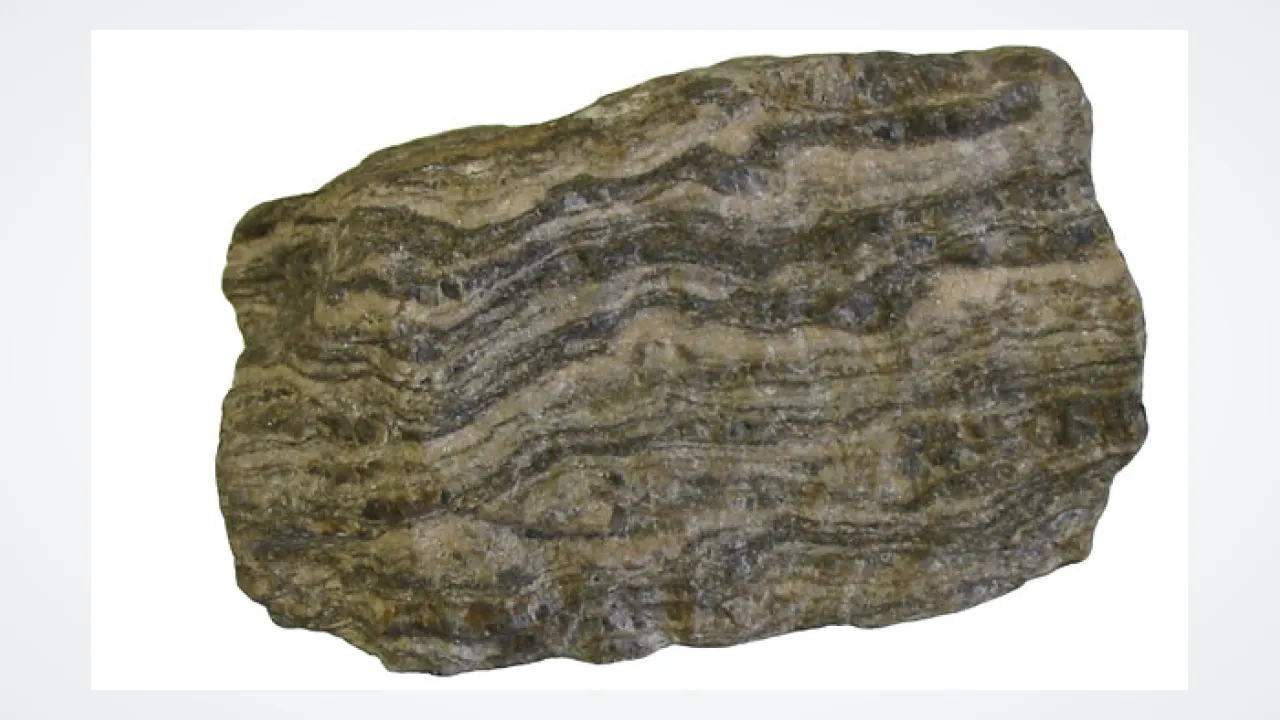
2. What pattern makes gneiss easy to recognize right away?
🤯 Mind-Blowing Fact • Grade 2
Scientists in Canada's Northwest Territories dated the famous Acasta Gneiss at 4.03 billion years old—nearly as old as Earth itself!
✨ Word Sparks (Grade 2 Glossary)
Tap 🔊 to hear
feldspar
Common pink or white crystal in granite and gneiss
hornblende
Dark green-black mineral found in gneiss stripes
fold
A bend or wave squeezed into rock layers
🪝
How did Earth sort speckled granite or muddy shale into neat ribbons of light and dark crystals?
1
Deep Inside Mountain Roots
Imagine diving fifteen miles beneath a crashing mountain range like the Himalayas! Down there, temperatures are hotter than a pizza oven and pressure is enormous. Ordinary granite or schist gets squeezed so intensely that its minerals separate into bands—becoming gneiss!
2
Light Bands and Dark Bands
Pale stripes hold tough pink or white and glassy quartz. Dark stripes pack black biotite mica and dark green . Even though gneiss has bands, it does NOT split easily like slate!
3
Twisted Like Taffy
Because the deep rock grew warm and bendy without melting completely, tectonic pushes folded its stripes into dramatic S-curves and waves.
1. Which minerals make up the pale light-colored stripes versus the dark stripes in gneiss?
2. Why are the stripes inside gneiss often curved and wavy like taffy?
🤯 Mind-Blowing Fact • Grade 3
Billion-year-old Blue Ridge gneisses in Shenandoah National Park formed during the Grenville supercontinent collision—more than twice as old as the earliest dinosaurs!
✨ Word Sparks (Grade 3 Glossary)
Tap 🔊 to hear
high-grade
Formed under extreme metamorphic heat and deep pressure
What happens at the very top of the metamorphic rock ladder—one tiny step before rock melts into magma?
1
High-Grade Metamorphic Champion
Follow humble gray shale all the way up the metamorphic ladder as heat and pressure climb: shale becomes slate, slate becomes silky phyllite, phyllite becomes glittering schist, and finally—at scorching temperatures of 600 to 750 degrees Celsius—schist transforms into coarse-banded gneiss! Igneous granite squeezed at the same depths also turns directly into gneiss.
2
Gneissic Banding Versus Schist
Unlike slate or mica-packed schist, gneiss holds fewer flat mica sheets and far more chunky feldspar and quartz crystals (Mohs hardness 6 to 7). That compositional layering—called —makes gneiss extremely strong and blocky, ideal for crushed highway stone, seawalls, and curbstones.
3
Eye-Shaped 'Augen' Crystals
Some gneisses display large, almond-shaped pink feldspar crystals wrapped by dark mica ribbons that look just like staring eyes! Geologists use the German word for eyes, calling it gneiss.
4
Ancient Basement of Virginia's Blue Ridge
Billion-year-old granitic gneisses form the deep ancient core of Virginia's Blue Ridge Mountains and crop out across the rolling Piedmont.
1. Which two different parent rocks commonly transform into gneiss under high-grade metamorphism?
2. What gives 'augen gneiss' its memorable nickname?
🤯 Mind-Blowing Fact • Grade 4
Push gneiss past 700°C and its pale stripes start melting into granite magma while its dark stripes stay solid—creating a dazzling half-melted swirl rock called migmatite!
✨ Word Sparks (Grade 4 Glossary)
Tap 🔊 to hear
orthogneiss
Gneiss formed by metamorphosing an igneous rock like granite
paragneiss
Gneiss formed by metamorphosing sedimentary rock like shale
migmatite
Mixed rock where gneiss partially melted into granite veins
🪝
How can geologists tell whether a striped cliff of gneiss began life as magma granite or ancient ocean mud?
1
Orthogneiss Versus Paragneiss
Stand before a dramatic banded cliff in the Appalachian Piedmont or Canadian Shield, and ask: what was this rock before mountain-building remodeled it? Geologists divide gneiss into two origin stories! formed when an igneous rock like granite or diorite was sheared and recrystallized deep underground. formed when sedimentary beds like shale or muddy sandstone cooked all the way to high metamorphic grade—often betraying its muddy origin by growing aluminum-rich red garnets and needle-like sillimanite!
2
Metamorphic Differentiation
How do randomly mixed crystals in granite unmix themselves into neat millimeter-to-centimeter stripes? Under intense directed stress above 600 degrees Celsius, chemical ions migrate short distances along microscopic fluid films while ductile shearing stretches mineral clusters—segregating felsic quartz-feldspar layers from dark mafic biotite-hornblende layers.
3
On the Brink of Melting: Migmatite
Push gneiss just a little hotter—past roughly 700 degrees Celsius—and the light-colored quartz and feldspar bands actually begin to melt into pockets of fresh granite magma while the dark bands stay solid! That half-metamorphic, half-igneous swirlrock is called .
4
Continental Shields
Erosion of ancient mountain belts exposes vast 'basement shields' of Precambrian gneiss underlying every continent on Earth.
1. What clue helps a geologist recognize that a gneiss is a 'paragneiss' formed from ancient sedimentary shale rather than granite?
2. What happens to gneiss when deep crustal temperatures climb high enough to start melting its pale quartz-feldspar bands?
🤯 Mind-Blowing Fact • Grade 5
Tiny zircon crystals locked inside Canada's Acasta Gneiss have ticked away like atomic clocks for 4.03 billion years—surviving almost ninety percent of Earth's entire existence!
✨ Word Sparks (Grade 5 Glossary)
Tap 🔊 to hear
granulite facies
Hottest, deepest metamorphic zone producing dry crystal assemblages
sillimanite
High-temperature aluminum silicate needle mineral in paragneiss
zircon
Ultra-durable crystal holding uranium-lead clocks for dating rocks
🪝
What secrets of Hadean and Archean Earth survive inside 4.03-billion-year-old Acasta Gneiss?
1
Amphibolite- to Granulite-Facies Conditions
Gneiss records upper amphibolite- to granulite-facies metamorphism—pressures of five to twelve kilobars (depths of 18 to 40 kilometers) and temperatures of 600 to over 800 degrees Celsius inside collisional orogens like the Grenville, Appalachian, and Himalayan belts. As hydrous muscovite breaks down via dehydration reactions (muscovite + quartz -> potassium feldspar + + H2O), coarse granoblastic bands of quartz and feldspar segregate from nematoblastic or lepidoblastic layers of hornblende, biotite, or anhydrous pyroxene.
2
Reading Tectonic Shear Sense From Augen
Far from random ornaments, asymmetric feldspar augen porphyroclasts in mylonitic shear zones carry curved recrystallized 'tails' (sigma and delta clasts). Structural geologists measure the step-geometry of those tails to determine whether ancient continents slid past one another leftward, rightward, or thrust upward over tens of millions of years!
3
Earth's Oldest Bedrock: The Acasta Gneiss Complex
On an island in Canada's Northwest Territories crops out the tonalitic Acasta Gneiss. Uranium-lead dating of refractory crystals inside its banded layers yields crystallization ages of 4.03 billion years—forged during the Hadean-Archean boundary when giant asteroids still bombarded the inner solar system, proving buoyant continental crust had already begun differentiating from primordial mantle!
4
Grenville Basement of Eastern North America
Along Virginia's Blue Ridge core—including Pedlar River and Robertson River gneisses aged 1.0 to 1.2 billion years—deep crustal roots uplifted by Paleozoic thrust faults let hikers walk directly across the eroded heart of the supercontinent Rodinia.
5
Dimension Stone and Deep Repository Integrity
Low porosity, interlocking crystal strength, and dazzling folded aesthetics make polished gneiss—such as Minnesota's 3.5-billion-year-old Morton 'Rainbow' Gneiss—a premier architectural facade stone worldwide.