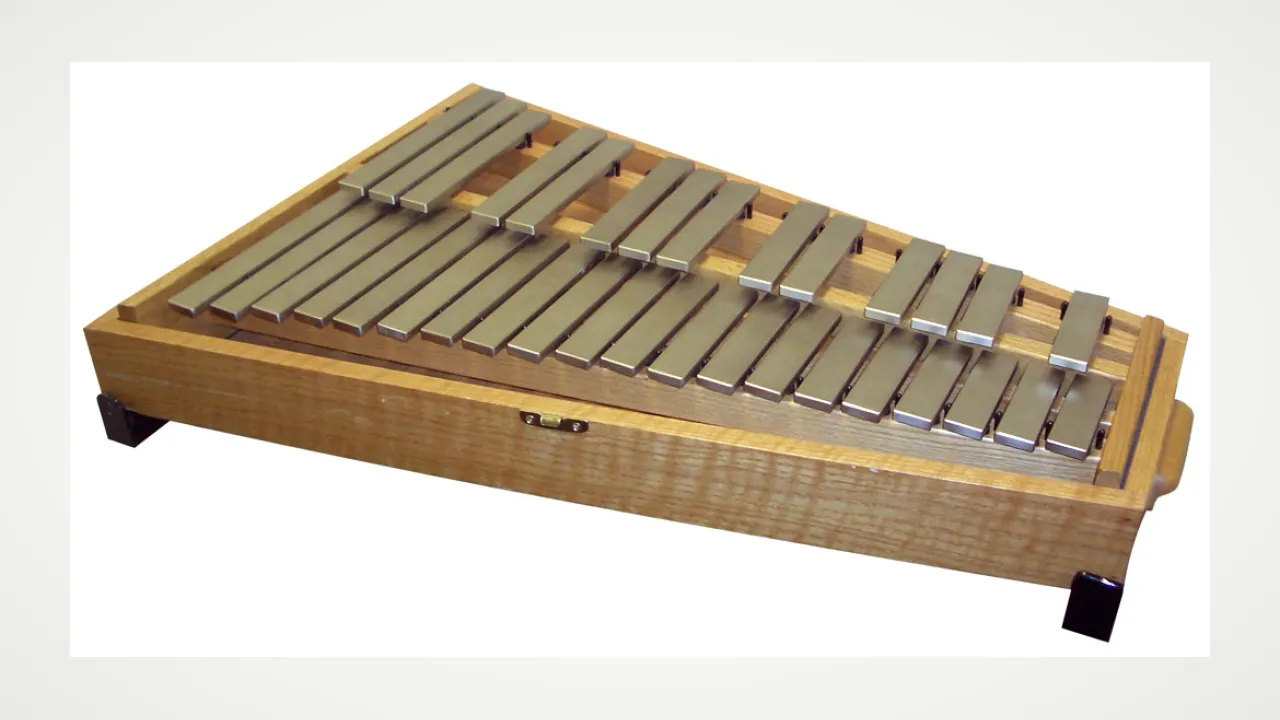
1. What does the German name 'glockenspiel' mean in English?
2. What are the shiny bars inside an orchestra glockenspiel made from?
🤯 Mind-Blowing Fact • Grade 2
Even though a glockenspiel looks small, its thick solid-steel bars make its carrying case surprisingly heavy—often weighing more than forty pounds!
✨ Word Sparks (Grade 2 Glossary)
Tap 🔊 to hear
dense
Packed tightly together and heavy for its size
lyre
A U-shaped frame held upright in parades
sparkling
Shining brightly with crisp, high musical notes
🪝
How can an instrument small enough to carry like a suitcase be heard over booming drums and horns?
1
Frosty Sparks of Sound
Ping-ting-ring! Whenever movie music shows falling snow, twinkling stars, or a wizard's wand, your ears are probably hearing an orchestral glockenspiel! Musicians in North America often call this compact powerhouse 'orchestral bells.'
2
Heavy Steel Bars, Tiny Mallets
Inside its open wooden frame lie two rows of thick, heavy steel bars resting on soft felt strips. Unlike marimbas or vibraphones, most glockenspiels do not even need long tubes underneath because steel rings so loudly and brightly all on its own!
3
Marching With a Bell Lyre
In parades, marching band players carry an upright version shaped like a harp frame called a bell , tapping out melodies with one hand while walking!
1. By what other name is the glockenspiel often known in symphony orchestras?
2. What is the upright glockenspiel carried vertically in marching bands called?
🤯 Mind-Blowing Fact • Grade 3
Glockenspiel music is written two whole octaves lower than it actually sounds—otherwise nearly every single note would float way up off the top of the musical staff!
✨ Word Sparks (Grade 3 Glossary)
Tap 🔊 to hear
carillon
Huge set of tuned bells in a tower
stiff
Resisting bending and snapping back into shape fast
staff
Five horizontal lines where musical notes are written
🪝
Why did seventeenth-century bell ringers shrink giant church-tower bells down into flat steel bars?
1
High Above Every Other Instrument
Ting! One single brass mallet kisses a short steel bar, and a diamond-bright pitch shimmers effortlessly over ninety orchestral players! Reaching all the way to the highest note on a grand piano, the glockenspiel rules the very top ceiling of orchestral pitch.
2
Stiff Steel and Nodal Felt
Instead of thin aluminum like a vibraphone, glockenspiel bars are cut from thick, high-carbon steel. Because thick steel is and dense, it snaps back and forth thousands of times every second when struck! Soft felt strips support the bars at quiet nodal points so the heavy metal can ring clearly for several seconds without buzzing.
3
Choosing the Right Mallet
Percussionists switch between hard rubber, acrylic, phenolic resin, or solid brass mallets to change the timbre. Rubber sounds sweet and glassy, while tiny brass mallets unleash a dazzling metallic ping!
4
Born From Church Carillons
Three hundred years ago in Germany and the Netherlands, musicians wanted a portable way to practice songs written for giant church-tower bell . Mozart loved its magical chime so much that he gave a charmed glockenspiel a starring role in his 1791 opera The Magic Flute!
1. How much higher does a glockenspiel actually sound compared to the notes written in its sheet music?
2. Which mallet material produces the brightest, sharpest metallic ping on steel glockenspiel bars?
🤯 Mind-Blowing Fact • Grade 4
When Mozart composed the enchanted glockenspiel solo for Papageno in The Magic Flute in 1791, the stage instrument wasn't played with mallets at all—it was a miniature keyboard box called an instrumento d'acciaio ('instrument of steel')!
✨ Word Sparks (Grade 4 Glossary)
Tap 🔊 to hear
tempered
Heat-treated so steel becomes tough and springy
articulation
How clearly and crisply each note starts
crystalline
Sparkling, pure, and clear like cut crystal
🪝
Why doesn't a glockenspiel even need resonator tubes to overpower eighty violins and a roaring brass section?
1
Acoustic Razor of the Symphony
Listen to Paul Dukas's The Sorcerer's Apprentice or Tchaikovsky's Sleeping Beauty waltz: floating high above swirling strings and blaring horns dances a trail of silver sparks. That unmistakable brilliance comes from the glockenspiel, the highest-pitched pitched idiophone in the standard orchestra.
2
High Stiffness, Zero Undercut, Pure Projection
Pick up a single glockenspiel bar and its heft surprises you—it is a thick, flat slab of high-carbon steel with almost no arch carved underneath! Whereas wooden marimba bars need deep arches to tame clashing overtones, a thick steel bar vibrating between roughly 784 hertz (G5) and 4,186 hertz (C8) throws its upper overtones far above the range of human pitch confusion, where our ears hear them simply as an icy, bell-like 'ping.' Because our ears are extraordinarily sensitive around 2,000 to 4,000 hertz, and few instruments play that high, the bare steel slices through orchestral textures without resonator tubes.
3
Box Models vs. Pedal Glockenspiels
Traditional orchestral glockenspiels rest inside a portable case, forcing players to mute unwanted ringing notes by touching bars lightly with spare fingers. Modern extended symphonic models mount wider steel bars over small resonators and add a vibraphone-style foot damper pedal for complex four-mallet passages.
4
From Keyboard Bell Boxes to Mallet Virtuosity
In eighteenth-century scores such as Handel's Saul (1739) and Mozart's The Magic Flute (1791), early glockenspiels actually used tiny piano-like keyboards to hammer metal bells or bars! By the nineteenth century, composers like Wagner switched to open mallet-struck bars for sharper and power.
1. Why can bare glockenspiel bars project clearly over a huge orchestra without needing tall resonator tubes?
2. How were early eighteenth-century glockenspiels in works by Handel and Mozart played?
🤯 Mind-Blowing Fact • Grade 5
On the highest C8 bar of a glockenspiel (4,186 Hz), its third bending mode vibrates above 22,000 Hz—literally crossing into ultrasonic territory beyond human hearing!
✨ Word Sparks (Grade 5 Glossary)
Tap 🔊 to hear
ultrasonic
Vibrating higher than human ears can hear
prism
Solid geometric block with matching flat ends
carillonneur
Musician who plays tower bells from a console
🪝
Why can a glockenspiel bar remain an uncarved rectangular slab of steel while xylophone and marimba bars require intricate parabolic undercuts?
1
The Physics of Uncarved High-Carbon Steel
Inspect the underside of a concert glockenspiel bar and a striking engineering contrast emerges: unlike the deeply scooped arches of marimba and vibraphone bars, a glockenspiel bar is a nearly uniform rectangular of high-carbon steel, often 6 to 9 millimeters thick and 30 millimeters wide, tuned only by tiny shallow grindings at the center or ends.
2
Euler-Bernoulli Beam Modes at Ultrasonic Heights
In a uniform free-free rectangular beam governed by Euler-Bernoulli bending physics, the second transverse vibrational mode rings at approximately 2.76 times the fundamental frequency—an inharmonic interval of an octave plus a sharp fourth—while the third mode jumps to 5.40 times the fundamental. On a low marimba bar, a 2.76f partial would clash harshly in the middle of our hearing range. On a concert glockenspiel spanning F5 (698.5 hertz) to C8 (4,186 hertz, sounding two octaves above written pitch), however, even a midrange C7 bar (2,093 hertz) launches its 2.76f and 5.40f partials at 5,777 hertz and 11,302 hertz! At those stratospheric frequencies, the human auditory cortex fuses brief inharmonic partials into an unmistakable metallic 'strike chime' before they decay, leaving a pure, crystalline fundamental singing behind.
3
Pin Mounting, Felt Isolation, and Pedagogical Pedals
Classified as a pitched struck metallophone (111.222), high-end symphonic glockenspiels float thick nickel- or chrome-plated steel bars on minimal-contact felt rails and vertical guide pins positioned precisely at the 22.4 percent nodal lines. Extended 3.3-octave pedal glockenspiels add small open or closed cylindrical resonators and a spring-loaded felt damper pedal, freeing both hands for rapid contrapuntal figures.
4
Hertzian Contact Duration and Mallet Selection
Percussionists tailor spectral brightness through mallet density: polycarbonate, phenolic resin, and solid brass spheres of 15 to 22 millimeters diameter produce ultra-short Hertzian contact times, exciting brilliant transient sparkle, whereas hard elastomer heads soften the initial click for Impressionist delicacies like Debussy's La Mer.
5
From Dutch Carillon Practice to Symphonic Staple
Originating in seventeenth-century Germany and the Low Countries as miniature practice metallophones for municipal , keyboard-actuated versions graced Handel's Saul (1739) and Mozart's Die Zauberflöte (1791). Nineteenth-century transition to hand-held mallets—championed in Wagner's Die Walküre ('Magic Fire Music') and Messiaen's twentieth-century bird-song scores—unlocked dazzling dynamic agility.