1. How were Giraffatitan's front legs different from most other dinosaurs?
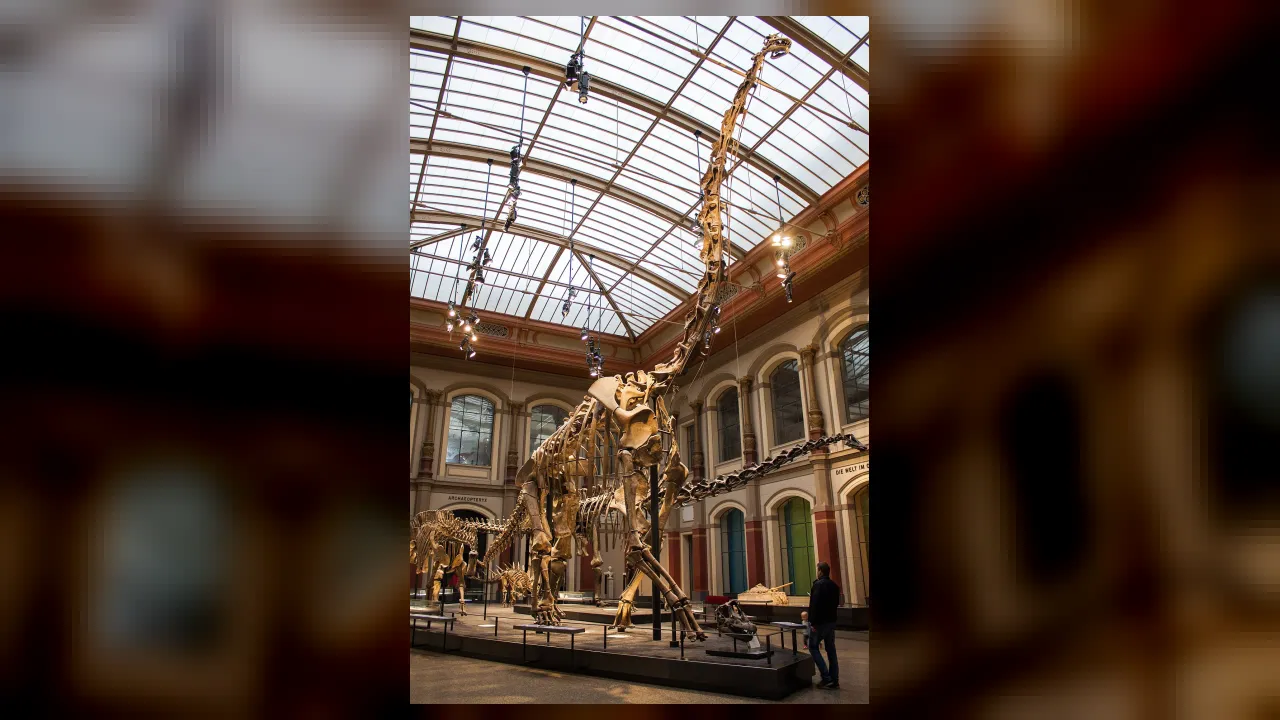
2. Where is the world-record tallest dinosaur skeleton of Giraffatitan displayed?
🤯 Mind-Blowing Fact • Grade 2
Hundreds of local workers carried Giraffatitan's massive stone bones across Tanzania by hand in bamboo cradles during a four-year expedition!
✨ Word Sparks (Grade 2 Glossary)
Tap 🔊 to hear
snorkel
a breathing tube sticking up above water
torso
the main trunk of a body without limbs
pressure
the heavy push of water or air
🪝
Did you know most famous pictures of 'Brachiosaurus' were actually showing Giraffatitan all along?
1
Secret Star Behind Another Name
Peek over the treetops of ancient East Africa and meet a true celebrity in disguise! When German diggers found this forty-three-foot-tall giant in Tanzania over a hundred years ago, they thought it was an African kind of Brachiosaurus.
2
Earning Its Own Giant Giraffe Name
Later, scientists compared the two dinosaurs bone by bone. Because the African skeleton had a shorter tail, lighter , and taller forehead arch than American Brachiosaurus, it earned its own name: Giraffatitan, meaning 'giant giraffe'!
3
Busting the Underwater Snorkel Myth
Old books once showed Giraffatitan walking underwater using its high forehead nose like a —until physics proved deep water would squeeze its lungs flat!
2. Why couldn't Giraffatitan walk along deep lake bottoms breathing through its head like a snorkel?
🤯 Mind-Blowing Fact • Grade 3
To pump oxygen-rich blood all the way up its vertical neck to its brain, Giraffatitan needed blood pressure roughly three to four times higher than a human's!
✨ Word Sparks (Grade 3 Glossary)
Tap 🔊 to hear
excavator
a worker who digs carefully to uncover fossils
blood pressure
pushing force moving blood through body vessels
silhouette
the dark outline shape of something
🪝
How did an African dinosaur pretend to be American Brachiosaurus in books and toys for nearly ninety years?
1
Digging Giants at Tendaguru Hill
Between 1909 and 1913, hundreds of Tanzanian and German paleontologist Werner Janensch unearthed over two hundred tons of Jurassic dinosaur bones at Tendaguru Hill in East Africa. Their prize find was a towering long-necked giant with seven-foot upper arm bones!
2
Why Brachiosaurus Borrowed Its Face
North America's Brachiosaurus was discovered first in 1900, yet its skull and many neck bones were missing. Because Janensch initially named the much more complete African giant Brachiosaurus brancai, museums and illustrators worldwide copied the African dinosaur's tall arched skull whenever drawing Brachiosaurus!
3
Twenty-Six Differences Seal the Split
In 1988 and 2009, paleontologists Gregory Paul and Michael Taylor proved the African giant had twenty-six major skeletal differences—including a lighter, shorter trunk and twin nasal openings perched inside a tall forehead crest—confirming its true genus name, Giraffatitan.
4
Super-Strong Heart Pump
Pumping blood thirty feet uphill from chest to brain required a muscular heart weighing hundreds of pounds and super-high !
1. Why did dinosaur books use Giraffatitan's skull to draw American Brachiosaurus for decades?
2. What special challenge did Giraffatitan's body solve to keep its high-held brain supplied with oxygen?
🤯 Mind-Blowing Fact • Grade 4
Even though the giant bony nose hole sits high on Giraffatitan's forehead, blood-vessel marks prove soft tissue guided its actual nostrils all the way down to the front of its snout!
✨ Word Sparks (Grade 4 Glossary)
Tap 🔊 to hear
humeri
upper arm bones between shoulders and elbows
resonate
echo and amplify into a deep booming sound
composite
assembled using matching parts from several individuals
🪝
Where were Giraffatitan's fleshy nostrils really located on its tall, arched skull—and why did scientists get it backward for a century?
1
Towering Over Tendaguru's Coast
One hundred fifty million years ago along the warm, lagoon-dotted coast of Late Jurassic Tanzania, Giraffatitan brancai browsed undisturbed forty feet above the ground. Unlike whip-tailed diplodocids whose hind legs towered higher than their shoulders, Giraffatitan possessed two-meter longer than its femora—tilting its spine upward like a natural crane to harvest high araucarian conifers and cycadophytes.
2
Untangling Two Continents' Giants
For decades, Berlin's 13.27-meter mount defined everyone's mental image of Brachiosaurus. Yet in 2009, paleontologist Michael Taylor published a meticulous bone-by-bone comparison against Colorado's Brachiosaurus altithorax. American Brachiosaurus proved noticeably longer-bodied, wider-hipped, and heavier-tailed—roughly twenty-five percent bulkier across the trunk—confirming the leaner, taller-proportioned African icon belonged in its own genus, Giraffatitan.
3
Solving the Forehead Nostril Puzzle
High atop Giraffatitan's skull arched a thin bony bridge framing huge nasal openings above the eyes. Early paleontologists placed its external nostrils right on its forehead! However, in 2001 Lawrence Witmer compared blood-vessel grooves across reptile skulls and discovered fleshy nasal passages actually ran forward from that bony arch, placing the real breathing nostrils right at the front tip of the snout!
4
Built-In Cooling and Sound Chamber
Meanwhile, that moist tissue-filled forehead arch cooled hot blood bound for the brain and resonated deep, booming calls across miles of Jurassic forest.
1. How did Lawrence Witmer discover where Giraffatitan's fleshy breathing nostrils actually opened?
2. How did North American Brachiosaurus differ in build from East African Giraffatitan?
🤯 Mind-Blowing Fact • Grade 5
In 1951, physicist-paleontologist Kenneth Kermack used simple water-pressure math to prove that if Giraffatitan stood chest-deep underwater using its head as a snorkel, water pressure would crush its lungs and stop it from inhaling a single breath!
✨ Word Sparks (Grade 5 Glossary)
Tap 🔊 to hear
hydrostatic
pressure exerted by resting water at depth
osteological
relating to detailed structure of skeleton bones
arterial
carrying oxygen-rich blood pumped from the heart
🪝
How did an epic East African excavation, cardiovascular physics, and comparative osteology transform 'Brachiosaurus brancai' into Giraffatitan?
1
Tendaguru's Monumental Excavation
Between 1909 and 1913, German paleontologists Werner Janensch and Edwin Hennig worked alongside roughly five hundred local Tanzanian quarry specialists—led by chief preparator Boheti bin Amrani—to excavate 235 metric tons of Late Jurassic fossils at Tendaguru. Carried on foot for days to the Indian Ocean port of Lindi, two partial brachiosaurid skeletons ('Skeleton S' and 'Skeleton t') plus referred skulls formed Berlin's breathtaking mounted centerpiece, named Brachiosaurus brancai by Janensch in 1914.
2
Taxonomic Separation From Brachiosaurus altithorax
Because Elmer Riggs's 1903 American holotype of Brachiosaurus altithorax lacked a skull and neck, science treated the African skeleton as the stand-in template for Brachiosaurus for over eighty years. In 1988, Gregory S. Paul noted dramatic trunk and dorsal-vertebra discrepancies and proposed subgenus (later genus) Giraffatitan. In 2009, Michael P. Taylor quantified 26 distinctions—showing B. altithorax possessed a 23-to-26-percent longer dorsal column, broader pelvis, and deeper caudal series—cementing Giraffatitan brancai as an independent genus.
3
Refuting Kermack's Submergence Hypothesis
Early textbooks depicted Giraffatitan submerged in deep lakes to buoy its 30-to-40-metric-ton mass, breathing through elevated forehead nares. In 1951, British paleontologist Kenneth Kermack calculated pressure on a chest submerged eight meters deep: external water pressure (~0.8 atmospheres above surface air) would exceed ribcage inspiratory muscle force and rupture lung capillaries—proving brachiosaurids were strictly terrestrial high-browsers.
4
Rostral Nares and Cardiovascular Extremes
Remounted in 2007 using 3D biomechanical posture modeling, Berlin's Guinness-certified 13.27-meter (43.5-foot) skeleton elevates its chisel-toothed skull nine meters above its heart—requiring mean blood pressures near 400 mmHg, one-way venous valves, and Witmer's reconstructed rostral fleshy nostrils fronting a pneumatic nasal resonance dome.
5
Canopy Sovereign of Gondwana
Towering twice as high as coexisting Kentrosaurus and Dicraeosaurus, Giraffatitan harvested untouched upper conifer crowns across Tendaguru's coastal woodlands, showcasing sauropod vertical specialization at its peak.