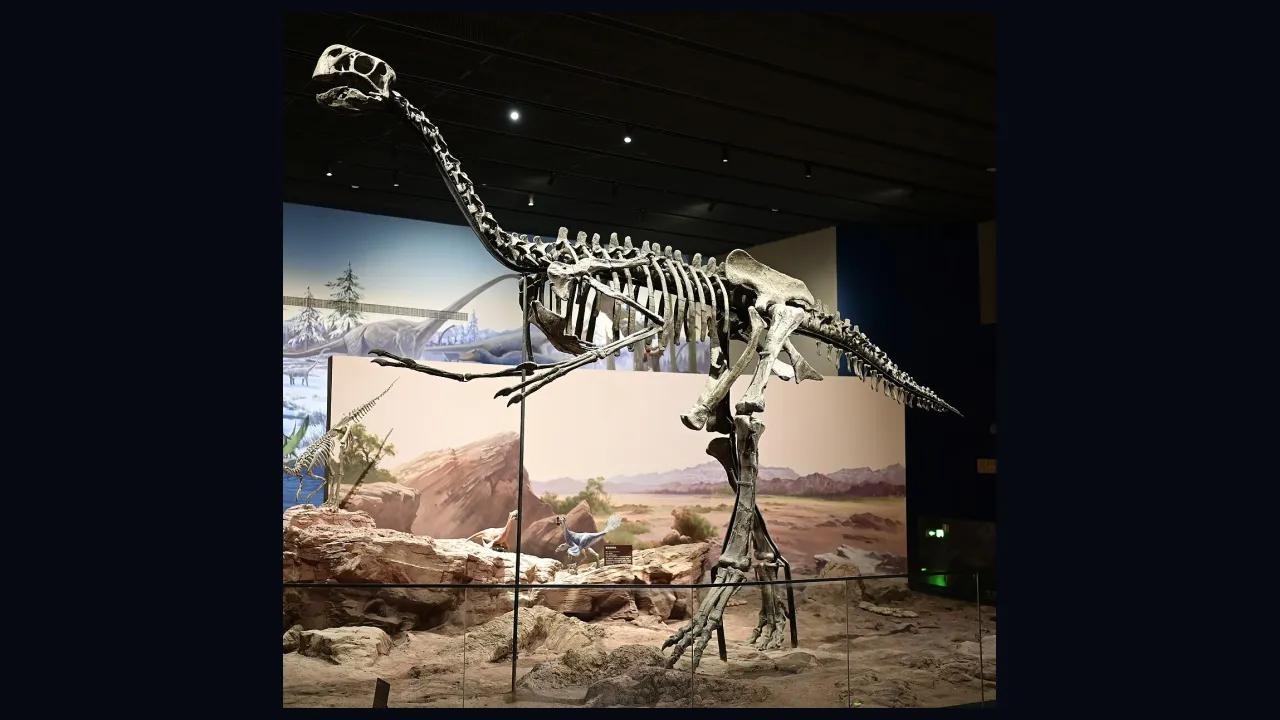
⚡ Survival SuperpowerTowering 11.5-foot-tall bird-like dinosaur with a giant toothless beak
🤯 Mind-Blowing Fact • Grade 1
Scientists discovered Gigantoraptor purely by accident on live camera while filming a TV documentary about a completely different dinosaur!
✨ Word Sparks (Grade 1 Glossary)
Tap 🔊 to hear
colossal
Enormously big and towering in size
stride
To walk forward with long, big steps
mound
A rounded pile of sand or earth
🪝
What if a feathered, beaked bird-dinosaur grew as big as a rhinoceros?
1
A Giant Surprise!
Boom, ! Look way up—eleven feet into the air! Gigantoraptor looked like a monster turkey or ostrich weighing two tons! Most of its cousins were no bigger than humans.
2
Huge Toothless Beak
It had zero teeth in its big jaws! A sharp, hard beak snipped branches, tough seeds, and small prey.
3
Giant Ring Nests
Its loaf-sized eggs sat in a giant ring ten feet wide so the heavy parent could rest safely in the middle!
1. How was the very first Gigantoraptor bone discovered in 2005?
2. How could a two-ton Gigantoraptor keep its eggs warm without squishing them?
🤯 Mind-Blowing Fact • Grade 2
Comparing Gigantoraptor to most of its turkey-sized oviraptorosaur cousins is like finding a mouse species that grew as big as an elephant!
✨ Word Sparks (Grade 2 Glossary)
Tap 🔊 to hear
oviraptorosaur
Group of feathered, toothless, parrot-beaked theropod dinosaurs
honeycomb
Filled with small air spaces that reduce weight
thigh
Upper part of the hind leg above knees
🪝
What happened when a scientist picked up a 'sauropod' bone for a TV camera and gasped in shock?
1
Live On-Camera Discovery!
Imagine filming a science show in Inner Mongolia in 2005. Paleontologist Xing Xu asked the camera crew to zoom in as he brushed off a four-foot bone sticking out of red rock, expecting a long-necked plant-eater. Seconds later he froze—the bone belonged to an unknown bird-like thirty-five times heavier than Citipati!
2
Light Bones and Sprinter Legs
Even though Gigantoraptor stretched twenty-six feet long and stood over eleven feet tall, hollow air pockets -lightened its backbones. Long, muscular lower legs made it the fastest giant dinosaur on the block!
3
Eighteen-Inch Eggs
Giant fossil nests named Macroelongatoolithus held foot-and-a-half-long eggs arranged in ten-foot rings built specially for giant caenagnathid parents.
1. How much heavier was Gigantoraptor than typical big oviraptorosaurs like Citipati?
2. What kept Gigantoraptor surprisingly fast despite its two-ton size?
🤯 Mind-Blowing Fact • Grade 3
Growth rings in the eleven-year-old Gigantoraptor fossil showed it grew far faster than giant North American tyrannosaurs of the same age!
✨ Word Sparks (Grade 3 Glossary)
Tap 🔊 to hear
caenagnathid
Slender-handed branch of toothless beaked oviraptorosaur dinosaurs
shear
To slice cleanly like sharp garden shears
pneumatic
Lightened internally by bird-like air sac spaces
🪝
Why did bird-like dinosaurs usually get smaller toward flight, while Gigantoraptor grew twenty-six feet long?
1
Breaking the Shrinking Rule
Sunlight gleams across lush riverbanks in Inner Mongolia's Erlian Basin 80 million years ago. Towering above the bushes at 3.5 meters tall is Gigantoraptor erlianensis, an eight-meter feathered weighing nearly two tons! Usually, as theropods evolved more bird-like traits, their bodies shrank smaller—yet Gigantoraptor reversed the rule and kept bird features at giant scale!
2
Still Growing at Age Eleven!
When scientists sliced a thin sliver from that famous 1.1-meter thigh bone to count yearly growth rings, they found another surprise: the dinosaur was only eleven years old when it died and was STILL growing! Fully mature adults grew even heavier.
3
Shearing Beak and Long Claws
Its massive half-meter lower jaw held zero teeth, forming a sharp shearing and crushing beak for slicing tough plants, nuts, or small animals, paired with long slender arms and curved hand claws.
4
Doughnut Nests for Two-Ton Parents
Fossilized ten-foot ring nests show giant left a wide central sandy hollow to support nearly all their body weight while feathers warmed the outer ring of half-meter eggs!
1. What did bone growth rings reveal about the age of the 26-foot Gigantoraptor skeleton?
2. Why did Gigantoraptor's relatives build ten-foot-wide doughnut-shaped nests?
🤯 Mind-Blowing Fact • Grade 4
Individual eggs of giant caenagnathids like Gigantoraptor measured up to 20 inches (50 cm) long—nearly three times the volume of an ostrich egg!
✨ Word Sparks (Grade 4 Glossary)
Tap 🔊 to hear
spongiose
Filled with tiny sponge-like air chambers inside bone
pedestal
Raised central base supporting weight safely
herbivory
Feeding mainly on leaves, stems, and plant matter
🪝
How do paleontologists engineer the nest physics of a 4,000-pound brooding bird-dinosaur?
1
Serendipity at Saihangaobi
Picture April 2005 in the Erlian Basin of Inner Mongolia, China. While demonstrating fossil excavation for a Japanese television documentary in Late Cretaceous rocks of the Iren Dabasu Formation, paleontologist Xing Xu exposed the articulated femur of what everyone assumed was the local sauropod Sonidosaurus. Minutes later, Xu recognized unmistakable bird-like trochanters on the 1.1-meter bone! Unveiled in Nature in 2007 as Gigantoraptor erlianensis, this eight-meter, 1.4-to-2-ton caenagnathid stunned evolutionary biologists.
2
More Bird-Like at Giant Scale
Paradoxically, Gigantoraptor possessed even more exaggerated avian-like features than its tiny cousins: deeply , air-filled caudal and dorsal vertebrae, an elongated manus with slender claws, and hind limbs with unusually long tibiae and metatarsals compared to other two-ton theropods—making it a remarkably swift runner.
3
Jaw Mechanics of a Giant Omnivore
In 2017, Waisum Ma and colleagues studied Gigantoraptor's fused, U-shaped toothless mandible. Sharp lateral tomial ridges combined with a broad crushing shelf inside the keratinous beak allowed both leaf-shearing and powerful bone-or-shell-cracking omnivory.
4
Solving the Giant Egg Physics Problem
In 2018, Kohei Tanaka and Darla Zelenitsky analyzed giant Macroelongatoolithus clutches—fifty-centimeter eggs laid in rings up to 3.2 meters across. Whereas turkey-sized oviraptorids sat directly on eggs, two-ton Gigantoraptor-sized parents supported their mass on a wide, egg-free central sand while draping feathered arms over the perimeter!
1. According to 2018 nest biomechanics research, how did nest shape change as oviraptorosaurs grew from 40 kg to 1,500+ kg?
2. What did 2017 jaw studies reveal about Gigantoraptor's huge toothless lower beak?
🤯 Mind-Blowing Fact • Grade 5
Even at two metric tons, Gigantoraptor kept a shin bone (tibia) longer than its thigh bone (femur)—an athletic sprinter ratio almost unheard of in dinosaurs weighing over a ton!
✨ Word Sparks (Grade 5 Glossary)
Tap 🔊 to hear
camellate
Bone interior subdivided into countless tiny honeycomb air pockets
allometry
How body proportions or behaviors shift mathematically with size
symphysis
Fused midline joint uniting the left and right lower jaws
🪝
Why does Gigantoraptor erlianensis challenge evolutionary trends of miniaturization along the stem-avian lineage?
1
Unprecedented Giantism in Maniraptora
Excavated in 2005 from Senonian-stage fluvial strata of the Iren Dabasu Formation (~85–70 MYA) near Erlianhot, Inner Mongolia, Gigantoraptor erlianensis was described by Xing Xu, Qingwei Tan, Jianmin Wang, Xijin Zhao, and Lin Tan in 2007. Measuring eight meters in length, standing 3.5 meters tall at the head, and weighing 1,400 to 2,000 kilograms, Gigantoraptor exceeded typical oviraptorosaurs in body mass by nearly two orders of magnitude—rivaling Deinocheirus and Therizinosaurus as one of the largest non-carnosaurian, bird-like coelurosaurs ever evolved.
2
Extreme Pneumaticity and Cursorial Hind Limbs
Despite evolving giant body size, Gigantoraptor intensified avian-grade skeletal adaptations. Its presacral and anterior caudal centra lack large simple pleurocoels in favor of pervasive, (spongiose) pneumatic chambers identical to large ratite birds. Remarkably among multi-ton theropods, its distal hind limbs remained elongated—with a tibia longer than its 1.1-meter femur—preserving high stride efficiency and cursorial agility.
3
Histological Growth Trajectory
Osteohistological thin sections of the holotype fibula preserved seven outer lines of arrested growth (LAGs), allowing researchers to retrocalculate hatchling-to-subadult growth. Dying at roughly age eleven while peripheral lamellar bone still lacked an external fundamental system, the holotype achieved multi-ton stature faster than North American tyrannosaurids through accelerated adolescent growth.
4
Caenagnathid Mandibular Mechanics
Phylogenetically resolved as a basal caenagnathid rather than an oviraptorid, Gigantoraptor possessed a deeply fused, edentulous mandibular bearing sharp occlusal ridges and lingual shelves adapted for high-fiber plant shearing and generalist durophagy.
5
Allometry of Macroelongatoolithus Incubation
Biomechanical eggshell-porosity and clutch-geometry analyses by Kohei Tanaka and colleagues (2018) linked giant caenagnathids to three-meter-diameter Macroelongatoolithus ring clutches: enlarging the central sediment core supported ninety-plus percent of parental mass while pennaceous forelimb plumage sheltered peripheral fifty-centimeter eggs.