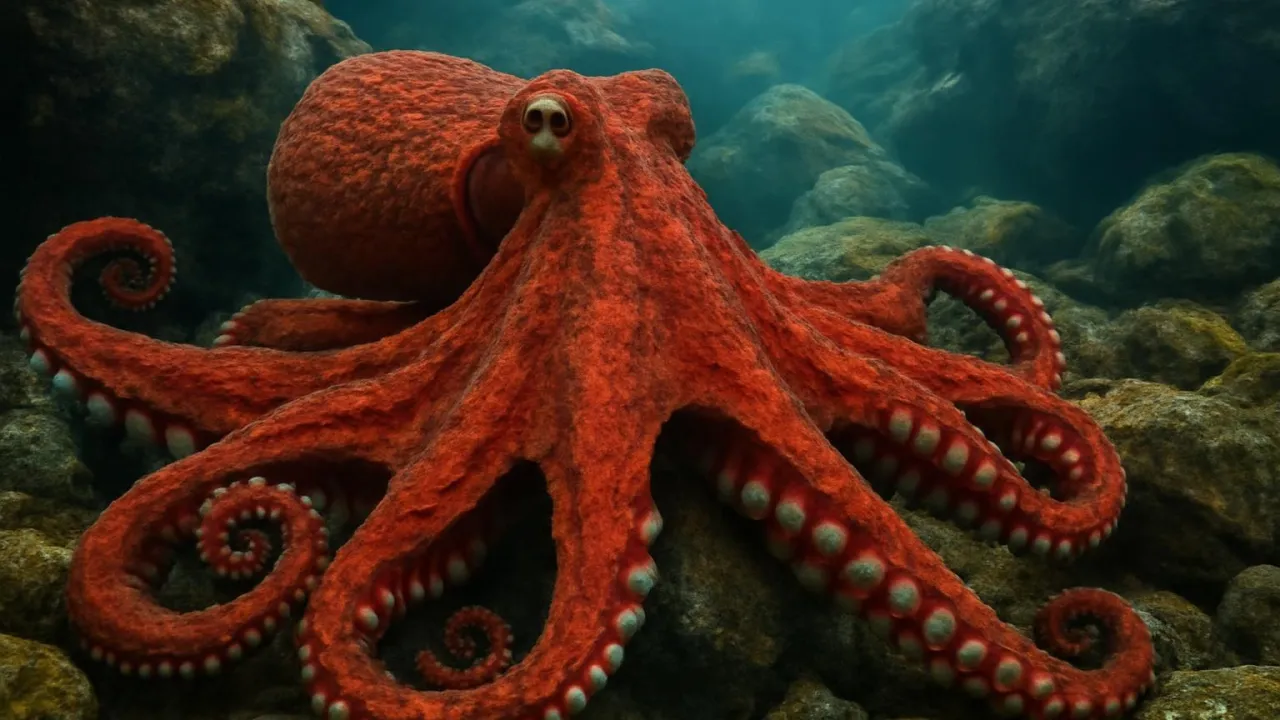
1. How many arms does the Giant Pacific Octopus have?
2. Why does the octopus change its skin color?
🤯 Mind-Blowing Fact • Grade 2
The Giant Pacific Octopus can fit its soft body through holes as small as a coin!
✨ Word Sparks (Grade 2 Glossary)
Tap 🔊 to hear
prey
Animals the octopus eats for food
predators
Animals that hunt the octopus to eat
den
A safe home or shelter for the octopus
🪝
Have you ever seen an octopus change colors like a magic trick?
1
Amazing Arms and Suckers
The Giant Pacific Octopus has eight strong arms covered with many suckers. These suckers help it grab and hold onto tightly. It uses its arms to explore and move around underwater.
2
Changing Colors to Hide
This octopus can quickly change its skin color and texture to blend into rocks or sand. Changing colors helps it hide from and sneak up on . It can be red, brown, white, or even spotted.
3
Where It Lives and Grows
The Giant Pacific Octopus lives in cold coastal waters of the North Pacific Ocean. It hides in made from rocks or shells. It grows very fast and can become very large, with arms reaching up to 16 feet.
The Giant Pacific Octopus can regrow lost arms, a process called regeneration.
✨ Word Sparks (Grade 3 Glossary)
Tap 🔊 to hear
camouflage
Changing color to blend in with surroundings
chromatophores
Cells in skin that change color quickly
regeneration
Growing back a body part that was lost
🪝
Did you know the Giant Pacific Octopus uses camouflage to survive in the ocean?
1
Master of Camouflage
The Giant Pacific Octopus can change its skin color and texture to match rocks or sand. This helps it avoid predators and sneak up on prey. Its skin has special cells called that control color changes. This adaptation is key to its survival.
2
Strong Arms and Suckers
It has eight long arms lined with hundreds of suckers that help it grab prey tightly. These suckers can taste and feel, helping the octopus explore its environment. The arms also help the octopus move across the ocean floor. This allows it to hunt and escape danger effectively.
3
Life in the Ocean
The Giant Pacific Octopus lives in cold coastal waters of the North Pacific Ocean, often near rocky reefs. It builds dens in crevices or under rocks to protect itself from predators. It feeds on crabs, clams, fish, and other shellfish. Its role as both predator and prey affects the ocean food web.
4
Amazing Intelligence
This octopus is known for its intelligence and problem-solving skills. It can open jars, escape traps, and remember solutions to puzzles. Its brain is large compared to other invertebrates, helping it adapt to many challenges. This intelligence helps it survive in a complex ecosystem.
1. What special skin cells help the octopus change color?
2. Why does the octopus build dens in rocks?
🤯 Mind-Blowing Fact • Grade 4
Giant Pacific Octopuses can live up to five years, which is long for an octopus species.
✨ Word Sparks (Grade 4 Glossary)
Tap 🔊 to hear
ecosystem
All living and nonliving things in one place
biodiversity
Many different kinds of plants and animals
conservation
Protecting animals and their homes
🪝
How does the Giant Pacific Octopus’s clever camouflage affect its ocean ecosystem?
1
Camouflage and Survival
The Giant Pacific Octopus uses camouflage to blend perfectly with its rocky surroundings, which helps it avoid predators and ambush prey. Its ability to change both color and skin texture allows it to mimic rocks, sand, and seaweed. This adaptation increases its chances of survival in a habitat full of predators. Because of this, it plays a vital role in maintaining balance in its .
2
Role in the Food Web
As a predator, the octopus controls populations of crabs, clams, and fish, preventing overpopulation of these species. At the same time, it is prey for larger animals like sea otters, sharks, and whales. This dual role helps keep the ocean food web balanced. Its presence supports healthy in coastal marine environments.
3
Habitat and Geographic Range
The Giant Pacific Octopus inhabits cold, coastal waters of the North Pacific Ocean, ranging from California to Alaska and across to Japan and Russia. It prefers rocky reefs and ocean floors with many hiding places. Human activities such as fishing and pollution can affect its habitat quality and population numbers. efforts aim to protect its important habitats.
4
Human Impact and Conservation
Fishermen sometimes catch Giant Pacific Octopuses for food, but overfishing could reduce their numbers. Pollution and habitat destruction also threaten their survival. Scientists study their behavior and habitats to help create rules that protect them. Public awareness about their ecological role encourages to keep ocean healthy.
1. What role does the Giant Pacific Octopus play in the ocean food web?
2. Why is conservation important for the Giant Pacific Octopus?
🤯 Mind-Blowing Fact • Grade 5
The Giant Pacific Octopus’s brain contains about 500 million neurons, more than many mammals.
✨ Word Sparks (Grade 5 Glossary)
Tap 🔊 to hear
cephalopod
Sea animals with arms, like octopus and squid
keystone
Very important for keeping an ecosystem balanced
chromatophores
Skin cells that change color very quickly
🪝
What makes the Giant Pacific Octopus a remarkable example of marine adaptation and intelligence?
1
Scientific Classification and Taxonomy
The Giant Pacific Octopus, scientifically named Enteroctopus dofleini, belongs to the class Cephalopoda and family Octopodidae. It is the largest octopus species, distinguished by its massive size and distinctive reddish-brown coloration. Its taxonomy places it among highly intelligent invertebrates that have complex nervous systems. This classification helps scientists study its evolutionary adaptations and ecological role.
2
Physiological Mechanics and Adaptations
This octopus can change its skin color and texture using , iridophores, and papillae cells, allowing rapid camouflage in diverse environments. Its eight muscular arms contain approximately 2,000 suction cups each, equipped with chemoreceptors to taste and feel. The soft, boneless body enables it to squeeze through openings as small as 3 inches in diameter. Its advanced nervous system supports problem-solving and learning abilities.
3
Ecological Role and Conservation Status
As a predator, the Giant Pacific Octopus regulates populations of benthic invertebrates and fish, maintaining ecosystem balance in North Pacific coastal waters. It is preyed upon by sea otters, sharks, and marine mammals, integrating it into complex food webs. Though not currently endangered, habitat degradation and fishing pressures pose risks. Conservation programs monitor populations and promote sustainable fishing practices.
4
Botanical and Culinary Curiosities
Interestingly, the Giant Pacific Octopus is sometimes featured in culinary traditions, but it is important to distinguish its biological classification from culinary uses. Unlike plants, it is an animal with no botanical fruit or seed structures. Its unique physiology and intelligence make it a fascinating subject for both biological study and cultural appreciation.
5
Quantitative Comparisons and Records
The Giant Pacific Octopus can reach arm spans up to 16 feet and weigh over 150 pounds, making it the largest octopus species. It can live up to five years in the wild, longer than many other octopus species. Its ability to squeeze through tiny openings less than 3 inches wide highlights its soft body flexibility. Its rapid color change occurs in milliseconds, demonstrating remarkable physiological control.