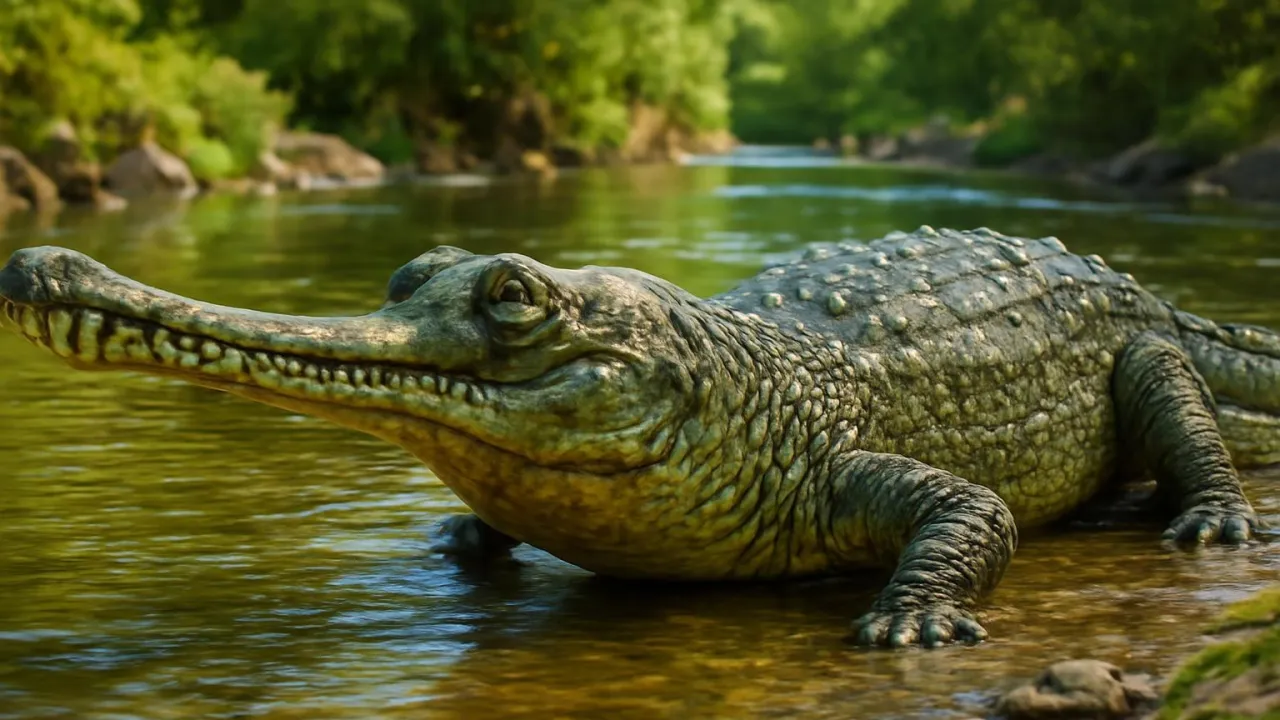
A gharial’s snout can be twice as long as its head!
✨ Word Sparks (Grade 2 Glossary)
Tap 🔊 to hear
snout
The long nose part of some animals.
prey
An animal that another animal eats.
riverbank
The land next to a river.
🪝
Have you ever seen a crocodile with a nose as long as a stick?
1
Amazing Snout
The gharial has a very long, thin that helps it catch fish easily. Its sharp teeth fit perfectly in this long nose. The snout moves fast when it snaps at its .
2
River Home
Gharials live in warm rivers in India and Nepal. They swim well and spend much time in water. They like sandy where they can rest and lay eggs.
3
Fish for Food
Gharials eat mostly fish and small water animals. Their long helps them catch slippery fish quickly. They hunt by swimming quietly and snapping their jaws fast.
Gharials’ snouts can make up half their total body length!
✨ Word Sparks (Grade 3 Glossary)
Tap 🔊 to hear
adaptation
A body change that helps animals survive.
ecosystem
A community of plants and animals living together.
predator
An animal that hunts other animals for food.
🪝
Did you know the gharial’s long snout is a perfect adaptation for fishing?
1
Snout Adaptation
The gharial’s long, narrow snout helps reduce water resistance when it snaps. This allows it to catch fast-moving fish more easily. Its sharp, needle-like teeth fit tightly to hold slippery prey. This specialized snout is unique among crocodilians.
2
River Habitat
Gharials live in large rivers with sandy banks in India and Nepal. Their habitat provides plenty of fish and places to nest. The sandy riverbanks allow females to lay eggs safely. Gharials spend most time swimming or basking in the sun.
3
Role in Ecosystem
As , gharials help control fish populations in their rivers. This balance supports healthy aquatic . Their presence indicates clean water and a thriving environment. Gharials also compete with other predators for food.
4
Life Cycle
Female gharials lay eggs in sandy nests near rivers. The eggs hatch after about 90 days. Young gharials stay near water to avoid . They grow slowly and learn to catch fish as they mature.
1. How does the gharial’s snout help it catch fish?
2. Why are gharials important to their ecosystem?
🤯 Mind-Blowing Fact • Grade 4
Gharials’ snouts can be half their total body length, a unique evolutionary trait!
✨ Word Sparks (Grade 4 Glossary)
Tap 🔊 to hear
evolutionary
Changes in animals over many generations.
incubate
To keep eggs warm until they hatch.
pollution
Harmful things that dirty water or air.
🪝
What makes the gharial’s long snout a powerful tool in its river home?
1
Snout and Survival
The gharial’s elongated snout reduces water resistance, allowing it to snap quickly at fish, its primary prey. This adaptation evolved to help it survive in fast-flowing rivers, where catching slippery fish is challenging. Its needle-like teeth interlock perfectly to grip prey securely. This physical trait is a key example of adaptation.
2
Ecosystem Role
Gharials play an important role in their river ecosystems by controlling fish populations, which maintains aquatic balance. Their presence indicates healthy, clean water, as they require good water quality to thrive. They coexist with other predators but specialize in fish hunting, reducing competition. Human activities like dam building threaten their habitat.
3
Geographic Distribution
Gharials are native to the rivers of northern India and Nepal, primarily the Ganges and Brahmaputra river systems. Their distribution has shrunk due to habitat loss and . Conservation efforts focus on protecting these river habitats and reducing human disturbances. Protected areas help maintain gharial populations.
4
Reproduction and Growth
Female gharials build sandy nests on riverbanks to lay eggs, which for about three months. Hatchlings remain near water to avoid predators and gradually learn to hunt fish. Juveniles grow slowly, reaching maturity after many years. This slow growth makes them vulnerable to environmental changes.
1. Why is the gharial’s snout important for survival?
2. What threatens gharial habitats today?
🤯 Mind-Blowing Fact • Grade 5
Gharials’ snouts can be nearly half their body length, a remarkable evolutionary specialization!
✨ Word Sparks (Grade 5 Glossary)
Tap 🔊 to hear
hydrodynamic
How water moves around a shape.
apex predator
Top animal that eats others in food chain.
bioindicator
An animal that shows if environment is healthy.
🪝
How does the gharial’s unique snout shape demonstrate evolutionary adaptation for aquatic hunting?
1
Taxonomy and Scientific Context
The gharial, Gavialis gangeticus, belongs to the family Gavialidae and is one of the longest crocodilian species. It is distinguished by its extremely elongated, narrow snout, which differs significantly from other crocodilians. This species is native to the river systems of northern India and Nepal, primarily the Ganges and Brahmaputra. Its evolutionary lineage dates back over 40 million years, showcasing specialized aquatic adaptations.
2
Physiological Mechanics
The gharial’s snout reduces drag, enabling swift lateral snapping motions to catch fish efficiently. Its interlocking, needle-like teeth prevent prey escape, while its powerful tail provides propulsion through water at speeds up to 20 miles per hour. The gharial’s eyes and nostrils are positioned on top of its head, allowing it to remain mostly submerged while scanning for prey.
3
Conservation and History
Once widespread throughout South Asia, gharial populations have declined drastically due to habitat loss, pollution, and fishing nets. Conservation programs, including captive breeding and river habitat restoration, aim to increase their numbers. The gharial is currently listed as Critically Endangered by the IUCN. Historical records show that gharials have been part of local culture and mythology for centuries.
4
Ecological Role and Impact
As , gharials regulate fish populations, maintaining balanced aquatic ecosystems. Their presence indicates healthy river environments, making them for water quality. Human-induced changes, such as dam construction, alter river flow and sediment, negatively impacting gharial habitats. Protecting gharials helps preserve biodiversity and ecosystem services.
5
Quantitative Comparisons
Adult gharials can reach lengths up to 20 feet (6 meters) and weigh approximately 400 pounds (180 kilograms). Their snouts can measure up to 3 feet (1 meter), nearly half their body length. They swim at speeds around 20 miles per hour (32 kilometers per hour), faster than most other crocodilians. Gharials lay 30 to 60 eggs per clutch, with incubation lasting about 90 days.