🇺🇸 U.S. HISTORY
🏛️ 1st President of the United States (1789–1797) • Founding Father
VA History & Social Science SOL K.1, 1.2, 2.4, VS.1–VS.10, USI & USII
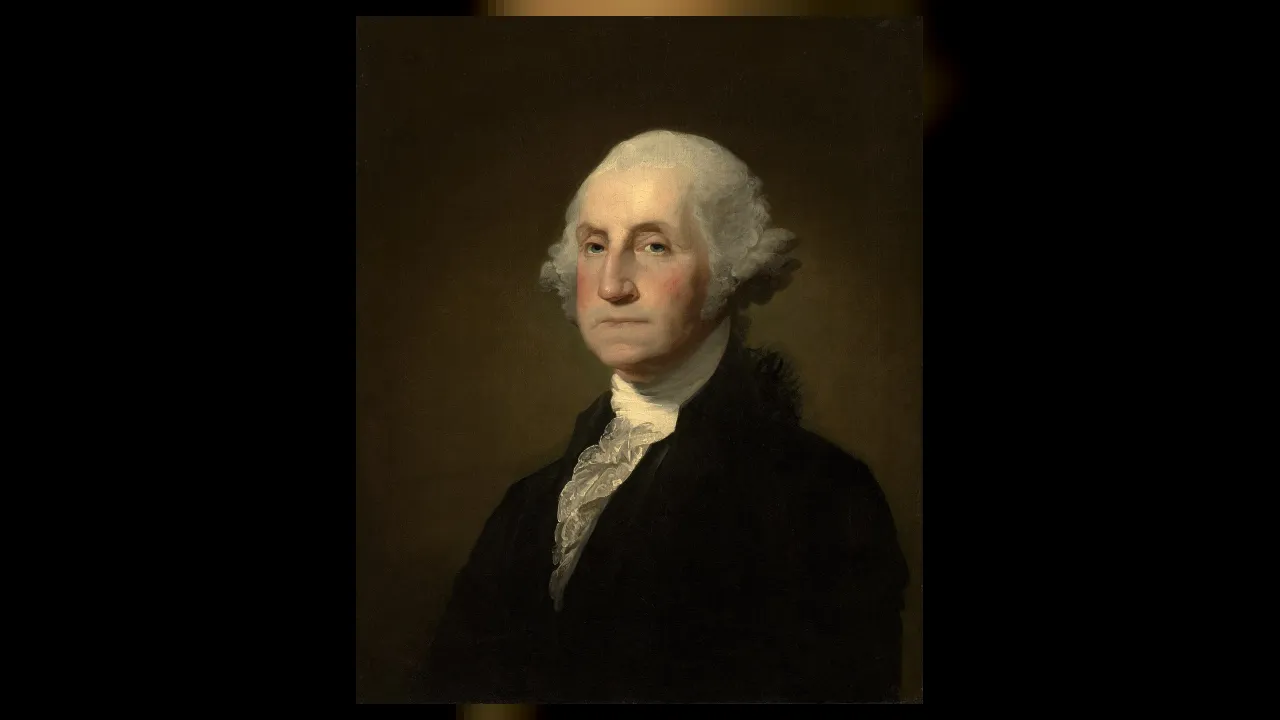
George Washington
General, First President, and Father of Our Country
Grade 2 • Developing • 100 words
⏳ Era / StatehoodPresidency: April 30, 1789 – March 4, 1797 (1732–1799)
🗺️ Region / CapitalMount Vernon • Commonwealth of Virginia
📜 Key MilestoneContinental Army Commander, 1787 Constitutional Convention President, and 1st U.S. President
⚡ Historical SparkFather of Our Country—twice walked away from power voluntarily so American democracy could thrive
🤯 Mind-Blowing Fact • Grade 1
Did George Washington really have wooden teeth? Nope—dentists actually made his dentures out of ivory, metal springs, and real animal teeth, never wood!
✨ Word Sparks (Grade 1 Glossary)
Tap 🔊 to hear
general
top leader who guides an army
president
elected leader of the United States
quarter
shiny American coin worth twenty-five cents
🪝
Why is George Washington's face on every one-dollar bill and shiny quarter?
1
Leading Through the Snow
Cold wind blows across an icy river! Brave soldiers row boats behind George Washington to help America become free.
2
Our First President
After the war, voters chose George Washington as our very first ! People called him the 'Father of Our Country.'
3
Home at Mount Vernon
He loved his Virginia farm, Mount Vernon, right beside the wide Potomac River.
1. Which number president of the United States was George Washington?
2. What famous nickname honors George Washington's leadership in starting the United States?
🤯 Mind-Blowing Fact • Grade 2
George Washington remains the only president in American history elected unanimously—receiving one hundred percent of the Electoral College votes twice!
✨ Word Sparks (Grade 2 Glossary)
Tap 🔊 to hear
surveyor
person who measures land to draw maps
unanimous
agreed on by every single voter together
term
set four-year time a president serves
🪝
Why did King George of Britain call George Washington 'the greatest character of the age'?
1
Young Virginia Mapmaker
Long before he led a nation, sixteen-year-old George carried brass compasses through Virginia's Shenandoah forests to draw accurate maps as a . Growing up along Virginia's rivers taught him patience, outdoor grit, and careful planning.
2
Keeping the Army Together
In 1775, Congress chose Washington to command the Continental Army in the Revolutionary War. He stayed right beside his freezing soldiers during the hard winter at Valley Forge and led the winning battle at Yorktown, Virginia, in 1781!
3
Stepping Down With Honor
Instead of making himself a king, Washington handed back his sword—and later stepped down after two as our first president so citizens could pick a new leader.
1. What job did teenage George Washington do in the woods of Virginia that helped him learn the land?
2. What amazed people around the world after George Washington won the Revolutionary War and served two terms as president?
🤯 Mind-Blowing Fact • Grade 3
George Washington loved creative farming at Mount Vernon so much that he designed a sixteen-sided wooden barn where horses walked in a dry circle upstairs to shake wheat grains loose through floor cracks!
✨ Word Sparks (Grade 3 Glossary)
Tap 🔊 to hear
precedent
first example that guides future decisions
Cabinet
team of top advisors helping the president
delegate
representative sent to speak at a convention
🪝
Why did George Washington insist on being called 'Mr. President' instead of 'Your Highness'?
1
Crossing the Icy Delaware
Picture sleet whipping across the Delaware River on Christmas night in 1776! Standing tall in a wooden boat, General George Washington led tired Continental soldiers across floating ice to win a surprise victory at Trenton, keeping hope for American independence alive through eight long years of war until victory at Yorktown in 1781.
2
Guiding the Constitutional Convention
After returning to his beloved farm at Mount Vernon in Virginia, Washington answered his country's call again in 1787. in Philadelphia elected him president of the Constitutional Convention, where his steady, trusted presence helped unite states behind the new U.S. Constitution.
3
Setting Every Presidential First
Sworn in at New York City on April 30, 1789, Washington knew every choice he made would set a —an example for future presidents. He rejected royal titles for simple 'Mr. President' and gathered trusted advisors into the first .
4
Two Terms and Home Again
In 1797, he retired peacefully after two four-year terms, establishing a democratic tradition that lasted for generations.
1. Why did George Washington choose the simple title 'Mr. President' in 1789?
2. What important meeting in Philadelphia did George Washington preside over in the summer of 1787?
🤯 Mind-Blowing Fact • Grade 4
George Washington's 1796 Farewell Address was never spoken aloud as a speech—instead, he published it directly in an everyday Philadelphia newspaper so citizens across every state could read it together!
✨ Word Sparks (Grade 4 Glossary)
Tap 🔊 to hear
commission
official paper granting military command authority
civilian
elected citizen leader outside the military
inaugurate
formally swear a leader into public office
🪝
How did one leader hold together an outnumbered army, a fragile convention, and a brand-new federal government?
1
Virginia Roots and Revolutionary Perseverance
Stand on the piazza at Mount Vernon in Fairfax County, Virginia, and gaze across the tidal Potomac River that shaped George Washington's life from his 1732 birth in Westmoreland County. As Commander-in-Chief of the Continental Army from 1775 to 1783, Washington lost more early battles than he won, yet he mastered the strategy that mattered most: keeping the army united, insisting that military officers obey elected leaders in Congress, and coordinating with French allies under Rochambeau and Lafayette to trap British General Cornwallis at Yorktown in October 1781.
2
The Resignation That Stunned Europe
Throughout history, victorious generals often seized permanent power. Instead, on December 23, 1783, inside the Maryland State House in Annapolis, Washington bowed to Congress, handed back his military , and rode home to plant crops by Christmas Eve! Four years later, his unifying leadership as presiding officer of the 1787 Constitutional Convention convinced skeptical citizens that the office of president could be trusted.
3
Building the Executive Branch From Scratch
Inaugurated on April 30, 1789, Washington remarked, 'I walk on untrodden ground.' Appointing brilliant thinkers with differing views—Secretary of State Thomas Jefferson, Treasury Secretary Alexander Hamilton, War Secretary Henry Knox, and Attorney General Edmund Randolph—he stabilized national finances, signed the Judiciary Act of 1789, selected the Potomac site for the future national capital, and kept the fragile young republic out of European wars.
4
Farewell Wisdom and Honest Legacy
In his famous 1796 Farewell Address, Washington urged Americans to cherish national unity above regional or partisan rivalries. And in his 1799 will—uniquely among slaveholding Founding Presidents—Washington arranged for the emancipation of all enslaved people he personally owned at Mount Vernon.
1. Why was George Washington's trip to Annapolis, Maryland, on December 23, 1783, considered a turning point for democracy?
2. What major piece of advice did George Washington share with Americans in his 1796 Farewell Address?
🤯 Mind-Blowing Fact • Grade 5
During the harsh Revolutionary War winter of 1777, George Washington ordered one of history's first mass military medical inoculations to protect his Continental soldiers from deadly smallpox—a scientific decision historians say saved the army!
✨ Word Sparks (Grade 5 Glossary)
Tap 🔊 to hear
indispensable
so essential that success depends upon it
neutrality
staying peaceful without taking sides in wars
inoculation
early medical step teaching bodies to resist disease
🪝
Why did historians call George Washington 'the indispensable man' of both the American Revolution and the Constitutional Republic?
1
Tidewater Youth to Continental Commander
Raised in Virginia's Northern Neck along the Rappahannock and Potomac rivers (1732–1799), George Washington gained early frontier experience surveying Lord Fairfax's Shenandoah lands at sixteen and serving in the Virginia militia before entering the House of Burgesses in Williamsburg. When the Second Continental Congress met in Philadelphia after Lexington and Concord in June 1775, Massachusetts delegate John Adams nominated the tall Virginian to command the Continental Army—forging essential solidarity between New England and Southern colonies.
2
Strategic Patience, Valley Forge, and Civilian Supremacy
Commanding citizen-soldiers against the eighteenth century's premier military empire, Washington recognized that the Revolution lived as long as the Continental Army survived in the field. Bold winter counterstrokes at Trenton and Princeton (1776–1777), disciplined training alongside Baron von Steuben and against smallpox at Valley Forge (1777–1778), and a swift 450-mile Franco-American march south to besiege Yorktown in October 1781 secured independence. Equally vital were his civic choices: quelling an officer mutiny at Newburgh in 1783 with a quiet plea for republican virtue and resigning his commission to Congress at Annapolis like an American Cincinnatus.
3
Anchor of Philadelphia and Precedent-Setting Executive
Alarmed by weaknesses under the Articles of Confederation, Washington chaired the 1787 Constitutional Convention in Philadelphia; historians note that delegates drafted Article II's executive powers confident that Washington would be its first steward. Unanimously chosen in both 1788–1789 and 1792—the sole president never affiliated with a political party—he established foundational constitutional precedents: forming a balanced Cabinet (Jefferson, Hamilton, Knox, Randolph), approving the First Bank of the United States and the Bill of Rights' transmission to the states, issuing the 1790 Touro Synagogue letter affirming religious liberty ('to bigotry gives no sanction'), and proclaiming during European conflict in 1793.
4
The Two-Term Tradition and the Farewell Address
Co-drafted with James Madison and Alexander Hamilton and printed in September 1796, Washington's Farewell Address counseled citizens to prize their national Union, uphold public credit and education, and steer clear of permanent foreign alliances. By declining a third term and attending John Adams's 1797 inauguration as a private citizen, Washington established the peaceful transfer of executive power—later codified in the Twenty-Second Amendment (1951).
5
Mount Vernon, Moral Reckoning, and Enduring Memory
At Mount Vernon, Washington pioneered crop rotation, soil conservation, and innovative granaries while grappling late in life with the contradiction between human bondage and republican liberty—directing in his 1799 last will and testament the emancipation and educational support of the 123 enslaved individuals he personally owned. Remembered in Henry 'Light-Horse Harry' Lee's eulogy as 'first in war, first in peace, and first in the hearts of his countrymen,' his legacy anchors Virginia SOL and national civic education.