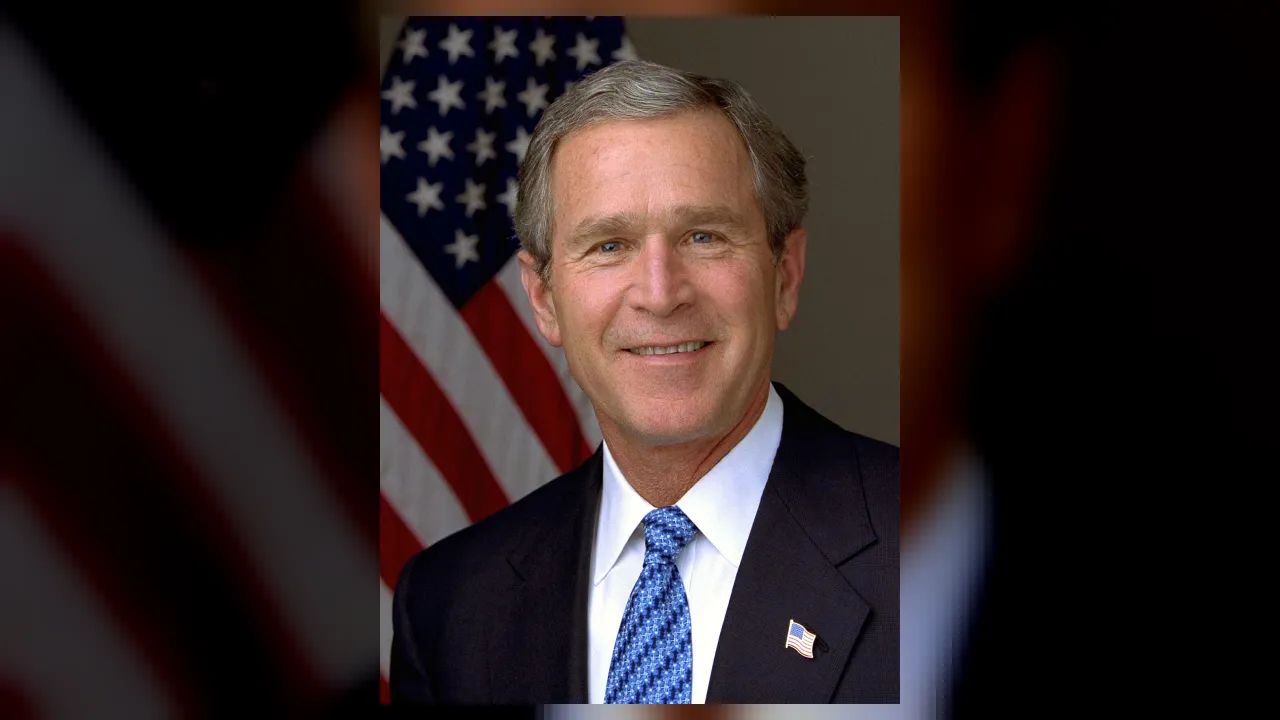
📜 Key MilestonePost-9/11 National Unity, Homeland Security & PEPFAR Global Health
⚡ Historical SparkRallied Americans after September 11 and launched a global health program saving 25 million lives
🤯 Mind-Blowing Fact • Grade 1
Before becoming governor of Texas and forty-third president, baseball fan George W. Bush helped run the Texas Rangers Major League Baseball team—and threw a perfect strike from the Yankee Stadium pitcher's mound at the 2001 World Series!
✨ Word Sparks (Grade 1 Glossary)
Tap 🔊 to hear
bullhorn
A handheld speaker that makes your voice loud
firefighter
A brave helper who puts out fires and rescues
sanctuary
A safe protected home for ocean or land animals
🪝
What happens when a president's dad was also president just eight years earlier?
1
Growing Up in Texas
Crack! Out on dusty Little League baseball fields in Midland, Texas, young George loved catching fly balls! Years later, voters chose him as governor of Texas—and then forty-third president!
2
Standing Together Bravely
In September 2001, America faced a sad, scary attack. Holding a beside brave , President Bush comforted families and reminded citizens to stand united.
3
Saving Oceans and Lives
He also protected a giant Hawaiian ocean home for sea turtles and sent life-saving medicine that helped millions of families across Africa!
1. Which sport did George W. Bush love so much that he once helped run the Texas Rangers team?
2. What giant nature area did President Bush protect around northwestern Hawaiian islands in 2006?
🤯 Mind-Blowing Fact • Grade 2
After retiring from the White House, George W. Bush took up oil painting as a brand-new hobby and painted colorful portraits of wounded American veterans and immigrants to honor their courage!
✨ Word Sparks (Grade 2 Glossary)
Tap 🔊 to hear
first responder
Firefighters, police, and medics who rush to help
coral reef
Colorful underwater habitat built by tiny sea creatures
veteran
A person who has served in the military
🪝
How did our forty-third president comfort Americans after a national tragedy and help save twenty-five million lives abroad?
1
Second Father-Son Presidential Pair
Play ball! Raised in West Texas, George W. Bush served as a pilot in the Texas Air National Guard, worked in business and Major League Baseball, and served two terms as governor of Texas. When he took office as our forty-third president in 2001, he and his father George H.W. Bush matched John and John Quincy Adams!
2
Courage and Unity After September 11
On September 11, 2001, terrorists attacked New York City, the Pentagon in Arlington, Virginia, and a flight over Pennsylvania. Standing arm in arm with rescue workers, Bush rallied Americans together and created the Department of Homeland Security to keep travel and cities safer.
3
Reading, Reefs, and Global Medicine
Working with both parties in Congress, Bush signed major school-reading laws, protected vast Pacific near Hawaii, and launched an emergency health plan that has saved twenty-five million lives across Africa!
1. Which historic building in Arlington, Virginia, was repaired and honored after the attacks of September 11, 2001?
2. What creative new skill did George W. Bush learn in retirement to honor wounded U.S. service members?
🤯 Mind-Blowing Fact • Grade 3
Started by President Bush and a bipartisan Congress in 2003, the PEPFAR global health program has saved more than twenty-five million lives from HIV/AIDS and malaria—making it the largest single-disease health rescue in human history!
✨ Word Sparks (Grade 3 Glossary)
Tap 🔊 to hear
Electoral College
The constitutional state-by-state system that elects presidents
reorganize
To arrange departments in a new, coordinated way
literacy
The ability to read and write confidently
🪝
Why did the 2000 presidential election go all the way to the U.S. Supreme Court before our forty-third president took office?
1
Texas Governor and Historic 2000 Election
Imagine an election so razor-close across a hundred million voters that everything came down to a few hundred paper ballots in Florida! After graduating from Yale and Harvard Business School and serving two popular terms as governor of Texas, George Walker Bush won the contested 2000 vote after a Supreme Court ruling, taking office peacefully in January 2001.
2
Responding to September 11, 2001
Eight months into his presidency, terrorists hijacked four airliners on September 11, 2001, striking New York's World Trade Center, the Pentagon in Virginia, and a field near Shanksville, Pennsylvania. Speaking through a bullhorn at Ground Zero—'I can hear you! The rest of the world hears you!'—Bush united the nation, visited an Islamic center to urge respect for Muslim American neighbors, and reorganized safety agencies into the Department of Homeland Security.
3
Overseas Conflicts and Tough Challenges
America and NATO allies entered Afghanistan in 2001 to dismantle terrorist camps, and in 2003 U.S.-led forces toppled Iraqi dictator Saddam Hussein—leading to two long, difficult wars. During his second term, Hurricane Katrina (2005) and the 2008 financial downturn tested federal emergency and economic responses.
4
PEPFAR and Ocean Conservation
Alongside First Lady Laura Bush—a former school librarian—President Bush championed global , protected hundreds of thousands of square miles of Pacific marine sanctuaries, and launched PEPFAR in 2003, a bipartisan global health partnership credited with saving more than twenty-five million lives!
1. Why did President Bush visit the Islamic Center of Washington just six days after September 11, 2001?
2. What record-setting achievement is President Bush's 2003 PEPFAR initiative celebrated for around the world?
🤯 Mind-Blowing Fact • Grade 4
With First Lady Laura Bush and Librarian of Congress James Billington, the Bush administration launched the very first National Book Festival on the National Mall in September 2001—a free celebration of reading still enjoyed by hundreds of thousands of book lovers!
✨ Word Sparks (Grade 4 Glossary)
Tap 🔊 to hear
recount
Counting election ballots a second time to verify
tolerance
Respecting neighbors whose beliefs or backgrounds differ
ecosystem
Living plants and animals interacting with their environment
🪝
How did the events of September 11, 2001, reshape George W. Bush's presidency, national security, and America's role in the twenty-first century?
1
From West Texas to a Razor-Thin Election
Born in Connecticut in 1946 while his father attended Yale after World War II, George W. Bush grew up in Midland and Houston, Texas. Educated at Yale and Harvard Business School, he worked in the Texas energy industry and co-owned the Texas Rangers baseball team before winning two elections as governor of Texas (1994 and 1998). In 2000, though Vice President Al Gore edged the national popular vote, Bush won Florida's decisive electoral votes following the Supreme Court's Bush v. Gore ruling on standards, demonstrating America's peaceful constitutional transfer of power.
2
Education Reform and September 11
Initially focusing on domestic issues, Bush signed 2001 tax reductions and partnered across party lines with Senator Edward Kennedy to pass the No Child Left Behind Act (signed January 2002), emphasizing reading and math benchmarks. Everything changed on the clear Tuesday morning of September 11, 2001, when al-Qaeda hijackers struck the World Trade Center, the Pentagon in Arlington, Virginia, and Flight 93 over Shanksville, Pennsylvania, claiming nearly 3,000 lives. Bush's bullhorn message at Ground Zero, visit to Washington's Islamic Center defending religious , and September 20 address to Congress rallied national resolve.
3
Homeland Security, Afghanistan, and Iraq
Congress and Bush created the cabinet-level Department of Homeland Security—merging twenty-two agencies—and enacted the USA PATRIOT Act, sparking ongoing civic debates over balancing security and privacy. Internationally, NATO invoked its mutual-defense clause for the first time in history as U.S. and allied forces removed Afghanistan's Taliban regime in late 2001. In March 2003, citing intelligence fears over weapons of mass destruction that later proved unfounded, Bush led a coalition into Iraq that deposed Saddam Hussein, followed by years of difficult insurgency before a 2007 troop surge reduced violence.
4
Global Humanitarian Aid, Marine Conservation, and 2008 Response
Reelected in 2004, Bush appointed Chief Justice John Roberts and Justice Samuel Alito to the Supreme Court, signed Medicare prescription-drug coverage for seniors, protected over 330,000 square miles of Pacific marine (including Hawaii's Papahanaumokuakea Marine National Monument), and championed the President's Malaria Initiative and PEPFAR—saving over twenty-five million lives. Facing the severe 2008 financial crisis in his final months, he worked with Congress and incoming President Barack Obama to stabilize the banking system.
1. Why did NATO allies invoke Article 5—their mutual-defense promise—for the very first time in history in September 2001?
2. Which cabinet department did President Bush and Congress establish in 2002 to coordinate airport, border, Coast Guard, and emergency safety?
🤯 Mind-Blowing Fact • Grade 5
Using the same 1906 Antiquities Act that Theodore Roosevelt signed a century earlier, President George W. Bush protected more than 330,000 square miles of pristine Pacific coral reefs, sea-turtle habitats, and deep-ocean trenches between 2006 and 2009!
✨ Word Sparks (Grade 5 Glossary)
Tap 🔊 to hear
pluralism
Diverse faiths and backgrounds living peacefully together
disaggregated
Broken down into subgroups so nobody gets overlooked
continuity
Smooth, unbroken continuation from one leader to next
🪝
How did George W. Bush navigate the constitutional, security, humanitarian, and economic turning points of the early twenty-first century?
1
Midland Upbringing, Texas Governorship, and 2000 Election
Raised in Midland and Houston, Texas, George Walker Bush graduated from Yale University (1968) and became the first U.S. president to hold an M.B.A., earned from Harvard Business School (1975). After working in energy exploration and serving as managing general partner of the Texas Rangers baseball franchise, he won two terms as governor of Texas (1995–2000), building bipartisan coalitions with Democratic legislative leaders around school accountability and juvenile-justice reform. The November 2000 presidential election against Vice President Al Gore produced the closest Electoral College outcome (271–266) since 1876; following thirty-six days of Florida recount litigation resolved by the Supreme Court in Bush v. Gore, Gore delivered a gracious concession upholding constitutional .
2
Domestic Reform and the Hinge of September 11
During his opening months in 2001, Bush enacted major tax reductions and partnered across the aisle with Senator Edward M. Kennedy and Representative George Miller on the No Child Left Behind Act (signed January 2002), linking federal Title I school funding to reading and mathematics reporting. On September 11, 2001, coordinated terrorist hijackings destroyed New York's Twin Towers, struck the Pentagon in Arlington, Virginia, and crashed Flight 93 near Shanksville, Pennsylvania, killing 2,977 innocent people. Bush's steady bullhorn reassurance to exhausted rescue crews on September 14, his September 17 address at the Islamic Center of Washington affirming and religious freedom, and his September 20 joint-session speech unified a grieving nation.
3
Reorganizing National Security and Two Prolonged Wars
Working with Congress, Bush signed the Homeland Security Act of 2002—integrating twenty-two federal entities into the Department of Homeland Security—reorganized intelligence coordination in 2004, and enacted the USA PATRIOT Act, prompting enduring constitutional dialogue over fourth-amendment privacy and national defense. Backed by UN resolutions and NATO's historic first invocation of Article 5, Operation Enduring Freedom toppled Afghanistan's Taliban regime in late 2001. In March 2003, authorized by Congress amid concerns over Iraqi weapons of mass destruction that postwar inspections found did not exist, U.S.-led coalition forces removed Saddam Hussein, initiating a costly multi-year conflict in Iraq that stabilized somewhat following the 2007 'surge' strategy.
4
PEPFAR, Ocean Stewardship, and Second-Term Trials
Reelected in November 2004, Bush appointed Chief Justice John G. Roberts Jr. and Justice Samuel A. Alito Jr., enacted the 2003 Medicare Prescription Drug Act, and used the Antiquities Act between 2006 and 2009 to establish four vast Pacific marine national monuments—starting with Hawaii's 140,000-square-mile Papahanaumokuakea Marine National Monument—at the time the largest marine conservation areas on Earth. Most enduringly abroad, his 2003 President's Emergency Plan for AIDS Relief (PEPFAR) and 2005 President's Malaria Initiative mobilized bipartisan congressional funding that has saved over twenty-five million lives across sub-Saharan Africa and beyond.
5
Hurricane Katrina, the 2008 Financial Crisis, and Graceful Transition
Bush's second term also faced severe domestic tests: federal emergency shortcomings after Hurricane Katrina devastated the Gulf Coast in August 2005, and the acute global financial crisis of September 2008. Prioritizing economic stability during his final months, Bush partnered with Federal Reserve Chair Ben Bernanke, Treasury Secretary Henry Paulson, congressional leaders of both parties, and President-elect Barack Obama to enact the Emergency Economic Stabilization Act, then conducted what observers hailed as a model, cooperative presidential transition in January 2009.
1. Which 1906 conservation law originally signed by Theodore Roosevelt did George W. Bush use a century later to protect vast Pacific Ocean ecosystems?
2. Why is the 2003 PEPFAR program widely studied as a model of twenty-first-century American humanitarian leadership?