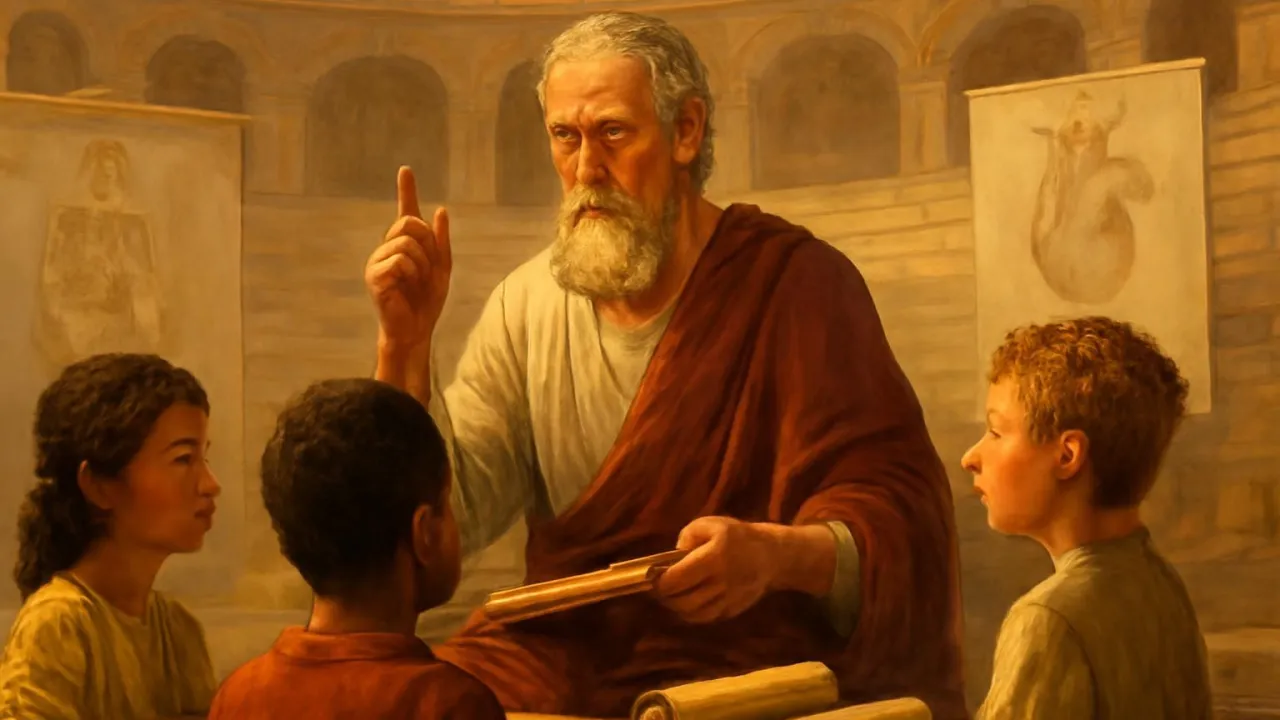
Galen
The Ancient Doctor Who Changed Medicine Forever
Galen wrote over three hundred books about medicine!
What if you could help fix a hurt friend?
1 Curious Young Healer
Galen loved to ask questions. He watched help people. He wanted to help, too.
2 Learning About Bodies
He read many old books. He drew pictures of . He learned how bodies work.
3 Helping People Feel Better
Galen became a . He helped sick people. He taught others to care, too.
1. What did Galen love to do?
2. What did Galen draw pictures of?
Galenโs ideas were used by doctors for over 1,000 years!
Have you ever wondered how your body works inside?
1 A Boy with Big Questions
Galen grew up near a busy city. He watched doctors help people and wanted to learn more. He asked many questions about how bodies heal.
2 Learning from Books and Practice
Galen read old and watched animals. He drew careful pictures to remember what he saw. He practiced helping people and learned from mistakes.
3 A Famous Ancient Doctor
Galen became a doctor for and . He wrote hundreds of books about medicine and the body. People studied his work for hundreds of years.
1. Who did Galen help as a doctor?
2. What did Galen use to learn?
Galenโs notes about the brain and nerves were used for centuries after his death.
Imagine being the doctor everyone in ancient Rome trusted most!
1 A Curious Mind in Pergamon
Young Galen grew up in Pergamon, a city with a famous healing temple. He watched doctors treat patients and asked endless questions about sickness and health. His father encouraged him to study science and explore nature. These early experiences sparked Galenโs lifelong curiosity about the human body.
2 Studying the Body Up Close
Galen read ancient Greek medical texts and observed animal . He drew detailed diagrams of bones, muscles, and to understand how they worked together. By practicing surgery on wounded gladiators, he learned how to treat injuries. His careful observations made him a skilled and trusted healer.
3 Teaching and Writing for the World
Galen became the personal doctor to Roman emperors and taught other doctors. He wrote over 350 books about medicine, sharing his discoveries about blood, nerves, and the brain. His books became the main source of medical knowledge in Europe and the Middle East. Doctors followed his ideas for over a thousand years.
4 Changing Medicine Forever
Galen believed in asking questions and testing ideas. He showed that observation and were important in medicine. Even though he sometimes made mistakes, his methods shaped how doctors learned and practiced. Galenโs work helped medicine become a science based on careful study.
1. How did Galen learn about the body?
2. Why did Galen write so many books?
Galenโs medical books were still taught in European universities 1,400 years after he died.
What if your ideas about the body shaped medicine for over a thousand years?
1 From Pergamon to Rome: A Lifelong Student
As a boy in Pergamon, Galen was fascinated by the healing temple of Asclepius and the doctors who worked there. His father, a respected architect, encouraged him to study mathematics, philosophy, and nature, which helped Galen develop a scientific mind. After his fatherโs death, Galen decided to devote his life to medicine, traveling to cities like Smyrna and Alexandria to learn from the best teachers. These early experiences gave him a strong foundation in both Greek and Roman medical traditions.
2 Innovative Experiments and Observations
Galenโs career took off when he became the physician for gladiators in Pergamon, where he treated serious wounds and learned about muscles, bones, and nerves firsthand. He performed animal to study anatomy, since human dissection was not allowed, and recorded his findings in detailed illustrations. Galenโs experiments led him to new ideas about how blood moves through veins and arteries, even though some of his theories were later proven wrong. His careful methods made him one of the most respected doctors in the Roman Empire.
3 A Teacher and Author for the Ages
Galen moved to Rome, where he became the personal doctor to several emperors, including Marcus Aurelius. He taught other doctors, gave public demonstrations, and wrote over 350 medical texts on topics like anatomy, disease, and surgery. His books, written in Greek, became the main source of medical knowledge in Europe, the Middle East, and North Africa for centuries. Galenโs influence was so great that doctors followed his teachings long after he died.
4 Legacy: Shaping the Science of Medicine
Galen believed that observation, logic, and experimentation were the best ways to learn about the body. He combined ideas from Greek philosophers with his own discoveries, helping to turn medicine into a science based on evidence. Although some of his ideas were later corrected, his approach inspired generations of doctors to ask questions and seek proof. Galenโs lives on in the way doctors study, , and treat patients today.
1. Why did Galen study animals instead of people?
2. How did Galenโs books help other doctors?
Galenโs writings made up nearly half of all surviving ancient Greek medical literature.
How did one ancient doctorโs curiosity and experiments shape the future of medicine for centuries?
1 The Spark of Curiosity in Ancient Pergamon
In the bustling city of Pergamon, young Galen was surrounded by temples, libraries, and bustling marketplaces, but it was the grand healing shrine of Asclepius that truly captured his imagination. Encouraged by his scholarly father, Galen studied mathematics, , and nature, developing a sharp, questioning mind. After his fatherโs death, Galen committed himself to medicine, traveling to famous learning centers like Smyrna, Corinth, and Alexandria to study with the most renowned physicians of his time. These early experiences gave him a broad foundation in both Greek and Roman science, philosophy, and medicine.
2 Mastering Anatomy Through Observation and Experimentation
Galenโs first major position was as a physician to gladiators in Pergamon, where he treated traumatic injuries and learned about the bodyโs structure from real-life cases. Because human dissection was forbidden in Rome, he performed detailed dissections on pigs and monkeys, recording his findings in precise anatomical drawings. Through these experiments, Galen advanced understanding of the nervous system, showing that the brain, not the heart, controlled movement and sensation. He also proposed that blood flowed through arteries and veins, although his ideas about were later revised by others.
3 Scholar, Teacher, and Imperial Physician
After moving to Rome, Galenโs reputation soared as he became physician to several Roman emperors, including Marcus Aurelius. He delivered public lectures, conducted live demonstrations, and taught hundreds of students, emphasizing the importance of observation, logic, and experimentation in medical practice. Galen wrote more than 350 on topics such as anatomy, physiology, disease, and pharmacology, many of which became foundational texts for medical students across Europe, the Middle East, and North Africa. His writings, translated into Latin and Arabic, shaped medical education for over a millennium.
4 Legacy and Limitations: The Long Shadow of Galenโs Ideas
Galenโs approach combined careful observation with theories from Greek philosophers like Hippocrates and Aristotle, helping to transform medicine from superstition to science. However, because his books were so influential, some of his mistakesโsuch as errors about blood flow and organ functionโwere accepted as fact for centuries. Later scientists, like Andreas Vesalius and William Harvey, eventually corrected these errors, but Galenโs insistence on evidence and experimentation paved the way for modern scientific medicine.
5 Inspiration for Future Generations
Galenโs story reminds us that curiosity, careful study, and a willingness to question old ideas can change the world. His work influenced not only doctors, but also scientists and philosophers who came after him. Today, doctors still use some of Galenโs methods, such as careful observation and detailed record-keeping, in their daily practice. Galenโs legacy endures as a symbol of lifelong learning and the power of asking, 'How does it work?'
1. How did Galenโs experiments change what people knew about the brain?
2. Why did Galenโs books remain important for so long?