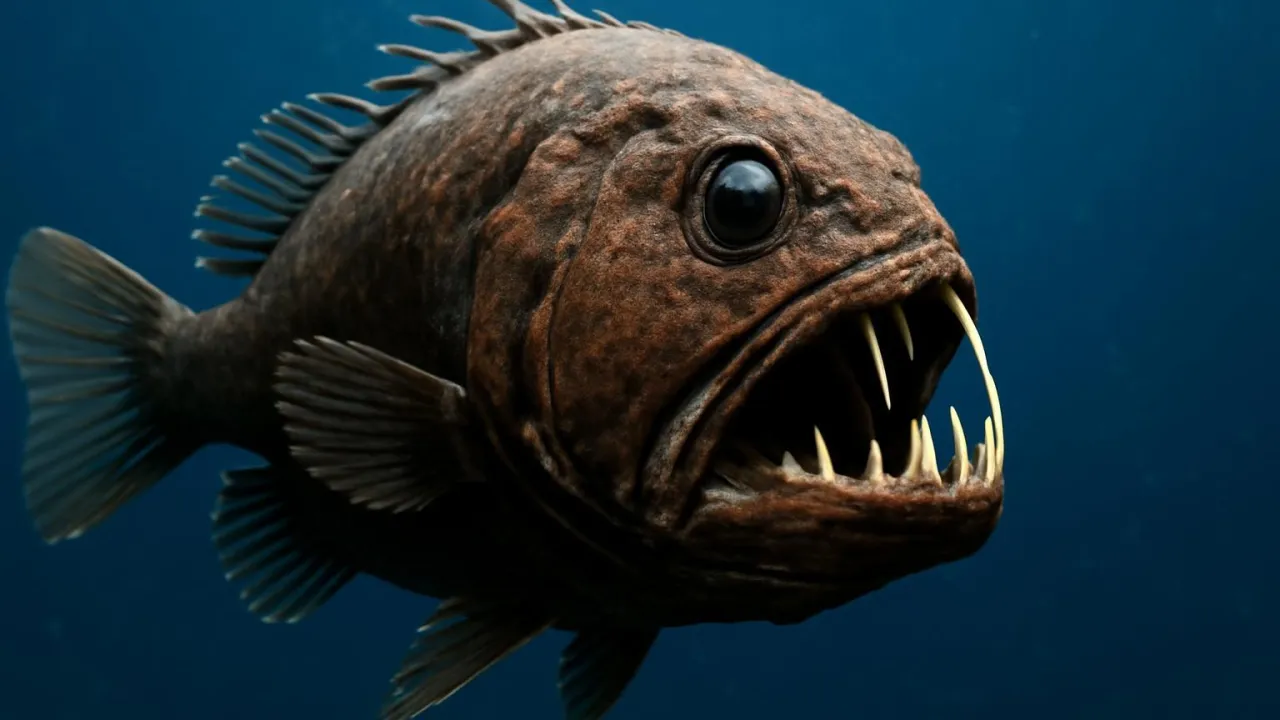
Fangtooth’s teeth are so long they cannot fit inside its mouth fully!
✨ Word Sparks (Grade 2 Glossary)
Tap 🔊 to hear
prey
An animal that another animal eats
depth
How deep or far down something is
pressure
Force pushing on something from all sides
🪝
Have you ever wondered how a tiny fish can have huge, scary teeth?
1
Huge Teeth on a Small Fish
The fangtooth fish has very large teeth that look sharp and dangerous. It uses these teeth to catch and hold its tightly. Even though it is small, its teeth are bigger than its head. This helps the fangtooth eat other fish and squid.
2
Living in the Deep Ocean
Fangtooth lives very deep in the ocean where it is dark and cold. It swims at between 2,000 and 5,000 feet. Because of the darkness, it has a dark color to hide from predators. It stays hidden and waits to catch food.
3
Strong and Ready to Hunt
Though the fangtooth is only about six inches long, it is a fierce hunter. Its body is built to survive in deep water . The big teeth help it bite hard and hold on to slippery . It eats small fish and squid to get energy.
Fangtooth’s teeth can be half as long as its entire body length!
✨ Word Sparks (Grade 3 Glossary)
Tap 🔊 to hear
camouflage
Colors or shapes that help hide an animal
predator
An animal that hunts other animals for food
nutrients
Parts of food that help animals grow strong
🪝
How does the fangtooth’s huge teeth help it survive in the deep ocean?
1
Fangtooth’s Sharp Teeth
The fangtooth fish has enormous, sharp teeth that help it catch prey. These teeth are so big they cannot fit fully inside its mouth. This adaptation allows it to grab slippery fish and squid easily. Its teeth are a powerful defense against .
2
Living in Extreme Depths
Fangtooth lives in the deep ocean where sunlight does not reach. This dark habitat requires special adaptations like . Its dark body color helps it blend into the black water to avoid . It can survive the high pressure found thousands of feet underwater.
3
Hunting and Feeding
Fangtooth is a that hunts small fish and squid for . It uses its large teeth to hold prey tightly and prevent escape. Its strong jaws can bite hard to tear food into pieces. This fish’s body shape helps it swim quietly to sneak up on prey.
4
Amazing Adaptations
The fangtooth’s adaptations help it survive in a harsh environment. Its teeth and are key to avoiding and catching prey. Living in the deep ocean means it must conserve energy and be patient. These traits make the fangtooth a successful deep-sea predator.
1. Why can the fangtooth hide well in the deep ocean?
2. What does the fangtooth use its big teeth for?
🤯 Mind-Blowing Fact • Grade 4
Fangtooth teeth can be up to half its body length, an extreme adaptation for deep-sea hunting.
✨ Word Sparks (Grade 4 Glossary)
Tap 🔊 to hear
ecosystem
All living and nonliving things in one place
adaptation
A change that helps animals survive better
camouflage
Colors or patterns that help hide animals
🪝
What makes the fangtooth one of the fiercest predators in the deep ocean?
1
Teeth That Defy Size
The fangtooth fish has enormous teeth that are longer than its head, making it a fearsome predator. These teeth cannot fit completely inside its mouth, so they stick out even when it closes its jaws. This unique allows it to catch and hold slippery prey effectively. The fangtooth’s large teeth are critical for its survival in the deep ocean’s harsh environment.
2
Surviving in Dark Depths
Living between 2,000 and 5,000 feet below the ocean surface, the fangtooth survives in near-total darkness. The extreme pressure at these depths requires special body to prevent injury. Its dark coloration provides , helping it avoid predators and sneak up on prey. This fish plays an important role in the deep-sea food web as both predator and prey.
3
Role in the Deep-Sea Ecosystem
As a predator, the fangtooth controls populations of smaller fish and squid, maintaining balance in the . It also serves as prey for larger deep-sea creatures, creating a complex food web. Human activities like deep-sea fishing can impact fangtooth populations, although they live in areas less affected by humans. Understanding its role helps scientists protect deep ocean biodiversity.
4
Adaptations for Hunting
The fangtooth’s powerful jaws and sharp teeth allow it to bite through tough prey skin and hold on tightly. Its body shape and swimming style enable quiet, efficient movement to surprise prey. Because food is scarce in the deep ocean, fangtooths conserve energy by waiting patiently for prey. These make it a successful hunter in a challenging environment.
2. What role does the fangtooth play in its ecosystem?
🤯 Mind-Blowing Fact • Grade 5
Fangtooth teeth can be half as long as its body, a rare feature unmatched by most fish species.
✨ Word Sparks (Grade 5 Glossary)
Tap 🔊 to hear
bathypelagic
Deep ocean zone with no sunlight
bioluminescent
Light made by animals in the dark
taxonomy
How scientists group and name living things
🪝
How does the fangtooth’s unique anatomy allow it to thrive under extreme deep-sea conditions?
1
Scientific Classification and Discovery
The fangtooth fish, scientifically named Anoplogaster cornuta, belongs to the family Anoplogastridae. It was first described in 1851 and is known for its distinctive large teeth and deep-sea habitat. This species inhabits mesopelagic to zones, typically between 600 and 1,500 meters depth. Its highlights evolutionary adaptations to extreme oceanic environments.
2
Physiological Adaptations to Pressure and Darkness
Fangtooths possess dense, robust bones and specialized muscles that withstand immense pressure at depths exceeding 1,500 meters. Their large, fang-like teeth are anchored securely to prevent damage during predation. Their bodies produce organs for limited communication and prey attraction, although fangtooths themselves are mostly dark-colored to avoid detection. These adaptations enable survival in cold, high-pressure, and lightless conditions.
3
Feeding Mechanics and Hunting Strategy
The fangtooth uses its disproportionately large teeth, which can be up to half its body length, to impale and grasp prey such as small fish and cephalopods. Its powerful jaw muscles allow rapid biting force, compensating for scarce prey availability. The fangtooth’s streamlined body facilitates silent stalking, while its sensory systems detect faint movements in the dark. This hunting strategy maximizes energy efficiency in a nutrient-poor habitat.
4
Conservation Status and Human Impact
Currently, fangtooth populations are considered stable due to their deep-sea habitat, which is less affected by human activities. However, increased deep-sea fishing and ocean pollution pose potential threats. Scientific monitoring is essential to understand population dynamics and ecosystem roles. Protecting deep-sea biodiversity ensures the survival of unique species like the fangtooth.
5
Quantitative Comparisons and Environmental Context
Fangtooths grow up to 15 centimeters long and weigh less than a pound. They inhabit depths where water pressure exceeds 150 atmospheres and temperatures range from 4 to 10 degrees Celsius. Their teeth can measure up to 7.5 centimeters, nearly half their body length. Compared to other deep-sea fish, fangtooths have some of the largest teeth relative to body size, a remarkable evolutionary trait.