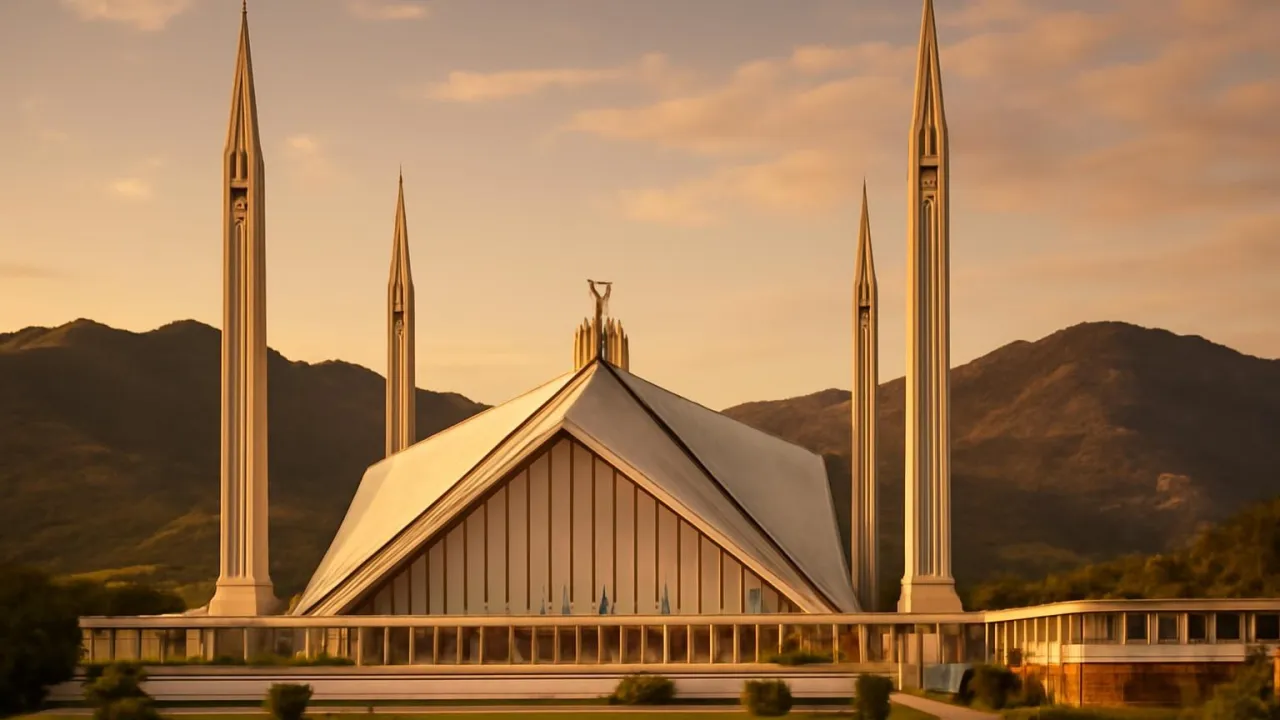
The Faisal Mosque is the biggest mosque in all of Pakistan!
✨ Word Sparks (Grade 2 Glossary)
Tap 🔊 to hear
Islamabad
The capital city of Pakistan
mountain
A very tall hill
prayer
Talking to God
🪝
Have you ever seen a building shaped like a mountain tent?
1
A Tent in the City
The Faisal Mosque looks like a giant tent, with sharp white peaks. Its roof was made to look like the nearby . Many people come to see its bright white walls and roof.
2
Towers That Touch the Sky
Each corner has a tall minaret, which is a tower for calling to . The minarets are thin and look like pencils pointing up. Visitors can see them from far away and know where the mosque is.
3
A Place for Everyone
Inside, the mosque is huge and peaceful, with room for many people. People come to pray, learn, or take quiet walks. The mosque welcomes visitors from all over the world.
The Faisal Mosque’s roof has no dome or arches, just a giant tent shape!
✨ Word Sparks (Grade 3 Glossary)
Tap 🔊 to hear
architecture
How buildings are designed and built
minaret
A tall, thin mosque tower
pillar
A tall post that holds up a roof
🪝
Can you imagine a building shaped like a mountain tent, sparkling in the sun?
1
A Tent Among the Hills
The Faisal Mosque’s roof looks like a giant white tent, inspired by the nearby Margalla Hills. Its sharp, pointed peaks mimic the mountains behind it. The bright white color makes it shine in the sunlight. Many people visit to see its unique tent shape.
2
Minarets That Reach Up
At each corner stands a tall , which is a slender tower for the call to prayer. These minarets are 272 feet high and shaped like pencils. Their design is different from the round minarets seen in many other mosques. The tall minarets help the mosque stand out from far away.
3
A Space for Thousands
The mosque can hold more than 70,000 people at once, both inside and outside. Its prayer hall is huge, with no in the middle, so everyone can see the front. The roof’s tent shape keeps the space open and airy. People from all over the world come to pray, learn, and visit.
4
Modern Design and Meaning
The Faisal Mosque was built between 1976 and 1986, using modern engineering. Its roof uses strong concrete and marble, with special supports instead of arches. The design shows how modern can blend with tradition. The mosque is a symbol of Pakistan and Islamic culture.
1. Why does the mosque have no pillars in the middle?
2. What inspired the roof’s shape?
🤯 Mind-Blowing Fact • Grade 4
The Faisal Mosque’s prayer hall can hold up to 10,000 people at once, with space for 70,000 more outside!
✨ Word Sparks (Grade 4 Glossary)
Tap 🔊 to hear
reinforced concrete
Strong concrete with steel bars inside
symmetrical
The same on both sides
imam
A leader who guides prayers
🪝
What if a mosque could look like a mountain and a tent at the same time?
1
A Modern Marvel in the Hills
The Faisal Mosque sits at the foot of the Margalla Hills, its soaring white roof echoing the sharp peaks behind it. Designed by Turkish architect Vedat Dalokay, the mosque’s tent-like roof was chosen to blend with the natural landscape. Its eight-sided shell structure is made of and covered in gleaming white marble. The mosque’s unique shape makes it one of the most recognizable landmarks in Pakistan.
2
Towering Minarets and Open Space
Each of the four minarets rises 272 feet, inspired by Turkish pencil-style towers rather than traditional domed minarets. These slender towers mark the mosque’s corners, giving it a balanced and look. The main prayer hall covers 54,000 square feet and features no interior pillars, thanks to innovative engineering. This open design allows thousands of worshippers to see and hear the clearly.
3
Engineering Without Arches or Domes
Unlike most large mosques, the Faisal Mosque has no central dome or traditional arches. Its roof uses a series of triangular concrete panels, forming a giant tent supported by steel cables and beams. This structure creates a vast, unobstructed interior space, while the marble reflects sunlight and keeps the building cool. The mosque’s design combines modern engineering with Islamic artistic traditions.
4
A Symbol for the Nation
Built between 1976 and 1986, the mosque was named after King Faisal of Saudi Arabia, who funded its construction. It stands as a symbol of unity, modernity, and faith for Pakistan and the Muslim world. The mosque hosts national ceremonies and welcomes visitors from around the globe. Its blend of tradition and innovation makes it an architectural wonder admired worldwide.
The Faisal Mosque’s minarets are taller than a 25-story building and visible from miles away!
✨ Word Sparks (Grade 5 Glossary)
Tap 🔊 to hear
acoustic resonance
How sound travels and echoes in a space
structural ingenuity
Smart ways engineers solve building challenges
sacred space
A special place for worship
🪝
Imagine standing beneath a vast tent of marble, with sunlight sparkling off sharp peaks—how did engineers make such a wonder?
1
A Vision Inspired by Nature and Faith
The Faisal Mosque rises dramatically at the base of Islamabad’s Margalla Hills, its angular white form mirroring the jagged mountain skyline. Turkish architect Vedat Dalokay designed the mosque after winning an international competition in 1969, envisioning a structure that blended Islamic traditions with modern engineering. Instead of domes and arches, he proposed a tent-like roof, symbolizing the Bedouin tents of the Arabian desert and the unity of worshippers under one shelter. This bold vision set the stage for one of the world’s most iconic modern mosques.
2
Engineering the Tent-Shaped Roof
The mosque’s distinctive roof is an eight-sided concrete shell, supported by a complex network of steel cables and beams. Each triangular panel slopes upward, converging at the apex to create a soaring, open interior. The absence of interior pillars was achieved through advanced engineering, distributing the weight across the shell and the four minarets. The roof is clad in white marble, which not only reflects sunlight but also reduces heat absorption, maintaining a comfortable environment inside even during Pakistan’s hot summers.
3
Towering Minarets and Expansive Prayer Hall
Each of the four pencil-shaped minarets stands 272 feet (88 meters) tall, echoing Ottoman architectural traditions. The main prayer hall spans 54,000 square feet (5,000 square meters), accommodating up to 10,000 worshippers indoors, while the surrounding courtyard and porticos expand the mosque’s total capacity to over 70,000 people. The absence of a central dome allows for uninterrupted sightlines and remarkable , ensuring that prayers and sermons can be heard clearly throughout the vast space.
4
Historical and Cultural Significance
Construction began in 1976 and was completed in 1986, funded largely by King Faisal bin Abdulaziz of Saudi Arabia, after whom the mosque is named. The Faisal Mosque quickly became a symbol of Pakistan’s national identity, representing a fusion of modernity and Islamic heritage. It hosts major religious festivals, state ceremonies, and educational events, drawing visitors, scholars, and tourists from around the world. Its innovative design has influenced mosque architecture globally, inspiring new interpretations of .
5
A Lasting Legacy in Modern Architecture
The Faisal Mosque stands as the largest mosque in South Asia and was the world’s largest from 1986 to 1993. Its unique tent-like silhouette, absence of domes, and integration with the natural landscape continue to inspire architects and engineers. The mosque’s blend of , cultural symbolism, and environmental adaptation marks it as a masterpiece of 20th-century architecture. Today, it remains a beacon of unity, faith, and innovation for millions of people worldwide.