🎵 INSTRUMENTS
🎶 Valved Conical Tenor-Bass Brass Aerophone (Hornbostel-Sachs 423.232)
VA Music, Fine Arts & Sound Physics SOL 5.5
Euphonium
Sweet-Voiced Cello of the Wind Band
Grade 2 • Developing • 113 words
🎶 Instrument Family & OriginBrass family; invented in 1843 by Ferdinand Sommer in Weimar, Germany, and refined in Victorian Britain
🪵 Materials & RangeSilver-plated or lacquered brass; ~9 ft (2.7 m) of wide conical B-flat tubing spanning ~4 octaves (B-flat1 to D5, plus pedals)
🔊 How Sound Is MadeSinging lip vibrations in a deep cup mouthpiece resonate through a steeply widening conical tube and four piston valves
⚡ Signature Sound SparkCombines golden, cello-like warmth with dazzling finger agility for soaring countermelodies
🤯 Mind-Blowing Fact • Grade 1
The word *euphonium* comes from an ancient Greek word meaning 'sweet-voiced' or 'good-sounding'!
✨ Word Sparks (Grade 1 Glossary)
Tap 🔊 to hear
upright
Standing straight up with the bell high
mellow
Soft, smooth, and gentle to hear
melody
Main singing tune of a song
🪝
What looks like a baby tuba yet sings like a warm, golden voice?
1
Meet the Little Giant!
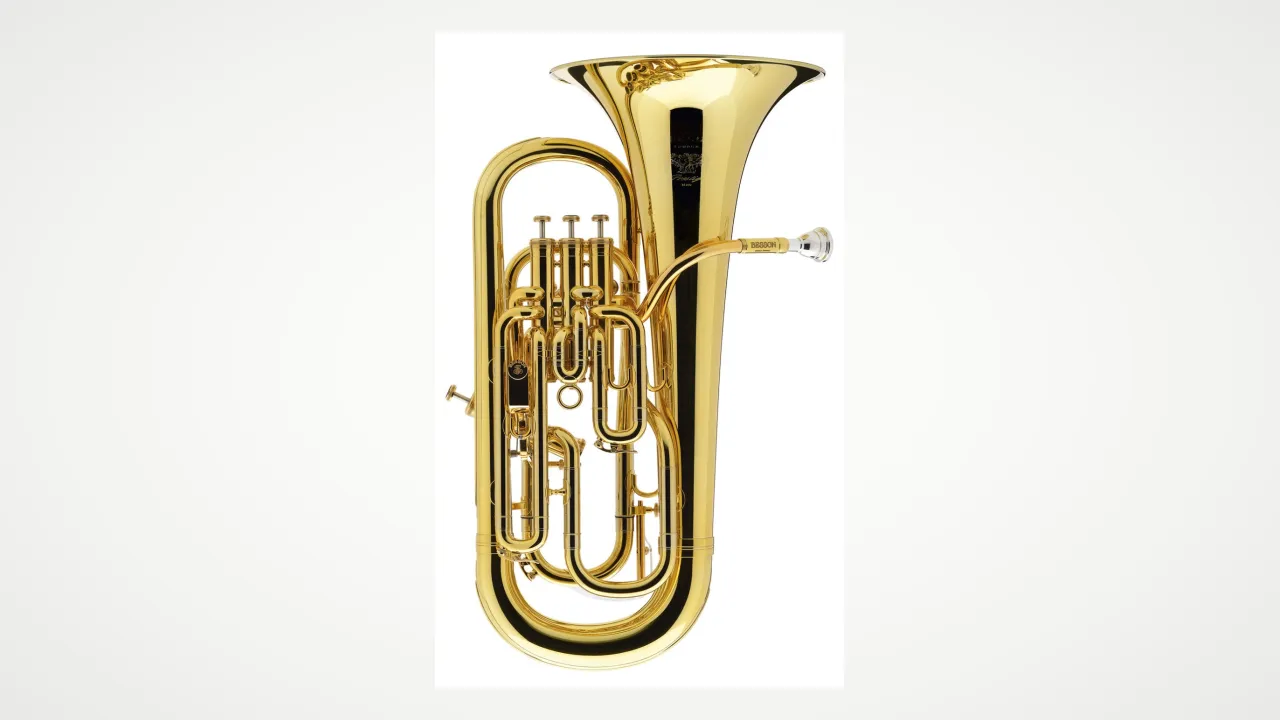
Hmmmm-aaah! A rich, sunny song floats out from a cozy brass horn! At first peek, it looks just like a baby tuba. It sits in the player's lap.
2
A Name Meaning Sweet Sound
Its Greek name means 'sweet-sounding voice,' and your ears will agree! Buzzing lips send warm waves through nine feet of brass tube. Its notes sit higher than a big tuba.
3
Fast Dancing Fingers
Three shiny buttons sit on top, plus one on the side! Quick fingers press them down to play bouncy, singing tunes.
1. What does the Greek root of the name *euphonium* mean?
2. Which bigger brass instrument does an upright euphonium resemble?
🤯 Mind-Blowing Fact • Grade 2
In military and concert bands without violins or cellos, composers hand the most emotional, soaring countermelodies straight to the euphonium!
✨ Word Sparks (Grade 2 Glossary)
Tap 🔊 to hear
countermelody
Second pretty tune weaving around the main song
cone
Tube shape starting narrow and growing wide
agile
Able to move quickly and smoothly
🪝
Why do concert band leaders call the euphonium 'the cello of the band'?
1
Singing Like a Cello
Close your eyes as a golden melody rises above the concert band—so smooth and warm you might guess a giant string cello is singing! Instead, that rich voice pours from a gleaming upright brass horn coiled neatly in a player's arms.
2
Nine Feet of Widening Brass
Just like a tenor trombone, a euphonium holds nine feet of tubing, so both horns share the exact same middle-low range! However, the euphonium's pipe widens steadily like a , giving it a much rounder, sweeter sound than a trombone's bright punch.
3
Three Top Pistons Plus One Side Helper
Right-hand fingers dance across three top piston valves while the left index finger presses a special fourth valve on the side, unlocking deep low notes and fast, sparkling runs!
1. Which brass instrument shares the same nine-foot tube length and pitch range as a euphonium?
2. Where is the special fourth valve usually placed on a professional euphonium?
🤯 Mind-Blowing Fact • Grade 3
Some experimental 19th-century 'double-bell' euphoniums actually sprouted two separate bells—a big warm main bell and a smaller trombone-like second bell switched by a fifth valve!
✨ Word Sparks (Grade 3 Glossary)
Tap 🔊 to hear
taper
Gradual widening or narrowing of a tube
baritone horn
Narrower-tubed brass cousin with a brighter voice
triple-tonguing
Rapidly articulating fast notes in groups of three
🪝
Wait—aren't a baritone horn and a euphonium the exact same instrument?
1
Twins at First Glance, Different Voices Inside!
Walk into a school band room and you might hear someone point at an upright brass horn and call it a baritone, while another student calls it a euphonium! Although both hold nine feet of B-flat brass tubing, their inside shapes tell two very different acoustic stories.
2
Steep Conical Bore Magic
A true uses narrower, mostly cylindrical tubing for a lighter, brighter ring. In contrast, the euphonium—invented by Ferdinand Sommer in Weimar, Germany, in 1843—expands rapidly in a wide conical all the way to an eleven- or twelve-inch bell, wrapping every pitch in dark, velvety overtones.
3
Clever Compensating Loops
In 1874, British maker David Blaikley invented an ingenious compensating valve system still used today. When the left-hand fourth valve is held down, air automatically detours through tiny extra loops attached to the main valves so deep low notes stay perfectly in tune!
4
Star of British Brass Bands
In British-style brass bands and modern wind ensembles, euphonium soloists perform breathtaking leaps and rapid triple-tongued fireworks.
1. How does a euphonium differ acoustically from a British baritone horn?
2. What problem did David Blaikley's 1874 compensating system solve for the euphonium?
🤯 Mind-Blowing Fact • Grade 4
Whenever Gustav Holst's *The Planets* or Mussorgsky's *Pictures at an Exhibition* is programmed, symphony orchestras hire a specialist guest artist to play the famous 'tenor tuba' solos on a euphonium!
✨ Word Sparks (Grade 4 Glossary)
Tap 🔊 to hear
cameo
Memorable guest solo appearance in a show
vibrato
Gentle, expressive pulsing warmth on held notes
arpeggio
Notes of a chord played one after another
🪝
Why does this superstar of wind ensembles and brass bands only make rare guest appearances in symphony orchestras?
1
Born Too Late for Classical Symphonies
When Ferdinand Sommer unveiled his wide-bored Sommerhorn—soon renamed the euphonium—in 1843, the Classical and early Romantic symphony orchestra had already cemented its brass seating chart around horns, trumpets, trombones, and the newly patented tuba. Meanwhile, strings like the cello and bassoon already covered the lyrical tenor register indoors, leaving the euphonium to become the undisputed crown jewel of concert wind bands and British brass bands instead.
2
Unforgettable Orchestral Cameos
Whenever late-Romantic and 20th-century composers wanted a noble tenor brass voice darker than a trombone yet nimbler than a tuba, they summoned the euphonium (often labeled tenor tuba in orchestral scores). Gustav Holst opened 'Mars, the Bringer of War' in The Planets with menacing euphonium fanfares, while Richard Strauss cast it as the chivalrous knight in Don Quixote.
3
Mechanics of the Four-Valve Compensating System
On a standard non-compensating three-valve horn, the lowest playable chromatic pitch above the pedal tone is E2, leaving a frustrating five-semitone gap above pedal B-flat1. Adding a fourth side piston drops the open horn four semitones down to F, while Blaikley's dual-port pistons route air back through secondary mini-slides behind valves one through three, unlocking resonant, dead-on-pitch notes all the way down to B1 and below.
4
Harmonic Warmth and Virtuoso Agility
Combining a 15-to-16.8-millimeter dual-bore valve block with short piston strokes, modern euphoniums glide across four octaves—executing delicate ballads one measure and dazzling sixteenth-note the next.
1. Under what name do orchestral scores like Holst's *The Planets* often list the euphonium part?
2. Why did the euphonium become a permanent star in wind bands rather than in standard Classical orchestras?
🤯 Mind-Blowing Fact • Grade 5
On a compensating euphonium, pressing the fourth valve plus the first valve actually routes your breath through the first piston cylinder twice in two different directions at the exact same instant!
✨ Word Sparks (Grade 5 Glossary)
Tap 🔊 to hear
dual-bore
Using wider tubing through the fourth valve
bel canto
Smooth, lyrical Italian style of singing
Monel
Corrosion-resistant nickel-copper alloy used for pistons
🪝
How do dual-bore pistons and steep conical expansion give the euphonium both tuba-like warmth and cornet-like speed?
1
Organology of the Conical Tenor-Bass Aerophone
Classified under Hornbostel-Sachs 423.232, the concert euphonium is a valved wide-bore conical labrosone pitched in nine-foot (2.74-meter) B-flat. Although identical in fundamental length to the tenor trombone and baritone horn, its fully chromatic compass spans more than four octaves—from pedal B-flat0 (29.1 Hz) and chromatic C1 (32.7 Hz) on compensating instruments up past D5 (587.3 Hz)—uniting contrabass richness with agile upper-register lyricism.
2
Bore Profile Physics: Euphonium Versus Baritone and Trombone
Three nine-foot B-flat brasses demonstrate how internal taper governs spectral timbre. A tenor trombone stays cylindrical (~13.9 mm) for nearly seventy percent of its length, emphasizing bright upper partials; a British baritone horn starts narrower (~13.0 mm) with a modest taper; a modern compensating euphonium opens at 15.0 millimeters across valves one through three, steps up to 16.8 millimeters through the fourth valve, and flares continuously into a 28-to-31-centimeter (11-to-12.2-inch) bell. This steep conical expansion strongly reinforces the first six harmonics while rolling off metallic energy above 2,000 Hz.
3
Fluid Dynamics of Blaikley's 1874 Compensating Architecture
In David Blaikley's ingenious compensating design, Pistons 1, 2, and 3 each carry two separate sets of internal air passages. During normal three-valve playing, air traverses the upper ports only; once the left index finger depresses Piston 4 (lowering the horn from B-flat to F by adding ~0.91 meters of tubing), the airstream loops backward through the main cluster a second time, engaging auxiliary compensating slides calibrated specifically to the longer F fundamental. This eliminates low-register sharpness down to B1 (61.7 Hz) without manual slide pulling.
4
Virtuosic Articulation and Brass-Band Tradition
Short, spring-loaded pistons coupled with responsive conical acoustic impedance allow virtuosos in championship British brass bands and wind symphonies to execute rapid double- and triple-tongued variations alongside vocal phrasing.
5
Contemporary Solo Repertoire
Over the past half-century, concertos by Joseph Horovitz, Philip Sparke, and Karl Jenkins have elevated the euphonium onto international recital stages as one of brassdom's most expressive solo voices.