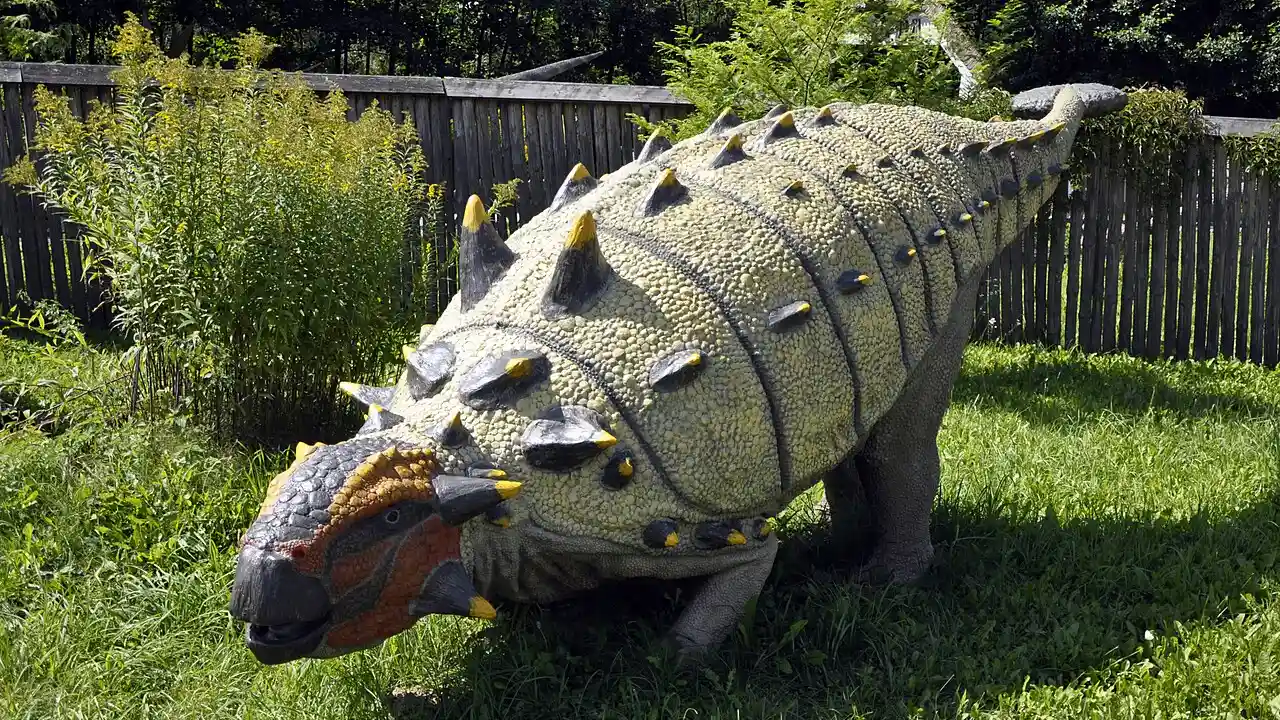
1. What made the eyelids of Euoplocephalus so special?
2. What sat at the end of Euoplocephalus's tail?
🤯 Mind-Blowing Fact • Grade 2
Air inside Euoplocephalus's snout twisted through wild, looping nose tunnels like a roller coaster before reaching its lungs!
✨ Word Sparks (Grade 2 Glossary)
Tap 🔊 to hear
Shutter
A hard cover that closes over an opening
Ankylosaur
A wide armored dinosaur with a tail club
Snout
The front nose and beak of an animal
🪝
What dinosaur wore bony shutters over its eyes and swung a bowling-ball tail?
1
Armored From Nose to Tail
Step into a lush riverbank in ancient Canada 76 million years ago. Waddling out of the bushes comes Euoplocephalus, a tank-like plant-eater as heavy as a pickup truck! Rows of studded bony plates covered its broad neck, back, and hips.
2
Bony Shutters for Eyes
Even its face was built like a helmet, with two triangular horns behind its eyes. Most amazing of all, curved bones sat inside its upper eyelids, rolling shut like window whenever danger came near.
3
Watch Out for the Tail
The back half of its tail locked stiff like a wooden handle, ending in a massive lump of solid bone. Swinging low to the ground, that club kept hungry tyrannosaurs far away!
2. How was the back half of Euoplocephalus's tail built?
🤯 Mind-Blowing Fact • Grade 3
Scientists first named this dinosaur Stereocephalus in 1902, until they realized a tiny beetle already owned that exact scientific name!
✨ Word Sparks (Grade 3 Glossary)
Tap 🔊 to hear
Palpebral
A special curved bone protecting the upper eyelid
Tendon
A tough cord connecting muscle tightly to bone
Nasal
Connected to the nose and breathing passages
🪝
Why did Euoplocephalus have twisty roller-coaster tubes hidden inside its armored skull?
1
Star of Dinosaur Park
Follow the muddy trails of Late Cretaceous Alberta 76 million years ago, and you would meet Euoplocephalus everywhere! Nearly 19 feet long and weighing over two tons, it is one of the best-known ankylosaurs in the world, with dozens of skulls and armor plates unearthed in Canada.
2
Helmet Head and Looping Nose
Thick armor tiles covered its triangular skull, and curved bones inside its eyelids closed like armored garage doors. CT scans also revealed crazy corkscrew passages inside its snout, which cooled its brain, saved moisture, and may have helped it rumble loud calls.
3
Lawnmower of the Forest
Unlike narrow-beaked cousins that picked single leaves, Euoplocephalus had a wide, square beak. Low-slung and broad-bellied, it cropped mouthfuls of tough ferns and ground plants like a four-legged lawnmower.
4
Sledgehammer Defense
Bundles of bony stiffened the end of its tail into an unbreakable rod tipped with four fused osteoderms. Powered by hip and tail muscles, that sledgehammer club swung swiftly sideways at ankle height.
1. What did CT scans discover inside the snout of Euoplocephalus?
2. Why did Lawrence Lambe have to rename Stereocephalus to Euoplocephalus?
🤯 Mind-Blowing Fact • Grade 4
Cross-sections of Euoplocephalus armor plates look just like woven fabric under a microscope, making them super tough without adding crushing weight!
✨ Word Sparks (Grade 4 Glossary)
Tap 🔊 to hear
Collagen
Strong, stretchy protein fibers inside bone and skin
Convoluted
Twisted and folded into many complex loops
Caudal
Relating to the bones inside an animal's tail
🪝
How did bone engineering turn Euoplocephalus into a walking fortress with built-in air conditioning?
1
Grazing Under Tyrannosaur Watch
Roughly 76 million years ago, the lush floodplains of Canada's Dinosaur Park Formation teemed with life—including fast tyrannosaurs like Gorgosaurus. Measuring nearly 6 meters long and standing lower than an adult human's chest, Euoplocephalus tutus moved calmly across fern meadows on stocky pillar legs. Its wide, U-shaped beak acted like a broad turf cutter, cropping huge quantities of low-growing flora into a massive barrel-shaped gut.
2
Lightweight Yet Unbreakable Armor
Carrying solid rock-heavy bone across its entire back would have exhausted any animal. Microscopic studies of Euoplocephalus osteoderms show nature's clever solution: fibers wove crisscross patterns through spongy inner bone, much like fiberglass or reinforced concrete! Transverse bands of keeled scutes alternated with flexible skin studded with tiny ossicles, while crescent-shaped palpebral bones rolled down to shield its eyes.
3
Looping Airways for Brain Cooling
Inside a thick, sun-warmed skull, overheating was a real challenge. Digital 3D reconstructions of Euoplocephalus skulls revealed elaborate, nasal passages surrounded by dense networks of blood vessels. As the dinosaur inhaled and exhaled, air swirling through these chambers acted as a heat exchanger, cooling blood flowing to its small brain while amplifying low-frequency vocalizations.
4
Biomechanics of the Tail Club
At the rear of its spine, the final ten or more vertebrae interlocked tightly, wrapped in latticed rods of ossified tendon to form a rigid handle. Fused to the tip sat a bulbous knob of dermal bone up to half a meter wide, capable of delivering bone-denting lateral impacts.
1. Why wasn't Euoplocephalus weighed down too heavily by all its armor plates?
2. How did Euoplocephalus's broad, U-shaped beak shape its feeding habits?
🤯 Mind-Blowing Fact • Grade 5
Modern taxonomic studies revealed that fossils once lumped into Euoplocephalus actually belonged to four distinct armored dinosaur genera living in Alberta over a few million years!
✨ Word Sparks (Grade 5 Glossary)
Tap 🔊 to hear
Thermoregulation
Keeping internal body and brain temperatures balanced
Fermentation
Gut microbes breaking down tough plant fibers
Prezygapophyses
Forward bony prongs locking backbone joints together
🪝
What do CT scans and finite-element physics reveal about the armored skull and tail club of Euoplocephalus?
1
Icon of Campanian Alberta
During a focused evolutionary window between 76.4 and 75.6 million years ago, Euoplocephalus tutus thrived across the subtropical alluvial plains of the Dinosaur Park Formation in southern Alberta, Canada. Reaching approximately 5.8 meters (19 feet) in length and weighing roughly 2.4 metric tons, this quintessential ankylosaurid combined a broad, low-slung torso with heavily fortified cranial and caudal anatomy.
2
Cranial Thermoregulation and Armored Eyelids
Its wide, equilateral-triangle skull wore fused caputegulae flanked by prominent squamosal and quadratojugal horns. Uniquely among dinosaurs, Euoplocephalus possessed mobile accessory palpebral bones embedded within its upper eyelids that rotated downward to seal the eye sockets completely. High-resolution computed tomography conducted by paleontologist Jason Bourke and colleagues demonstrated that its nasal vestibule coiled through dramatic hairpin loops lined with rich vascular networks, operating as a countercurrent heat exchanger that prevented cerebral overheating.
3
Hindgut Fermentation and Bulk Grazing
Unlike narrow-snouted nodosaurids living in the very same forests—such as Edmontonia, which browsed selectively—Euoplocephalus partitioned ecological resources with a broad, squared premaxillary beak. Tiny phylliform teeth sliced fibrous ferns and horsetails minimally before swallowing, leaving massive microbial inside its expanded ribcage and wide pelvis to extract nutrients.
4
Composite Biomechanics of the Tail Club
At the distal half of the tail, elongated interlocked adjacent vertebrae into an inflexible beam reinforced by braided sheaths of ossified tendons. Two major lateral osteoderms and smaller terminal plates fused around the tip to create a dense, asymmetrical knob. Finite-element engineering models by Victoria Arbour calculated that large tail clubs could swing at high velocity, generating enough kinetic force to fracture tyrannosaurid metatarsals or settle territorial contests with rival ankylosaurids.
5
Sorting Out a Century of Fossils
First unearthed by Lawrence Lambe along the Red Deer River in 1897 and renamed Euoplocephalus tutus in 1910 after Stereocephalus proved preoccupied by a beetle, this genus became a taxonomic catch-all for decades. Modern revisions carefully separated close relatives—such as Scolosaurus, Anodontosaurus, and Dyoplosaurus—based on distinct cervical half-rings and tail-club shapes, sharpening our portrait of rapid ankylosaurid evolution.