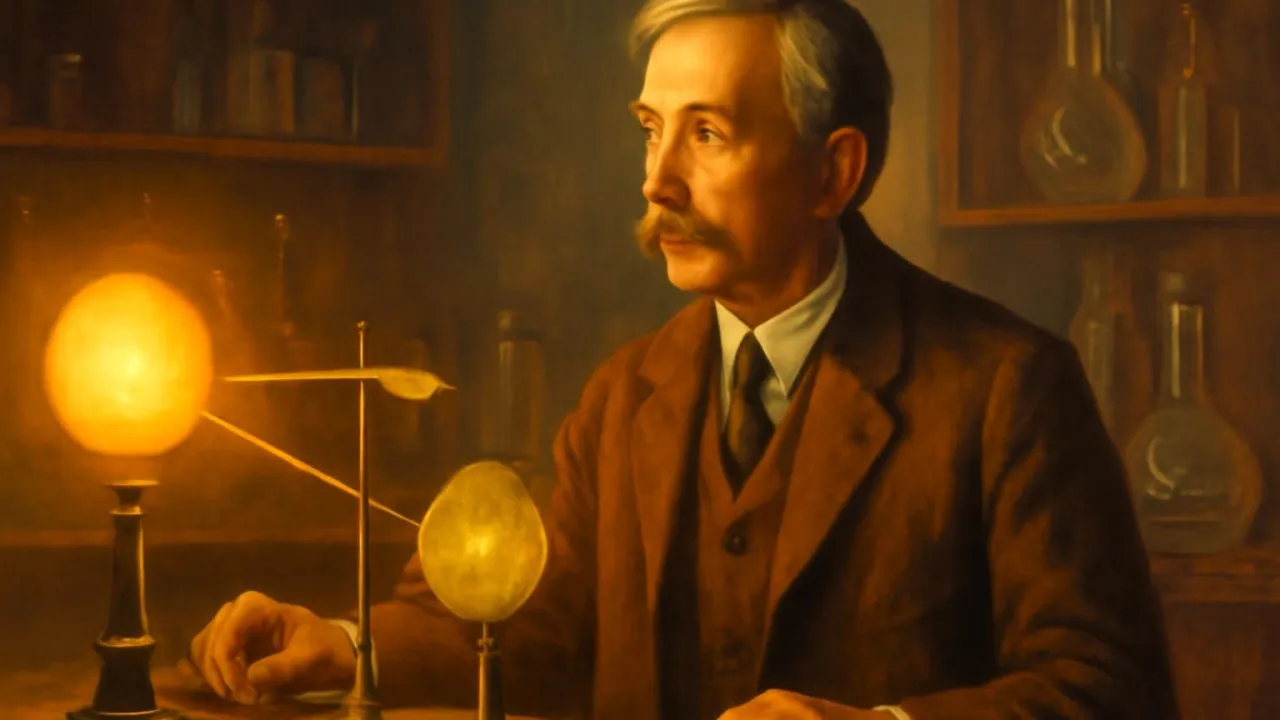
Rutherford’s gold foil experiment helped scientists discover the nucleus inside every atom!
✨ Word Sparks (Grade 2 Glossary)
Tap 🔊 to hear
nucleus
The center part of an atom
particle
A tiny bit of matter
science
Learning about how things work
🪝
Have you ever wondered what’s inside everything around you?
1
Big Questions, Small Pieces
Ernest was a curious boy who loved experiments. He always asked what things were made of. He wanted to look inside the tiniest pieces of matter.
2
The Gold Foil Test
He made a famous experiment using thin gold foil and tiny . He watched how the particles bounced off the foil. This showed him that atoms have a hard center called the .
3
Sharing His Discovery
Ernest told other scientists about his new idea. People were excited to learn about the atom’s center. His work changed how we understand today.
Rutherford’s students included scientists who later split the atom, leading to even bigger discoveries!
✨ Word Sparks (Grade 3 Glossary)
Tap 🔊 to hear
radioactive
Something that gives off energy
alpha particle
A tiny bit shot out of atoms
legacy
What someone leaves behind for others
🪝
Imagine firing tiny particles at gold and discovering the hidden heart of matter!
1
A Boy Full of Curiosity
Young Ernest Rutherford loved exploring nature and solving science puzzles. He often built gadgets and tested ideas in his family’s New Zealand home. His curiosity led him to ask, 'What are things made of?' He dreamed of peeking inside the tiniest building blocks.
2
The Famous Gold Foil Experiment
As a scientist, Rutherford created a clever experiment using thin gold foil and . He noticed that most particles passed through, but some bounced back. This surprising result showed atoms were mostly empty space. It also revealed a dense center, which he named the nucleus.
3
Changing the World of Science
Rutherford’s discovery of the nucleus changed how scientists understood atoms. His work introduced new words like 'nucleus' and '' to science. He proved that experiments could unlock nature’s secrets. Many scientists followed his methods to make more discoveries.
4
A Lasting Legacy
Rutherford became a famous teacher who inspired many students. He won the Nobel Prize in Chemistry for his work on elements. His ideas helped create nuclear science. Today, we remember him as the 'father of nuclear physics.'
1. Why did some alpha particles bounce back in Rutherford’s experiment?
2. What prize did Rutherford win for his discoveries?
🤯 Mind-Blowing Fact • Grade 4
Rutherford’s gold foil experiment was so surprising that it changed science textbooks around the world!
✨ Word Sparks (Grade 4 Glossary)
Tap 🔊 to hear
proton
A tiny particle in the atom’s center
radioactivity
Energy released from some atoms
experimental physics
Testing ideas with careful experiments
🪝
What would you discover if you could see inside the tiniest parts of everything?
1
Curiosity in New Zealand
Growing up on a farm in New Zealand, Ernest Rutherford was endlessly curious about the natural world, always building gadgets and reading science books. In the late 1800s, few people understood what atoms looked like, but Rutherford wanted to solve this mystery. He earned scholarships that took him far from home, eventually reaching England to study in famous laboratories. His early experiments with laid the groundwork for his greatest discovery.
2
The Gold Foil Breakthrough
In 1909, Rutherford and his team designed the gold foil experiment, firing alpha particles at a thin sheet of gold. Most particles passed straight through, but a few bounced back, which shocked everyone. This unexpected result proved that atoms are mostly empty space with a tiny, dense center called the nucleus. The experiment’s clever design and careful observation made Rutherford a leader in .
3
Changing Atomic Theory
Before Rutherford’s work, scientists imagined atoms as solid balls or 'plum puddings' with scattered charges. His discovery of the nucleus completely changed atomic theory, inspiring new models and vocabulary, like 'nucleus' and '.' Rutherford’s methods showed that careful experiments could reveal hidden truths about nature. His findings opened the door to nuclear science and future breakthroughs in energy and medicine.
4
A Teacher and a Pioneer
Rutherford became a famous professor, mentoring many future Nobel Prize winners. He received the Nobel Prize in Chemistry in 1908 for his work on , even before his gold foil experiment. His legacy lives on in every science classroom, as students learn about atoms, nuclei, and the power of asking big questions. Today, Rutherford is remembered as the 'father of nuclear physics,' whose curiosity changed the world.
1. What did Rutherford’s gold foil experiment prove about atoms?
2. Why was Rutherford called the 'father of nuclear physics'?
🤯 Mind-Blowing Fact • Grade 5
Rutherford’s work directly led to the discovery of the proton and the neutron, two of the universe’s most important particles!
✨ Word Sparks (Grade 5 Glossary)
Tap 🔊 to hear
plum pudding model
Old idea: atoms are like mixed pudding
alpha particle
A fast, tiny bit from some atoms
nuclear physics
Science of the atom’s center and energy
🪝
Can a single experiment change the way humanity understands the universe’s building blocks forever?
1
A Farm Boy’s Scientific Spark
On the windswept fields of New Zealand, young Ernest Rutherford’s mind buzzed with scientific wonder as he built simple machines and read every science book he could find. His early fascination with nature’s mysteries pushed him to win scholarships, eventually taking him from his rural home to the prestigious laboratories of Cambridge University in England. There, he joined a community of brilliant thinkers who were just beginning to unravel the secrets of matter. Rutherford’s curiosity and determination set the stage for discoveries that would transform science.
2
Inventing the Gold Foil Experiment
In 1909, Rutherford and his colleagues Hans Geiger and Ernest Marsden designed a groundbreaking experiment to probe the structure of the atom. They fired —tiny, fast-moving bits of matter—at an extremely thin sheet of gold foil and observed how the particles scattered. Most particles passed straight through, but a small fraction bounced backward at sharp angles, a result so unexpected that Rutherford compared it to firing a cannonball at tissue paper and having it bounce back. This experiment provided the first direct evidence that atoms are mostly empty space, with a dense, positively charged nucleus at their core.
3
Revolutionizing Atomic Theory
Before Rutherford’s discovery, most scientists believed in the 'plum pudding' model, which pictured atoms as balls of positive charge with electrons stuck inside. Rutherford’s results shattered this idea, leading him to propose a new atomic model with a tiny nucleus surrounded by orbiting electrons. He coined the term 'nucleus' and later discovered the proton, a fundamental particle within the nucleus. These breakthroughs introduced new scientific vocabulary and inspired future research into the structure of matter, energy, and the forces that hold atoms together.
4
Mentoring the Next Generation
Rutherford was not only a pioneering researcher but also a gifted teacher and leader. He mentored students who would themselves become Nobel Prize winners, including Niels Bohr and James Chadwick, who discovered the neutron. Rutherford’s approach to experimental physics emphasized careful measurement, creative problem-solving, and the courage to question old ideas. His influence shaped the direction of 20th-century science, from nuclear energy to medical imaging technologies.
5
A Legacy That Changed the World
Ernest Rutherford’s discoveries earned him the 1908 Nobel Prize in Chemistry for his investigations of radioactive substances, and his later work laid the foundation for . His gold foil experiment remains one of the most famous in scientific history, and his ideas continue to appear in textbooks and laboratories worldwide. Rutherford’s story shows how curiosity, perseverance, and bold experiments can unlock the deepest secrets of the universe. Today, he is celebrated as the 'father of nuclear physics,' whose legacy continues to inspire scientists and students everywhere.