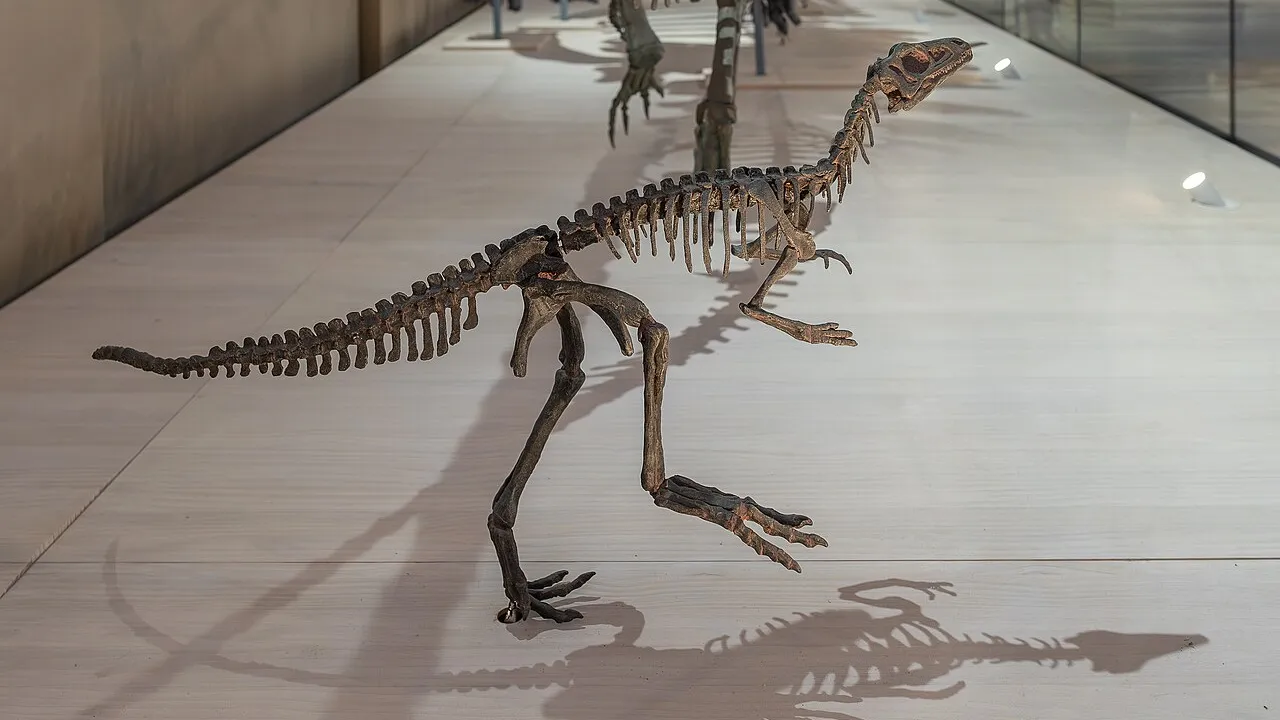
2. Which giant dinosaurs turned out to be distant relatives of tiny Eoraptor?
🤯 Mind-Blowing Fact • Grade 2
The nearly complete skeleton of Eoraptor was discovered when a scientist picked up a random rock to toss it out of his walking path!
✨ Word Sparks (Grade 2 Glossary)
Tap 🔊 to hear
lunar
relating to the moon or moonlike landscapes
hollow
lightweight with empty space inside bone
pebble
a small smooth stone on the ground
🪝
How did flipping over one desert stone in Argentina reveal a 231-million-year-old treasure?
1
Treasure Under a Rock
Imagine kneeling in Argentina's dusty Valley of the Moon in 1991, tossing aside a loose sandstone , and staring straight at tiny fossil teeth! Paleontologist Ricardo Martinez had just discovered Eoraptor lunensis, meaning dawn plunderer of the Valley of the Moon.
2
Menu of Everything
Unlike picky eaters, Eoraptor packed two styles of teeth inside its three-inch skull. Curved, saw-edged teeth grabbed beetles and small reptiles, while leaf-shaped front teeth snipped tender ferns and shoots.
3
Light and Speedy
leg bones, huge watchful eyes, and five-fingered hands helped this nimble omnivore dart safely past bigger Triassic hunters like Herrerasaurus.
2. Why was having two shapes of teeth helpful for Eoraptor?
🤯 Mind-Blowing Fact • Grade 3
Despite having 'raptor' in its name, Eoraptor is not closely related to Velociraptor—it sits at the root of the long-necked sauropod family!
✨ Word Sparks (Grade 3 Glossary)
Tap 🔊 to hear
sauropodomorph
the dinosaur branch leading to long-necked giants
forerunner
an early member coming before later relatives
adaptable
able to adjust easily to different foods
🪝
Why did scientists first think Eoraptor was a meat-eating raptor before moving it onto the giant sauropod branch?
1
Fooled by the Name!
Don't let the word raptor in Eoraptor trick you! When Ricardo Martinez, Paul Sereno, and colleagues announced this three-foot skeleton in 1993, its sharp claws and curved back teeth convinced many researchers it was an early meat-eating theropod. Years of closer study, however, revealed a thrilling plot twist.
2
Clues Pointing to Giant Descendants
When paleontologists examined its enlarged nostrils, twisted thumb bone, and leaf-shaped upper teeth under microscopes, they realized Eoraptor actually belonged at the very base of Sauropodomorpha! That makes this agile, twenty-two-pound sprinter a distant of seventy-ton titans like Argentinosaurus and Diplodocus.
3
Five Fingers, Three Claws
Each hand carried five digits: three long clawed fingers for snatching lizards or pulling ferns, plus two tiny stubby outer fingers without claws.
4
Sharing the Triassic Dawn
Living 231 million years ago alongside Herrerasaurus, Eoraptor shows that the earliest dinosaurs started out small, quick, and .
1. Which body clues showed scientists that Eoraptor belonged on the sauropodomorph branch?
2. How did the very earliest dinosaurs like Eoraptor start out in size and lifestyle?
🤯 Mind-Blowing Fact • Grade 4
The entire skull of an adult Eoraptor was only about three and a half inches long—small enough to rest comfortably in the palm of your hand!
✨ Word Sparks (Grade 4 Glossary)
Tap 🔊 to hear
holotype
the single specimen used to name a species
dentition
the arrangement and shape of teeth in jaws
transition
gradual change from one way to another
🪝
How does one meter-long skeleton from Argentina bridge the split between meat-eating and plant-eating dinosaurs?
1
Snapshot From 231.4 Million Years Ago
Few fossils capture an evolutionary crossroads as vividly as Eoraptor lunensis. Unearthed in 1991 in the Carnian-age Ischigualasto Formation of San Juan, Argentina, the preserved nearly every bone from snout tip to tail tip in lifelike articulation. Measuring just one meter long and weighing roughly ten kilograms, Eoraptor darted through floodplain horsetails and conifers when dinosaurs were still rare newcomers on Pangaea.
2
Omnivory in Action
Its slender, nine-centimeter skull tells the story of a dietary caught mid-step. Posterior maxillary teeth curve backward with fine serrations like a carnivore's knives, ideal for snapping up insects and small vertebrates. Right beside them in the premaxilla and front maxilla sit broadened, constricted-base leaf-shaped crowns—the hallmark used by early sauropodomorphs to shred tender leaves!
3
Reclassified by New Triassic Finds
Originally interpreted in 1993 as a primitive theropod, Eoraptor was restudied alongside newly discovered Triassic cousins such as Panphagia and Chromogisaurus. Detailed CT scans and anatomical comparisons in 2011 and 2013 demonstrated key sauropodomorph hallmarks: expanded external nostrils, a subtly downturned lower jaw tip, and a robust, twisted first finger.
4
Built to Outrun Danger
Hollow thin-walled limb bones and elongated shins let Eoraptor sprint swiftly away from larger contemporaries like Herrerasaurus and Saurosuchus.
1. What does the mix of curved and leaf-shaped teeth in Eoraptor capture?
2. Roughly how long was the complete skull of Eoraptor?
🤯 Mind-Blowing Fact • Grade 5
CT scans and bone preparation proved Eoraptor had tiny, clawless fourth and fifth 'pinky' fingers tucked beside three sharp grasping claws—a telltale blueprint of early saurischian hands!
✨ Word Sparks (Grade 5 Glossary)
Tap 🔊 to hear
lanceolate
shaped like a narrow pointed leaf or spearhead
vestigial
shrunken evolutionary remnant with little left to do
synapomorphy
a shared new trait linking related species
🪝
How did synchrotron-era CT scans of three-foot Eoraptor rewrite the origin story of seventy-ton sauropods?
1
Serendipity in the Valley of the Moon
On an October morning in 1991, Argentine paleontologist Ricardo Martinez crouched along grey volcanic mudstones in Ischigualasto Provincial Park and lifted a weathered concretion—exposing two tiny serrated teeth gleaming in sunlight. Excavated by a joint Argentine-American team led with Paul Sereno and formally named Eoraptor lunensis in 1993, the 231.4-million-year-old holotype (PVSJ 512) remains one of the most complete Carnian dinosaur skeletons ever recovered.
2
From Putative Theropod to Basal Sauropodomorph
Because Eoraptor possessed raptorial grasping hands, hollow long bones, and recurved posterior teeth, initial 1990s analyses placed it at the base of Theropoda or outside Eusaurischia altogether. Yet discoveries of coeval Argentine taxa—including Saturnalia, Panphagia, and Pampadromaeus—prompted a comprehensive 2013 anatomical monograph by Sereno, Martinez, and Alcober. High-resolution scans revealed unmistakably sauropodomorph synapomorphies: enlarged subnarial nostrils, anterior crowns constricted at the root, an inset first lower tooth, and a stout, twisted first metacarpal.
3
Anatomy of an Ancestral Omnivore
Measuring one meter in length and roughly ten kilograms in body mass, Eoraptor illustrates the lightweight, cursorial body plan from which giant quadrupedal sauropods eventually evolved. Large scleral rings framed keen eyes inside a lightly built nine-centimeter skull, while five-digit hands retained clawless fourth and fifth fingers alongside three clawed grasping digits.
4
Ecological Role in the Carnian Pluvial Aftermath
Foraging across seasonally humid river basins dominated by rhynchosaurs and traversodontid cynodonts, Eoraptor exploited an omnivorous diet—snapping up insects and small vertebrates while cropping nutritious ferns and seed ferns.
5
Dietary Flexibility as Evolutionary Launchpad
By broadening its menu beyond strict carnivory, the lineage represented by Eoraptor unlocked vast botanical energy reserves that later fueled the largest land animals in Earth's history.