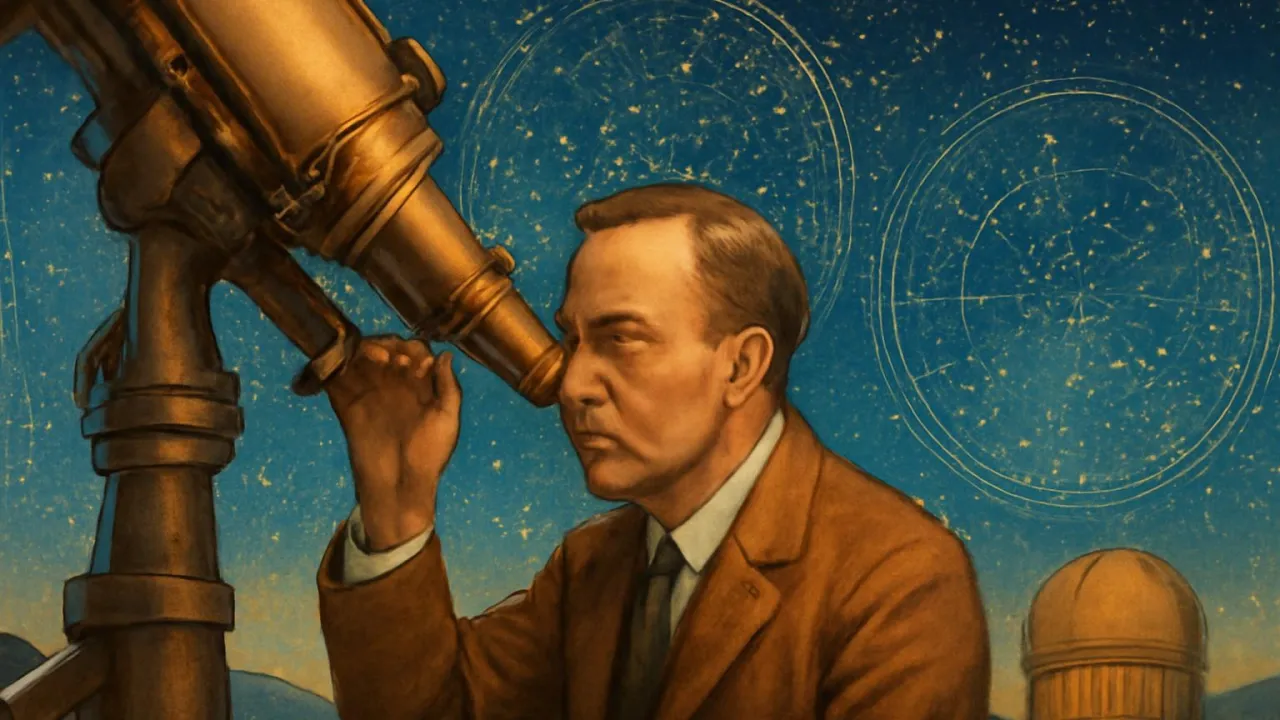
Edwin’s discovery helped scientists realize there are billions of galaxies in space.
✨ Word Sparks (Grade 2 Glossary)
Tap 🔊 to hear
astronomer
A scientist who studies space
Milky Way
The galaxy we live in
discovery
Finding something new
🪝
Have you ever wondered how far space goes?
1
Dreaming of the Night Sky
As a boy, Edwin loved to watch the stars. He often asked questions about space and wanted to know more. He dreamed of making big discoveries and learning secrets hidden in the sky. His favorite nights were spent imagining what might be out there.
2
Looking Through a Giant Telescope
Edwin worked with a huge telescope on a mountain. He spent many nights looking for new things in the sky. He studied star patterns and shapes, writing down everything he saw in his notebook. The telescope helped him see farther than ever before.
3
Finding Other Galaxies
One day, Edwin saw something amazing through his telescope. He found galaxies outside the , shining like tiny clouds. His changed what people knew about the universe, showing it was much bigger than anyone had thought before.
The Hubble Space Telescope orbits Earth and helps us see deep into space.
✨ Word Sparks (Grade 3 Glossary)
Tap 🔊 to hear
observatory
A place to study stars and space
lens
A glass piece that helps us see better
evidence
Proof that something is true
🪝
What secrets could a giant telescope reveal about the universe?
1
A Curious Mind Under the Stars
Young Edwin often gazed up at the night sky, wondering about the twinkling stars. He loved reading books about planets and space. His curiosity grew as he asked, 'How big is the universe?' He decided to become an astronomer to find answers.
2
Climbing High for Clearer Views
Edwin worked at Mount Wilson , where a powerful telescope stood. He learned to use its giant to study distant objects. Night after night, he recorded star patterns and fuzzy clouds. He hoped to discover something no one else had seen.
3
A Universe Full of Galaxies
One evening, Edwin noticed that some star clusters were actually whole galaxies. These galaxies were far beyond the Milky Way. He realized the universe was much larger than anyone believed. His discovery changed astronomy forever.
4
Sharing Wonders With the World
Edwin wrote about his findings so everyone could learn. Scientists everywhere were amazed by his and new ideas. He inspired others to keep exploring the universe’s mysteries. Today, the Hubble Space Telescope is named in his honor.
2. What did Edwin discover about some star clusters?
🤯 Mind-Blowing Fact • Grade 4
Edwin used Cepheid variable stars to measure distances to faraway galaxies.
✨ Word Sparks (Grade 4 Glossary)
Tap 🔊 to hear
nebulae
Cloudy spots in space, sometimes galaxies
Cepheids
Special stars that help measure distance
cosmology
The science of how the universe works
🪝
Can you imagine discovering that the universe is far bigger than anyone ever guessed?
1
A Boy With Cosmic Curiosity
When Edwin Hubble was young, he spent countless nights staring at the stars and reading about space. His fascination with the mysteries above led him to study mathematics and astronomy in college, hoping to answer his biggest questions. At a time when most people believed the Milky Way was the entire universe, Edwin wondered if there was more out there. His curiosity and determination set him on a path to change science forever.
2
Scaling Mount Wilson’s Observatory
Edwin joined Mount Wilson Observatory in California, home to the world’s largest telescope in the 1920s. He learned to operate the 100-inch Hooker telescope, which allowed him to observe faint, distant objects. Working late into the night, he carefully photographed and analyzed mysterious, cloudy patches in the sky. He believed these '' might be something more than just clouds of gas.
3
Revealing a Universe of Galaxies
Through patient study, Edwin discovered that many were actually separate galaxies, each containing billions of stars. He measured their distance using variable stars called , showing they lay far outside our Milky Way. This breakthrough proved the universe was vast and filled with countless galaxies. His findings completely changed humanity’s understanding of space.
4
A Legacy That Reaches the Stars
Edwin Hubble’s discoveries inspired generations of astronomers to explore even deeper into space. His work led to the idea that the universe is expanding, which became a foundation for modern . The famous Hubble Space Telescope, launched in 1990, was named to honor his contributions. Thanks to Edwin, we now know the universe is much larger and more mysterious than anyone imagined.
Hubble’s Law shows galaxies move away from us at speeds up to thousands of kilometers per second.
✨ Word Sparks (Grade 5 Glossary)
Tap 🔊 to hear
light-year
How far light travels in one year
period-luminosity
A way to measure star brightness and distance
Big Bang
The event that started our universe
🪝
What would it feel like to be the first to prove our universe stretches far beyond the stars we see?
1
A Childhood Fueled by Wonder
Long before he changed astronomy, Edwin Hubble was a curious child who spent hours gazing at the night sky, asking questions about the stars. His early fascination with the cosmos led him to read every book he could find about planets, comets, and distant worlds. Driven by a thirst for knowledge, he excelled in mathematics and science, eventually earning degrees from the University of Chicago and Oxford. At a time when most people believed the Milky Way was the entire universe, Edwin’s questions pushed him to seek answers no one else dared to imagine.
2
Mastering the Tools of Discovery
In the 1920s, Edwin began working at Mount Wilson Observatory in California, home to the world’s largest telescope: the 100-inch Hooker telescope. He learned to capture long-exposure photographs of faint, distant objects, carefully analyzing the light from mysterious nebulae. Night after night, Edwin compared his observations with star charts and calculated distances using the relationship of Cepheid variable stars. His rigorous method and attention to detail set a new standard for astronomical research.
3
Unveiling a Universe of Galaxies
Edwin’s breakthrough came when he demonstrated that many nebulae were actually entire galaxies, each containing billions of stars far outside the Milky Way. By measuring Cepheid variables in the Andromeda 'nebula,' he proved it was a separate galaxy over two million away. This discovery shattered the old belief that our galaxy was the whole universe and revealed that the cosmos was vastly larger than anyone had ever imagined.
4
The Expanding Universe and Lasting Legacy
Building on his findings, Edwin and his colleague Milton Humason observed that galaxies were moving away from each other, leading to the revolutionary idea that the universe is expanding. This observation, now known as Hubble’s Law, became a cornerstone of modern cosmology and paved the way for the theory. Edwin published influential papers and inspired astronomers worldwide to explore the universe’s deepest mysteries.
5
Inspiring Generations to Explore
Edwin Hubble’s legacy endures through the Hubble Space Telescope, launched in 1990, which continues to reveal breathtaking images and new discoveries about our universe. His work transformed our understanding of space, showing that curiosity and perseverance can unlock secrets beyond imagination. Today, scientists use his methods and ideas to study galaxies billions of away, proving that one person’s questions can change what humanity knows about the cosmos.