1. What was missing from the end of Edmontonia's tail?
2. How did Edmontonia protect its soft belly from hungry meat-eaters?
🤯 Mind-Blowing Fact • Grade 2
Paleontologists found tiny tooth marks on one Edmontonia shoulder spike, showing it survived a real dinosaur face-off!
✨ Word Sparks (Grade 2 Glossary)
Tap 🔊 to hear
Fortress
A super strong place built for protection
Nodosaur
An armored dinosaur with spikes but no club
Beak
A hard, horn-covered mouth tip for clipping plants
🪝
How did an armored dinosaur defend itself without a tail club?
1
A Walking Fortress
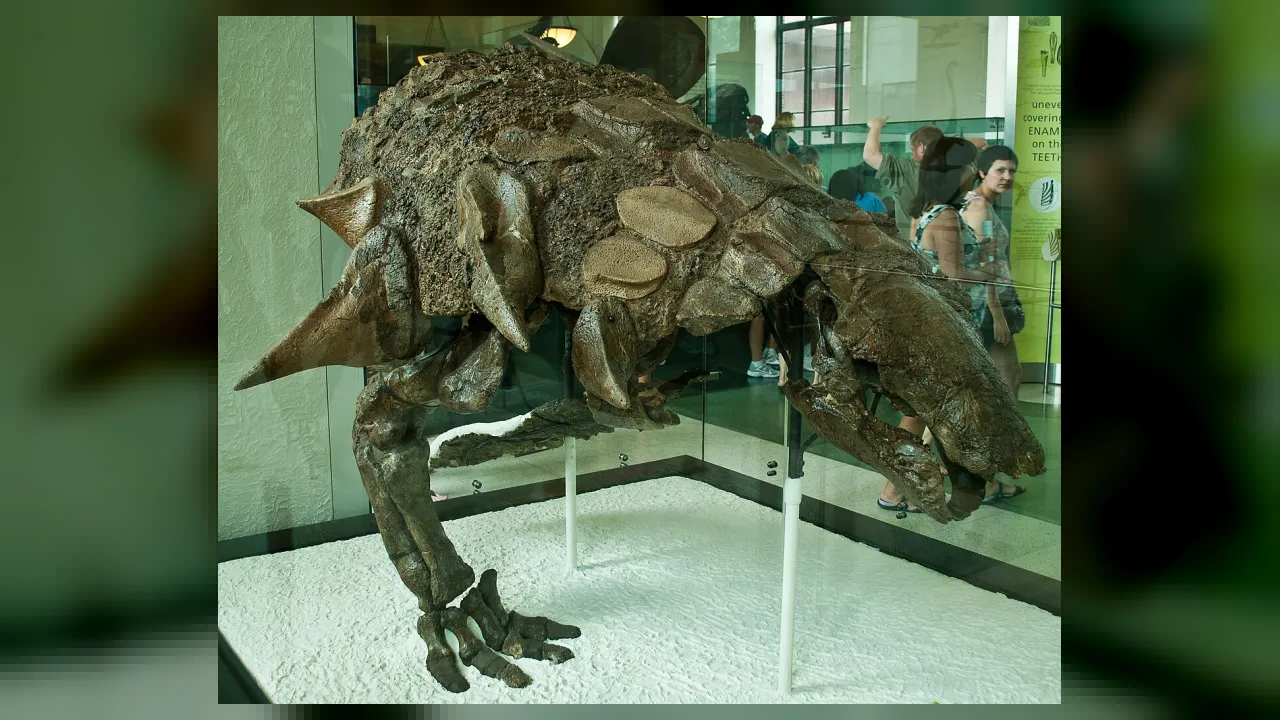
Imagine meeting a 22-foot lizard built like an armored truck! Edmontonia lumbered across swampy forests in Western North America about 75 million years ago. Its wide, flat body weighed nearly four tons.
2
Forward-Pointing Spikes
Three thick bands of bony plates wrapped across its neck like a knight's collar. Along its shoulders, huge forked spikes pointed straight forward and outward, ready to block any tyrannosaur that stepped too close.
3
Peaceful Berry Snipper
Despite looking fierce, Edmontonia was a gentle plant-eater. It used a narrow, scoop-shaped to nip soft ferns, shrubs, and fallen fruit near the forest floor.
1. Which direction did Edmontonia's largest shoulder spikes point?
2. What kind of food did Edmontonia clip with its narrow beak?
🤯 Mind-Blowing Fact • Grade 3
Broad cheek pouches inside Edmontonia's pear-shaped head kept chewed plant bits from spilling out of its mouth!
✨ Word Sparks (Grade 3 Glossary)
Tap 🔊 to hear
Osteoderm
A bony plate grown deep inside tough skin
Fused
Joined tightly together into one solid piece
Prong
One sharp point on a forked spike
🪝
Why did Edmontonia carry giant forked spikes on its shoulders instead of a club on its tail?
1
Meet the Nodosaur Family
Crash through the lush coastal plains of Late Cretaceous Alberta, and you might spot a wide, spiky shadow browsing among the ferns. Edmontonia belonged to the nodosaurs, one of the two main branches of armored dinosaurs. Unlike its cousin Ankylosaurus, it had a flexible, clubless tail.
2
Rings of Shield Bone
Three broad half-rings of bony plates shielded its neck and shoulders, while rows of ridged covered its broad back like pebbles in concrete. Its skull looked pear-shaped from above and wore flat, puzzle-like armor tiles on top.
3
Built-In Shoulder Spears
Jutting from each shoulder were magnificent spines up to 20 inches long—and on some species, one spike even split into twin ! Powered by huge shoulder muscles, Edmontonia could push forward to drive predators away or rival nodosaurs aside.
4
Named After Edmonton
Paleontologist Charles Mortram Sternberg named Edmontonia in 1928 after the Edmonton rock formation in Canada, where a beautifully preserved skull and body armor were uncovered.
1. How do scientists tell a nodosaur like Edmontonia apart from an ankylosaurid?
2. Why was this dinosaur given the name Edmontonia?
🤯 Mind-Blowing Fact • Grade 4
Fossils assigned to the Edmontonia group have been found from sunny Texas all the way up to snowy Late Cretaceous Alaska!
✨ Word Sparks (Grade 4 Glossary)
Tap 🔊 to hear
Ossicle
A tiny pebble-like bone filling gaps between plates
Keratin
Tough protein forming claws, horns, and fingernails
Transverse
Running sideways from one side to the other
🪝
When giant tyrannosaurs prowled North America, how did a slow four-ton herbivore stand its ground?
1
Sharing Territory With Tyrannosaurs
Between 76.5 and 69 million years ago, lush river deltas stretched along the Western Interior Seaway from Alberta down to Texas and north toward Alaska. Edmontonia browsed steadily through these coastal forests alongside duck-billed hadrosaurs and horned ceratopsians. Whenever apex predators such as Gorgosaurus or Albertosaurus stalked nearby, Edmontonia could not sprint away—so evolution engineered an almost impenetrable passive and active defense system.
2
Interlocking Armor Architecture
Across its broad neck and shoulders sat three cervical half-rings made of keeled osteoderms, surrounded by hundreds of tiny that allowed its skin to bend without leaving gaps. In life, tough sheaths coated every bony plate and spine, extending them well beyond the fossilized bone cores we see in museums today.
3
Active Shoulder Defense
Scientists once assumed nodosaurs simply crouched passively like turtles, waiting for predators to lose interest. However, biomechanical studies of Edmontonia rugosidens reveal massive muscle attachment scars on its shoulder blades and forelimbs. Instead of merely hiding, Edmontonia could brace its low, four-ton frame and thrust its forward-angled, sometimes forked shoulder spikes toward a predator's shins—or lock horns in shoving contests with rival Edmontonia.
4
Selective Low Browser
Unlike square-beaked grazers that cropped everything in sight, Edmontonia possessed a pear-shaped skull tapering to a narrow, rounded beak. It plucked nutritious ferns, cycad shoots, and fruiting shrubs while large bony palate shelves helped it breathe smoothly as its muscular cheeks chewed.
Ancient island continent forming western North America
🪝
How did biomechanical armor design turn Edmontonia into one of Late Cretaceous North America's widest-ranging herbivores?
1
Across the Laramidian Coastal Plains
During the Campanian and early Maastrichtian ages of the Late Cretaceous Period (76.5 to 69 million years ago), Western North America formed an isolated landmass called , bordered on the east by the warm Western Interior Seaway. Through its cypress swamps and fern-carpeted floodplains strode Edmontonia, a formidable four-ton nodosaurid measuring roughly 6.6 meters (22 feet) in length and nearly 2 meters across its armored flanks.
2
Cranial Specializations for Selective Browsing
Viewed dorsally, the skull of Edmontonia longiceps resembled an elongated pear, armored tightly by fused cranial that left no openings in front of the eyes. Its premaxillary beak was narrow and scoop-shaped, suited for cropping dicot leaves, low ferns, and fruiting bodies within a meter of the soil. Inside the skull, an extensively ossified secondary palate separated the nasal airway from the oral cavity, enabling continuous respiration while small leaf-shaped teeth processed tough vegetation inside fleshy cheeks.
3
Composite Dermal Shielding
Paleontologists marvel at the composite engineering of nodosaurid osteoderms. Three broad cervical half-rings guarded the neck, transitioning into transverse bands of keeled plates interspersed with flexible matrices of millimeter-scale ossicles. Along the anterolateral shoulders projected colossal parascapular spines—exceeding 50 centimeters in Edmontonia rugosidens and occasionally into dual points—sheathed in resilient keratin.
4
Active Versus Passive Defense Mechanics
Lacking the fused caudal handle and heavy tail club of ankylosaurids, Edmontonia relied on dual defensive strategies. Against towering tyrannosaurids like Daspletosaurus or Albertosaurus, dropping onto its broad plastron-like belly prevented overturning while its dorsal shield deflected crushing bites. Simultaneously, enlarged deltopectoral crests on the humerus anchored powerful forelimb muscles capable of driving those forward-swept shoulder spikes into an attacker's legs or sparring in intraspecific flank-shoving contests.
5
Discovery and Taxonomic History
In 1924, fossil hunter George Paterson discovered the holotype skeleton near Morrin, Alberta, in the Horseshoe Canyon Formation, leading Charles Mortram Sternberg to name Edmontonia longiceps four years later. Subsequent finds from the Dinosaur Park Formation—originally dubbed Palaeoscincus rugosidens by Charles Gilmore in 1930—revealed extraordinary mummified skin impressions and life-position armor, cementing Edmontonia as an icon of North American paleontology.