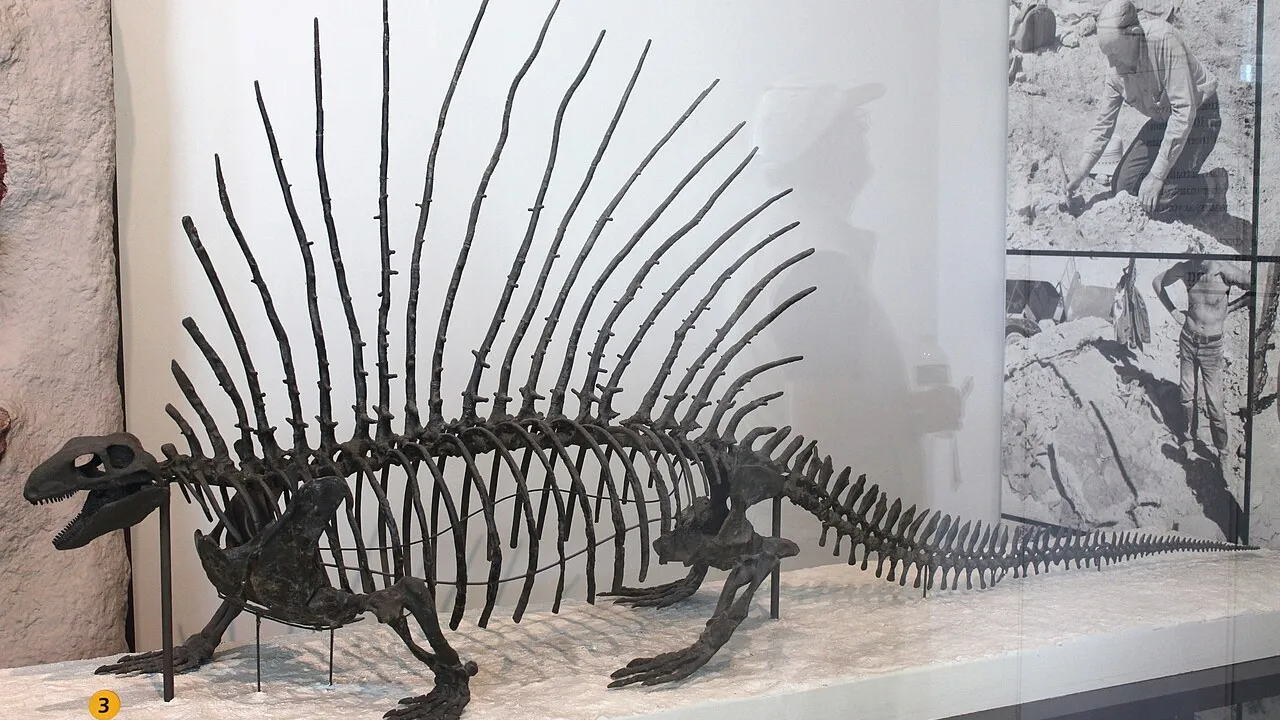
⚡ Survival SuperpowerMouth packed with pavement-like crushing tooth plates and a crossbar-studded back sail
🤯 Mind-Blowing Fact • Grade 1
Edaphosaurus had hundreds of blunt peg teeth covering the roof of its mouth like cobblestones on a street!
✨ Word Sparks (Grade 1 Glossary)
Tap 🔊 to hear
Herbivore
An animal that eats mostly leaves and plants
Peg
A short blunt pin shape
Crossbar
Small bar sticking out across a tall post
🪝
Why did this giant sail-backed beast have such a tiny head?
1
Tiny Head, Giant Belly
Munch, crunch, chomp! Meet Edaphosaurus in a sunny ancient swamp. At first glance, its tall back sail looks just like Dimetrodon's sail. Look closer at its tiny head and round barrel tummy!
2
One of the First Salad Fans
While sharp-toothed hunters chased meat, Edaphosaurus loved eating crunchy plants! Its wide belly held lots of green leaves and fern stems.
3
Bumpy Crossbars on Its Sail
Little bony bumps stuck out sideways along its tall sail spines. No meat-eating sail beast had bumps like those!
1. How can you quickly tell Edaphosaurus apart from meat-eating Dimetrodon?
2. What was Edaphosaurus's favorite food?
🤯 Mind-Blowing Fact • Grade 2
Edaphosaurus evolved its tall back sail completely on its own, separate from Dimetrodon—just like bats and birds evolved wings separately!
✨ Word Sparks (Grade 2 Glossary)
Tap 🔊 to hear
Palate
The bony roof inside an animal's mouth
Microbes
Tiny living helpers that break down tough food
Pavement
Flat stones fitted closely together like a floor
🪝
How do you chew tough prehistoric ferns before flat grinding molars were even invented?
1
The First Big Leaf Muncher
Wander beside an Early Permian marsh 290 million years ago, and you might spot two tall sails rising above the horsetails. One belongs to hungry Dimetrodon—and the other belongs to peaceful Edaphosaurus! Growing over eleven feet long, Edaphosaurus was one of the earliest large plant-eating vertebrates on land.
2
Pavement Inside Its Mouth
Its name means ' lizard' for a cool reason. Besides neat rows of peg teeth along its jaws, Edaphosaurus grew thick plates packed with over a hundred blunt teeth on the roof of its mouth and inner jaw! Sliding its lower jaw backward and forward mashed tough stems into pulp.
3
A Barrel Full of Helpers
Wide, curved ribs made room for huge intestines filled with friendly that digested fibrous plants—and like Dimetrodon, this mammal cousin was not a dinosaur!
1. Why did scientist Edward Drinker Cope name this animal Edaphosaurus, meaning 'pavement lizard'?
2. Why did Edaphosaurus have such a wide, barrel-shaped ribcage?
🤯 Mind-Blowing Fact • Grade 3
Edaphosaurus's skull was so small for an eleven-foot, 660-pound animal that its head measured barely six to eight inches long!
✨ Word Sparks (Grade 3 Glossary)
Tap 🔊 to hear
Convergent
Unrelated animals independently evolving very similar body traits
Tubercle
Small rounded bony knob sticking off a spine
Fermentation
Microbes breaking down tough plant fibers for energy
🪝
Why did two Early Permian mammal cousins—one hunter and one herbivore—independently build giant sails on their backs?
1
Unlocking Green Energy on Land
For tens of millions of years after vertebrates first crawled onto land, almost every four-legged animal ate insects, fish, or other animals because fibrous leaves are hard to break down. Around 300 million years ago during the Late Carboniferous, Edaphosaurus cracked the plant-eating puzzle—helping build the modern land food web where herbivores outnumber predators!
2
Fore-and-Aft Jaw Grinding
Inside Edaphosaurus's remarkably small skull, special jaw joints allowed propalinal motion—sliding the lower jaw forward and backward instead of just snapping shut. Upper palatal tooth plates rubbed directly against lower lingual tooth plates like two millstones grinding horsetails and seed-ferns.
3
Convergent Sails With a Twist
Although Edaphosaurus and Dimetrodon were both synapsids, they belonged to separate families whose ancestors had no sails. Edaphosaurus grew thicker, gently curved spines studded with rows of stubby horizontal crossbars called .
4
What Did Those Crossbars Do?
Paleontologists debate whether those bony braced a thick skin sail, created turbulent airflow to shed excess heat, or anchored fatty humps and visual displays.
1. How did Edaphosaurus move its lower jaw to grind up tough Permian plants?
2. Why is the similarity between Edaphosaurus's sail and Dimetrodon's sail an example of convergent evolution?
🤯 Mind-Blowing Fact • Grade 4
Early Carboniferous species like Edaphosaurus novomexicanus started out under three feet long before later Permian descendants ballooned to more than ten times their weight!
✨ Word Sparks (Grade 4 Glossary)
Tap 🔊 to hear
Propalinal
Jaw movement sliding forward and backward while chewing
Cellulose
Tough structural fiber inside plant cell walls
Battery
Tightly packed group of many working teeth together
🪝
How did a six-hundred-pound synapsid with a head the size of a grapefruit transform terrestrial ecosystems forever?
1
Inventing High-Fiber Herbivory
Survey the lush river plains of Late Carboniferous and Early Permian Euramerica 295 million years ago. Before animals like Edaphosaurus pogonias evolved, land vertebrates tapped plant energy only indirectly by eating plant-munching insects. Vertebrates lack native enzymes to digest , so harnessing leaves directly required radical anatomical redesign—making Edaphosauridae (alongside reptile-line diadectids) pioneers of modern trophic pyramids.
2
Cranial Millstones and Propalinal Mechanics
Measuring up to 3.5 meters long and weighing roughly 300 kilograms, Edaphosaurus sported a skull astonishingly small for its bulk. Serrated leaf-shaped marginal teeth cropped vegetation at the front of a keratin-rimmed mouth, while expansive pterygoid and coronoid tooth batteries—each studded with over a hundred blunt pegs—occupied the palate and inner mandible. Elongated quadrate-articular jaw joints enabled fore-and-aft shearing that ruptured tough plant cell walls before swallowing into a cavernous hindgut vat.
3
Enigma of the Crossbar Sail
Rising in a graceful, semicircular arc over its barrel torso were stout neural spines bristling with paired lateral tubercles—bony crossbars completely absent in Dimetrodon. Microscopic bone histology by Huttenlocker and colleagues showed fewer deep vascular grooves than once assumed, plus dense cortical bone inside the crossbars.
4
Thermoregulation, Fat Storage, or Display?
Whether those lateral pegs generated boundary-layer air turbulence to cool a fermenting gut, supported fibrous sail webbing, or advertised species identity across floodplains where multiple sail-backed synapsids coexisted, Edaphosaurus thrived for thirty million years—all while hunted by its fellow synapsid, Dimetrodon.
1. Why couldn't early land vertebrates digest leaves without evolving wide barrel-shaped bodies like Edaphosaurus?
2. How did the neural spines of Edaphosaurus differ structurally from those of Dimetrodon?
🤯 Mind-Blowing Fact • Grade 5
The species name Edaphosaurus cruciger literally means 'cross-bearing pavement lizard'—inspired by how each tall spine and its horizontal side knobs resemble tiny stone crosses!
✨ Word Sparks (Grade 5 Glossary)
Tap 🔊 to hear
Comminution
Mechanical grinding of food into very small particles
Cellulolysis
Chemical breakdown of tough plant cellulose by microbes
Gigantothermy
Maintaining steady body warmth simply through huge size
🪝
How did Edaphosaurus engineer oral mastication and convergent neural sails to help establish Earth's first modern terrestrial food webs?
1
Assembling the Terrestrial Trophic Pyramid
During the Kasimovian Stage of the Late Carboniferous (~303 MYA), terrestrial ecosystems lacked abundant large vertebrate herbivores; carnivores subsisted primarily on aquatic fish, amphibians, and detritivorous arthropods. Within the basal synapsid clade Edaphosauridae, natural selection forged one of the earliest solutions to high-fiber terrestrial herbivory. Culminating in Early Permian giants like Edaphosaurus pogonias and Edaphosaurus cruciger (up to 3.5 meters and 300 kilograms), first named by Edward Drinker Cope in 1882 from the Texas Red Beds, these synapsids reshaped continental energy flow.
2
Oral Processing and Palatal Tooth Batteries
Unlike modern reptiles that swallow foliage nearly whole, Edaphosaurus evolved sophisticated oral inside a remarkably diminutive skull. Laterally compressed, obliquely serrated marginal teeth cropped equisetalean horsetails and pteridosperms. Internally, paired palatal plates (formed by pterygoid, palatine, and ectopterygoid bones) opposed massive mandibular tooth plates on the prearticular and coronoids—each bearing 100 to 150 bulbous denticles. Longitudinally expanded jaw joints powered propalinal (anteroposterior) grinding strokes, shredding plant cuticle to accelerate microbial inside a capacious, barrel-ribbed hindgut.
3
Histological Scrutiny of Tuberculate Spines
Edaphosaurids evolved hyper-elongated dorsal neural spines independently of sphenacodontids like Dimetrodon. Uniquely, Edaphosaurus spines carried serial pairs or irregular clusters of lateral bony projections (tubercles). Comparative bone histology by Adam Huttenlocker, Hans Sues, and colleagues revealed thick lamellar-zonal bone and woven Sharpey's fiber insertions within the tubercles—challenging older ideas of exposed bony pegs or giant blood reservoirs, and suggesting tough collagenous sail membranes braced against wind flex and agonistic display.
4
Thermodynamics of a Fermenting Giant
Because microbial hindgut fermentation generates substantial internal metabolic heat while large body mass slows cooling (), aerodynamicists have also proposed that tubercle-induced air turbulence across the sail aided convective heat dumping under intense tropical Permian sun.
5
Ecological Turnover in the Cisuralian
Sharing Euramerican floodplains with apex predator Dimetrodon for nearly thirty million years, Edaphosauridae vanished near the Kungurian end of the Early Permian (~272 MYA), succeeded in Middle Permian ecosystems by diverse herbivorous caseids, pareiasaurs, and dicynodont therapsids.