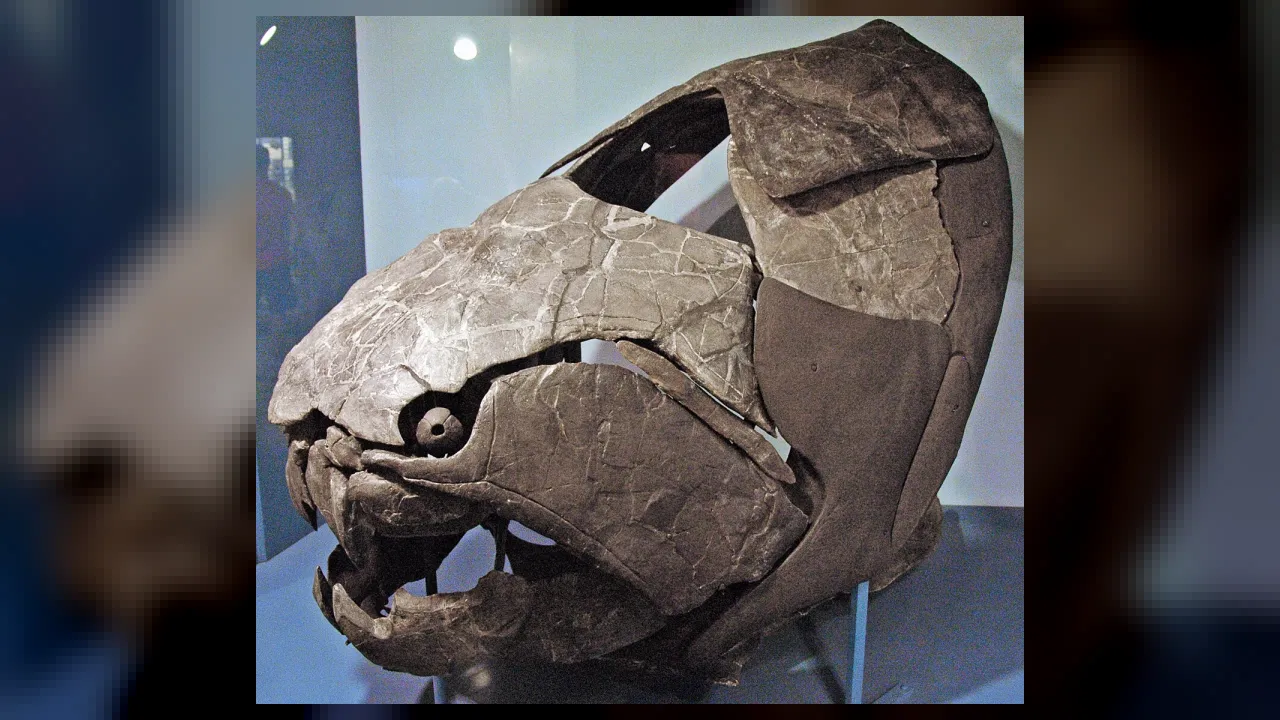
1. What did Dunkleosteus have inside its mouth instead of regular teeth?
2. Did Dunkleosteus live at the same time as dinosaurs?
🤯 Mind-Blowing Fact • Grade 2
Construction crews digging highway roads around Cleveland, Ohio, uncovered dozens of world-famous Dunkleosteus skulls in dark shale rock!
✨ Word Sparks (Grade 2 Glossary)
Tap 🔊 to hear
placoderms
Extinct ancient fishes with armored bony heads
cartilage
Firm, bendable tissue like your nose tip
shale
Dark layered rock formed from seafloor mud
🪝
Why have paleontologists found dozens of Dunkleosteus skulls in Ohio, yet almost zero tails?
1
When Ohio Lay Underwater
Picture standing near Cleveland, Ohio, 360 million years ago! Warm salty waves covered the Midwest during the Devonian Period, often called the Age of Fishes. Gliding above the muddy bottom was Dunkleosteus, an armored giant belonging to an extinct group called .
2
Armored Front, Flexible Back
Thick, two-inch-thick bony armor shielded its head and shoulders. Behind its shoulders, however, its backbone was made of soft like a shark's, so only the bony front half usually turned into stone fossils!
3
Blink-of-an-Eye Bite
Hinges in its neck let Dunkleosteus lift its whole upper skull while dropping its jaw, opening its mouth in one-fiftieth of a second!
1. Why do museums usually find only the armored head and shoulders of Dunkleosteus?
2. Where in the United States have many famous Dunkleosteus fossils been unearthed?
🤯 Mind-Blowing Fact • Grade 3
Concentrating an 11,000-pound bite onto the sharp front fang tips of its jaw blades created enough pressure—80,000 pounds per square inch—to punch right through bone armor!
✨ Word Sparks (Grade 3 Glossary)
Tap 🔊 to hear
milliseconds
Thousandths of a second—super fast!
suction
Inward water pull created by opening fast
gnathal blades
Sharp bony jaw plates replacing individual teeth
🪝
Why did scientists recently shrink Dunkleosteus's length—while making it even chunkier and stronger?
1
Earth's First Vertebrate Super-Predator
Before sharks or marine reptiles ever grew giant, armored fishes called placoderms ('plate-skinned') ruled the Late Devonian oceans. Dunkleosteus terrelli—named after paleontologist David Dunkle and fossil hunter Jay Terrell—crowned the food chain across North America, Europe, and Morocco.
2
Four-Bar Linkage Jaws
Engineers studying Dunkleosteus skulls discovered a clever four-joint lever system connecting its skull, neck shield, and lower jaw. In just twenty , powerful muscles yanked the mouth wide open to create , then slammed bony down with over 11,000 pounds of force!
3
A Chunky Makeover in 2023
Because its unarmored tail rarely fossilized, older books guessed Dunkleosteus stretched thirty feet long like an elongated shark. In 2023, researcher Russell Engelman measured its torso armor carefully and proved Dunkleosteus was shorter—about thirteen to eighteen feet—with a deep, muscular, tuna-shaped body!
4
Spitting Out Indigestible Armor
Fossilized pellets around Cleveland show Dunkleosteus crunched smaller armored fishes and neatly coughed up indigestible shell bits, much like owls cough up bone pellets today!
1. How did 2023 research update what Dunkleosteus looked like in life?
2. How did Dunkleosteus handle hard bone pieces from armored prey it swallowed?
🤯 Mind-Blowing Fact • Grade 4
When paleontologist Russell Engelman published the stockier, deep-bodied 2023 reconstruction of Dunkleosteus, scientists affectionately nicknamed the muscular look 'Chunky Dunk'!
✨ Word Sparks (Grade 4 Glossary)
Tap 🔊 to hear
arthrodire
Armored fish with a hinged neck joint
four-bar linkage
Four connected bony levers multiplying speed and force
extrapolated
Estimated unknown size from smaller known parts
🪝
How could a fish open its jaws in one-fiftieth of a second AND deliver one of history's strongest bites?
1
Arthrodire Engineering
Most animals face a mechanical trade-off: jaws built for fast snapping sacrifice crushing power, while heavy bone-crushers close slowly. Lurking in Late Devonian epicontinental seas 360 million years ago, Dunkleosteus terrelli solved both challenges at once! As an ('joint-necked') placoderm, it possessed a movable ball-and-socket joint linking its heavy cranial shield to its thoracic trunk armor.
2
Dual-Speed Four-Bar Mechanics
Biomechanical computer models built by Philip Anderson and Mark Westneat revealed a unique driven by synchronized neck and cheek muscles. Firing together, these muscles popped the upper skull upward while dropping the mandible in twenty milliseconds—sucking nearby sharks and ammonoids inward—before slamming beveled bony gnathal plates shut with roughly 53,000 Newtons (11,000 pounds) of bite force!
3
Recalibrating 'Chunky Dunk'
For decades, artists Dunkleosteus to nine meters by scaling whole-body great white sharks against its skull length. Yet placoderm skulls occupied a far larger fraction of total body length than shark heads! Analyzing head-to-gill-chamber ratios across thousands of living fishes and complete small in 2023 recalibrated typical adult Dunkleosteus to roughly 4.1 meters (up to 5.5 meters in giant fragments), sporting a deep, barrel-chested fuselage.
4
Growing Up Jaw-First
Comparing juvenile and adult Cleveland Shale skulls shows young Dunkleosteus had slimmer jaws suited to snapping soft prey before thickening into armor-shearing guillotines as adults.
1. Why did older reconstructions accidentally make Dunkleosteus way too long?
2. What special joint helped Dunkleosteus open its mouth so fast?
🤯 Mind-Blowing Fact • Grade 5
Matching blade-shaped gouges punched straight into fossilized Dunkleosteus head armor prove these armored titans sometimes sparred with other Dunkleosteus!
✨ Word Sparks (Grade 5 Glossary)
Tap 🔊 to hear
gnathostomes
All vertebrate animals possessing hinged jaws
heterocercal
Asymmetrical tail fin with longer upper lobe
anoxia
Dangerous drop in dissolved underwater oxygen
🪝
How did Late Devonian arthrodires pioneer vertebrate apex predation—and why did every single placoderm vanish at the Hangenberg Crisis?
1
Rise of the First Gnathostome Megapredators
When amateur collector Jay Terrell spotted massive dermal bone plates eroding from Lake Erie shale bluffs at Sheffield Lake, Ohio, in 1867—later honored alongside Cleveland Museum curator David Dunkle in Dunkleosteus terrelli—paleontology met Earth's earliest vertebrate super-predator. Thriving during the Famennian stage (382–358 MYA) across Laurussia and Gondwana, arthrodire placoderms spearheaded the evolutionary radiation of jawed vertebrates ().
2
Kinetic Four-Bar Feeding Biomechanics
Lacking true replaceable teeth, Dunkleosteus wielded self-sharpening dermal bone projections—supragnathal and infragnathal plates—whose shearing occlusion maintained razor edges throughout life. Dynamic four-bar linkage modeling demonstrates cranio-thoracic muscles elevated the neurocranium on paired cervical condyles while depressing the mandible within twenty milliseconds. The resulting sub-ambient buccal cavity sucked prey inward before adductor muscles concentrated 4,400 to 5,300 Newtons at the anterior fang tip—yielding localized pressures exceeding 550 megapascals, rivaling Tyrannosaurus rex in bone-puncturing capability!
3
Morphometric Revision of Body Proportions
Because post-thoracic placoderm skeletons consisted of uncalcified cartilage rarely preserved outside anoxic Lagerstätten, twentieth-century reconstructions stretched Dunkleosteus to nine meters based on lamnid shark allometry. In 2023, Russell Engelman introduced an orbit-to-operculum morphometric proxy validated across hundreds of extant fishes and complete smaller arthrodires like Coccosteus. Results shortened modal adult Dunkleosteus terrelli to 3.4–4.1 meters (reaching ~5.5 meters in giant Moroccan and Ohioan fragments) while deepening its trunk into a massive, tuna-like fusiform body.
4
Caudal Fin Anatomy and Cannibalism
Preserved tails of smaller arthrodires confirm a shark-like fin suited to active pelagic swimming rather than sluggish bottom-dwelling. Unhealed gouges matching conspecific gnathal blades across Cleveland Shale head shields even document intraspecific combat or opportunistic cannibalism!
5
The Hangenberg Extinction
Around 359 million years ago, widespread oceanic and rapid glaciation triggered the end-Devonian Hangenberg Crisis. Every placoderm species on Earth vanished completely, clearing ecological space for cartilaginous chondrichthyans (sharks) and actinopterygian bony fishes to inherit modern seas.