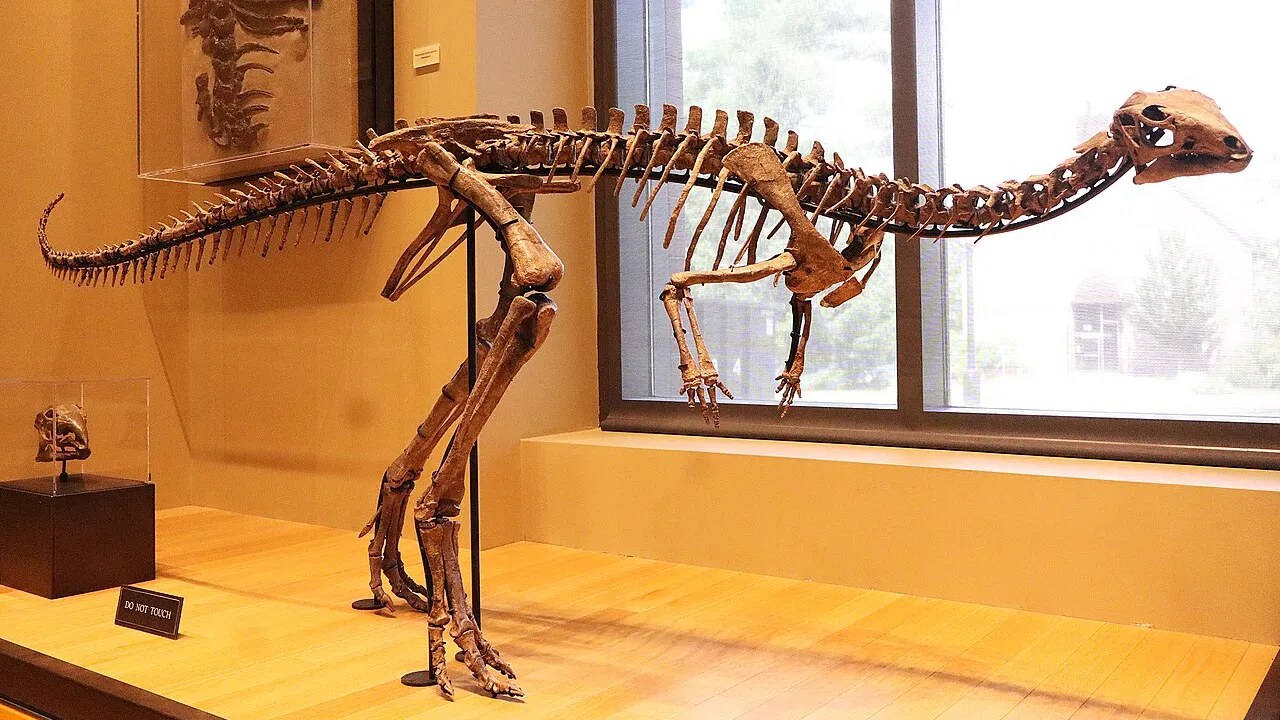
⚡ Survival SuperpowerLong gazelle-like shin bones and a stiff balancing tail for lightning-fast sprints
🤯 Mind-Blowing Fact • Grade 1
Baby Dryosaurus had giant eyes and extra-short snouts that made them look almost like cute puppies with beaks!
✨ Word Sparks (Grade 1 Glossary)
Tap 🔊 to hear
sprint
to run at top speed right away
balance
staying steady without tipping or falling over
slim
thin, light, and built for speed
🪝
How did a small dinosaur with no horns or armor stay safe from giants?
1
Zoom Through the Ferns!
Zoom, dash, leap! A green runner darts through tall ferns. Dryosaurus had no sharp horns and no heavy shell. Instead, it trusted its super-fast back legs!
2
Big Watchful Eyes
Huge round eyes helped it spot danger right away. Its stiff tail stretched straight back like a balancing pole on sharp turns.
3
Oak-Leaf Teeth
Its name means oak tree lizard because its cheek teeth had bumpy edges shaped like oak leaves!
1. How did Dryosaurus escape from hungry meat-eaters?
2. Why did scientists name Dryosaurus the oak tree lizard?
🤯 Mind-Blowing Fact • Grade 2
Dryosaurus had five nimble fingers on each hand to grasp tender plant shoots and pull them right to its beak!
✨ Word Sparks (Grade 2 Glossary)
Tap 🔊 to hear
nimble
quick, light, and easy in movement
gazelle
a fast, slender hoofed mammal that leaps
horsetail
an ancient reed-like plant with jointed stems
🪝
Why was Dryosaurus named after oak leaves even though oak trees did not exist yet?
1
Funny Name, Clever Teeth
Take a close peek at a fossilized Dryosaurus tooth! Ridges along its edges look just like a little oak leaf, which inspired scientist Othniel Charles Marsh to name it oak tree lizard in 1894. Ironically, flowering oak trees had not even appeared on Earth during the Late Jurassic Period!
2
Built Like a Gazelle
Dryosaurus shared western North America with towering giants like Diplodocus and fierce hunters like Allosaurus. Long lower leg bones, light hollow limb bones, and three toes made it one of the fastest runners on the plain.
3
Cheeks Full of Greens
A hard front beak snipped low ferns and , while muscular cheeks kept chewed bits from spilling out.
1. What is funny about the name oak tree lizard for Dryosaurus?
2. How did fleshy cheeks help Dryosaurus while eating?
🤯 Mind-Blowing Fact • Grade 3
Tiny rings of bone preserved inside Dryosaurus eye sockets show it had enormous eyes for spotting predators in dim forest light!
✨ Word Sparks (Grade 3 Glossary)
Tap 🔊 to hear
savanna
an open plain with scattered trees
counterbalance
a weight that keeps movement steady
stride
one long step taken while running
🪝
How did a two-hundred-pound plant-eater weave safely underneath eighty-foot sauropods?
1
Life Under the Giants
Imagine standing in a sunlit conifer in ancient Colorado 150 million years ago. Towering Brachiosaurus and Diplodocus strip treetops overhead, while nimble herds of Dryosaurus dart among cycads and fern thickets below. Measuring ten to fourteen feet long—half of that tail—this fleet-footed ornithopod filled the ecological role that deer and antelope fill today.
2
Anatomy of a High-Speed Runner
Paleontologists can tell an animal's top speed by comparing its upper and lower leg bones. In Dryosaurus, the shin bone was significantly longer than the thigh bone, multiplying every . Bony tendons stiffened its long tail into a rigid so it could zigzag sharply without tumbling.
3
Watchful Eyes and Quick Hands
Rings of tiny bones inside its huge eye sockets prove Dryosaurus had crisp vision for spotting stalking Allosaurus or Ceratosaurus. Meanwhile, short arms with five-fingered hands grabbed low stems.
4
Growing Up Fast
Fossils ranging from tiny hatchlings at Dinosaur National Monument to sleek adults show that Dryosaurus grew rapidly and likely stayed in watchful family flocks.
1. Which modern animals had a lifestyle most similar to Dryosaurus?
2. What bone clue proves Dryosaurus was built for fast running?
🤯 Mind-Blowing Fact • Grade 4
Scientists found Dryosaurus fossils from tiny babies up to full-grown adults, revealing that their snouts stretched much longer as they matured!
✨ Word Sparks (Grade 4 Glossary)
Tap 🔊 to hear
velocity
high speed of motion in one direction
acceleration
speeding up quickly from a slower pace
lineage
a line of ancestors and descendants
🪝
What do juvenile Dryosaurus skulls tell us about how dinosaur faces transformed as they grew up?
1
Speedster of the Morrison Formation
Across the vast seasonal floodplains of the Late Jurassic Morrison Formation—stretching from Montana to New Mexico—giant armored stegosaurs and colossal sauropods dominated the landscape. Weaving swiftly between them ran Dryosaurus altus, a slender dryosaurid ornithopod first named by Othniel Charles Marsh in the late nineteenth century. Weighing less than two hundred pounds at fourteen feet long, Dryosaurus relied entirely on vigilance and .
2
Cranial Changes from Hatchling to Adult
Remarkably complete growth series from Utah and Wyoming show dramatic skull remodeling as Dryosaurus matured. Hatchlings possessed proportionally huge eyes and short, rounded snouts—classic juvenile traits seen across vertebrates. As youngsters grew, their snouts lengthened forward to accommodate expanding rows of oak-leaf-shaped cheek teeth and a sharp keratinous cropping beak.
3
No-Thumb-Spike Ancestor
Although Dryosaurus belonged to the broader iguanodontian that later produced thumb-spiked Iguanodon and giant duck-bills, it retained primitive five-fingered grasping hands and lacked defensive spikes. Instead, powerful caudofemoralis tail muscles yanked its femora backward for explosive .
4
Continental Connections
Closely related dryosaurids such as Dysalotosaurus in Tanzania prove this agile family spread across connected landmasses before Late Jurassic seas widened. Living in multi-generational flocks gave young runners dozens of watchful neighbors to sound early alarms whenever shadows moved along the forest edge.
1. How did the skull of a baby Dryosaurus change as it grew into an adult?
2. What does the discovery of close cousin Dysalotosaurus in Tanzania show?
🤯 Mind-Blowing Fact • Grade 5
Microscopic bone studies of Dryosaurus have never yet found a 'fully stopped growing' outer ring, hinting that even the biggest fourteen-foot skeletons found so far were still teenagers!
✨ Word Sparks (Grade 5 Glossary)
Tap 🔊 to hear
cursorial
anatomically specialized for fast running strides
ontogeny
how an organism changes while growing up
metatarsal
long bone inside the middle of a foot
🪝
How did agile, lightweight Dryosaurus lay the evolutionary foundation for multi-ton Cretaceous duck-billed giants?
1
Discovery During the Bone Wars
In 1878, Yale paleontologist Othniel Charles Marsh described slender ornithopod remains from Wyoming's Como Bluff quarry, later establishing the genus Dryosaurus in 1894 for its oak-leaf-shaped dental crowns. Over the following century, quarries across Utah, Colorado, and Wyoming—especially Dinosaur National Monument—yielded dozens of articulated skeletons spanning embryonic-scale juveniles to mature four-meter adults, making Dryosaurus the benchmark genus for family Dryosauridae.
2
Cursorial Biomechanics and Balance
Every proportion of the Dryosaurus skeleton prioritized efficiency across semi-arid Morrison Formation savannas. Elongated tibiae and tightly appressed maximized stride length, while the hallux—the inner first toe—had vanished completely, leaving a symmetrical, fast-striking three-toed foot. Along the spine, ossified tendons locked caudal vertebrae into a dynamic horizontal stabilizer powered by massive caudofemoralis retractor muscles.
3
Nascent Pleurokinesis and Selective Browsing
Inside its narrow skull, Dryosaurus pioneered feeding innovations that later empowered giant hadrosaurs. Behind a toothless premaxillary beak that snipped low ferns, cycads, and conifers, subtle hinges allowed the maxillary bones to flex slightly outward when lower teeth occluded upward—an early version of pleurokinetic chewing that ground tough Jurassic flora efficiently.
4
Ontogeny and Unceasing Growth
Histological bone sections studied by paleontologists reveal rapid, uninterrupted fibrolamellar bone deposition without definitive adult growth stops in known specimens, suggesting even four-meter individuals may still have been growing when buried, accelerating youngsters quickly past vulnerable small size classes.
5
Outwitting Apex Theropods
With wide scleral rings supporting keen twilight vision and spacious braincase lobes tuned to balance and hearing, Dryosaurus relied on sensory acuity and explosive sprints to evade Allosaurus, Ceratosaurus, and Torvosaurus across Late Jurassic floodplains.