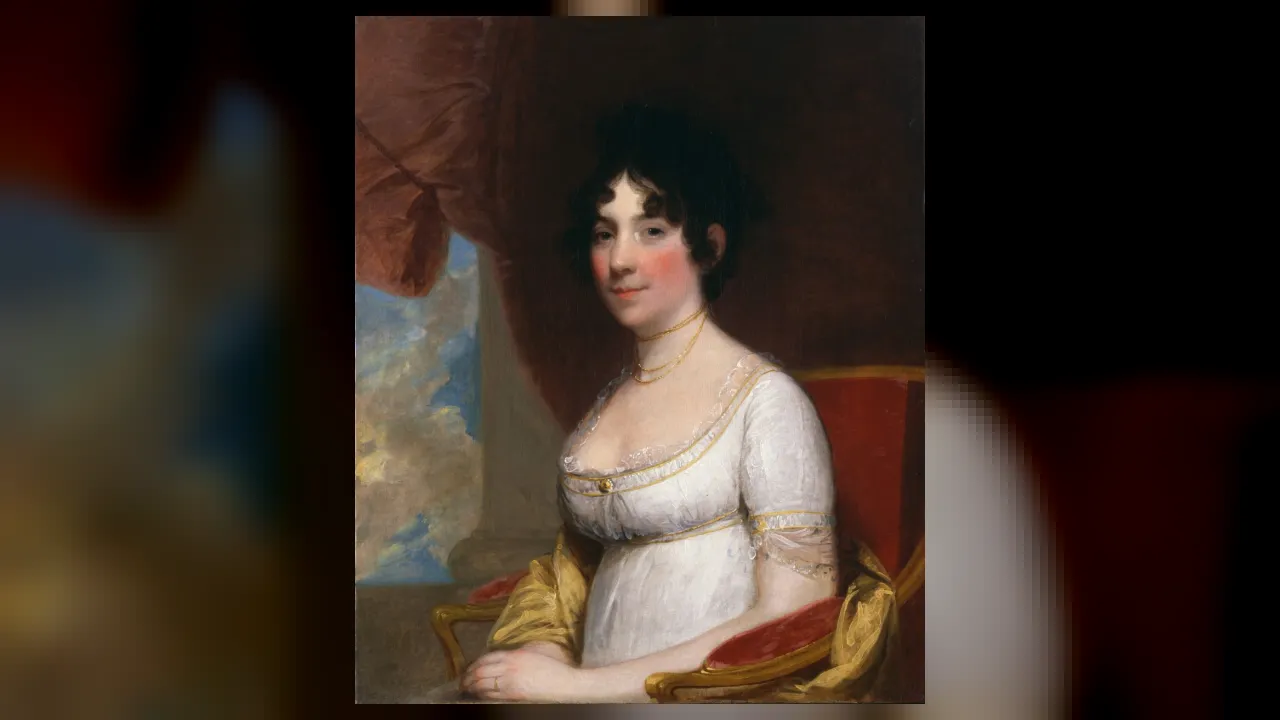
🇺🇸 U.S. HISTORY
🏛️ Fourth First Lady & Civic Hostess of the Republic • 1768–1849
VA History & Social Science SOL K.1, 1.2, 2.4, VS.1–VS.10, USI & USII
Dolley Madison
First Lady Who Saved George Washington's Portrait
Grade 2 • Developing • 127 words
⏳ Era / Statehood1768–1849 • Early Republic & War of 1812 (First Lady 1809–1817)
🗺️ Region / CapitalHanover & Orange Counties, Virginia & Washington, D.C.
📜 Key MilestoneRescued George Washington's portrait & vital papers before the 1814 White House fire
⚡ Historical SparkUnited rival lawmakers through warm hospitality and protected priceless national treasures under fire
🤯 Mind-Blowing Fact • Grade 1
Dolley Madison popularized serving ice cream—including fresh strawberry and oyster flavors—at joyful White House dinners!
✨ Word Sparks (Grade 1 Glossary)
Tap 🔊 to hear
portrait
A painted picture of a person
canvas
Strong cloth used for oil paintings
hostess
Someone who welcomes guests warmly inside
🪝
Who stayed calm to save a giant painting of George Washington right before soldiers burned the White House?
1
A Friendly Hostess
Dolley grew up in Virginia. When her husband James Madison became president, Dolley welcomed everyone kindly to the White House. She even served yummy ice cream!
2
Danger in the City
During the War of 1812, British soldiers marched toward Washington. Smoke filled the sky! Everyone told Dolley to hurry away fast.
3
Saving the Painting
Dolley refused to leave George Washington's big painting behind! Helpers broke its heavy frame and carried the safely away in a wagon.
1. Whose famous painting did Dolley Madison insist on saving from the White House in 1814?
2. Which U.S. President was married to Dolley Madison?
🤯 Mind-Blowing Fact • Grade 2
It was because of beloved Dolley Madison that Americans first invented the title 'First Lady'—a phrase President Zachary Taylor used in 1849 to honor her!
✨ Word Sparks (Grade 2 Glossary)
Tap 🔊 to hear
gilded
Covered thinly with shiny gold leaf
hospitality
Friendly, generous care shown to visitors
treasure
Something precious worth protecting with care
🪝
Why did rival politicians who argued all day in Congress happily chat together at Dolley Madison's Wednesday parties?
1
Bringing People Together
Picture candlelit rooms in the White House filled with music, laughter, and dishes of cold strawberry ice cream! Raised in a Quaker family in Virginia, Dolley Payne Todd married future fourth president James Madison in 1794. While shy James studied constitutional law, cheerful Dolley invited lawmakers from opposing parties to talk as neighbors.
2
August 24, 1814
During the War of 1812, British troops defeated American militia outside Washington, D.C., and marched straight toward the White House. Packing trunks of important government papers first, Dolley looked up at Gilbert Stuart's eight-foot portrait of George Washington bolted tightly to the wall.
3
Rescuing History
With no time to unscrew the heavy frame, Dolley ordered the frame cracked open so helpers could lift out the canvas safely—just hours before British troops burned the White House!
1. How did Dolley Madison help lawmakers from rival political parties work better together?
2. Why couldn't workers simply lift George Washington's portrait off a wall hook on August 24, 1814?
🤯 Mind-Blowing Fact • Grade 3
Gilbert Stuart's rescued 1797 Lansdowne portrait of George Washington is the ONLY object from before the 1814 fire that has hung continuously in the White House collection to this day!
✨ Word Sparks (Grade 3 Glossary)
Tap 🔊 to hear
bipartisanship
Cooperation between members of rival parties
reception
A welcoming social gathering for guests
orphanage
A caring home for parentless children
🪝
What happened inside the White House when cannon fire boomed just miles away in August 1814?
1
From Virginia Quaker Home to Capital Hostess
Imagine peering through a brass spyglass from the White House roof on a hot August afternoon in 1814 as distant cannon smoke rises over Maryland! Born in 1768 and raised on Scotchtown Plantation in Hanover County, Virginia, Dolley grew up in a Quaker family that freed its enslaved workers and moved to Philadelphia. Years after losing her first husband to yellow fever, she married Virginia statesman James Madison.
2
Defining the Role of First Lady
First helping widowed President Thomas Jefferson host official dinners and then serving as First Lady during James Madison's presidency (1809–1817), Dolley redecorated the White House with Architect Benjamin Henry Latrobe and hosted famous Wednesday night where diplomats, writers, and ordinary citizens mingled freely.
3
Courage Under Fire in 1814
On August 24, 1814, during the War of 1812, President Madison rode to the Battle of Bladensburg while British troops advanced on Washington. Refusing to panic, Dolley packed trunks of Cabinet records and insisted Gilbert Stuart's full-length portrait of George Washington be saved. Assisted by White House doorkeeper Jean-Pierre Sioussat, gardener Thomas McGraw, and young enslaved attendant Paul Jennings, the outer frame was broken open and the canvas handed safely to two New York gentlemen for safekeeping!
4
Montpelier and Civic Charity
After retiring to Montpelier in Orange County, Virginia, Dolley co-founded a home for orphaned children in Washington and helped raise funds for the Washington Monument.
1. Who worked alongside Dolley Madison inside the White House to take down and rescue George Washington's portrait?
2. What was the name of James and Dolley Madison's historic Virginia home in Orange County?
🤯 Mind-Blowing Fact • Grade 4
In 1844, Congress respected seventy-five-year-old Dolley Madison so highly that lawmakers voted unanimously to grant her an honorary seat right on the floor of the House of Representatives!
✨ Word Sparks (Grade 4 Glossary)
Tap 🔊 to hear
archives
Important historical records preserved for posterity
stretcher
Inner wooden frame holding canvas taut
compromise
Reaching agreement where each side yields
🪝
How did Dolley Madison turn White House hospitality into a powerful civic glue that held a divided young republic together?
1
Virginia Roots and Philadelphia Resilience
Step into the oval drawing room of the White House in 1810, where Federalists and Democratic-Republicans who traded sharp speeches on the Capitol floor an hour earlier now stand side by side smiling with Dolley Madison. Raised at Scotchtown in Hanover County, Virginia—the very house Patrick Henry had owned earlier!—Dolley Payne moved to Philadelphia when her Quaker father emancipated his enslaved workers in 1783. Surviving a devastating 1793 yellow-fever epidemic that claimed her first husband, John Todd, and infant son, she married Congressman James Madison in 1794 with Aaron Burr introducing the pair.
2
Inventing 'Republican Court' Diplomacy
In early Washington, D.C., unpaved streets and isolated boardinghouses kept lawmakers segregated into partisan cliques. Serving first as occasional hostess for widower President Thomas Jefferson and then for eight years as First Lady (1809–1817), Dolley partnered with architect Benjamin Henry Latrobe to furnish the Executive Mansion with American craftsmanship and inaugurated open 'Wednesday drawing rooms.' By remembering every guest's name, family, and home district, she created neutral civic ground essential for legislative .
3
Saving Symbols of the Republic in August 1814
When British regulars routed American militia at Bladensburg on August 24, 1814, during the War of 1812, Dolley packed entire wagonloads of Cabinet before addressing a final urgent letter to her sister Lucy recounting how she refused to abandon Gilbert Stuart's life-sized portrait of George Washington to enemy capture. Directing doorkeeper Jean-Pierre Sioussat, gardener Thomas McGraw, and fifteen-year-old enslaved footman Paul Jennings to break the bolted outer frame while keeping the inner intact, she entrusted the canvas to New Yorkers Jacob Barker and Robert DePeyster, who hid it on a Maryland farm just before British torches gutted the mansion.
4
Elder Stateswoman of Washington
Following years at Montpelier editing James Madison's priceless Constitutional Convention notes for publication after his 1836 death, Dolley returned to Lafayette Square—honored with a lifetime seat on the floor of the U.S. House of Representatives and invited in 1844 to tap out one of the first messages on Samuel Morse's telegraph!
1. Besides rescuing George Washington's portrait, what priceless historical writings did Dolley Madison preserve and publish for Congress after 1836?
2. Why were Dolley Madison's 'Wednesday drawing rooms' politically important in early Washington, D.C.?
🤯 Mind-Blowing Fact • Grade 5
On May 24, 1844, right after Samuel Morse tapped 'What hath God wrought' on the world's first intercity telegraph line from the U.S. Capitol, seventy-six-year-old Dolley Madison was invited to send the very first personal social message over the wires!
✨ Word Sparks (Grade 5 Glossary)
Tap 🔊 to hear
neoclassical
Architecture inspired by ancient Greece and Rome
transcribe
To copy handwritten notes neatly and accurately
philanthropy
Raising money and effort to help communities
🪝
How did Dolley Madison invent the civic institution of the modern First Lady through bipartisan statecraft, wartime composure, and constitutional preservation?
1
Quaker Upbringing and Forging a Political Partnership
Read the urgent postscript penned at 3:00 p.m. on August 24, 1814, inside the President's House as British regulars under Major General Robert Ross march within miles of the Capitol: 'Our kind friend, Mr. Carroll, has come to hasten my departure, and is in a very bad humor with me because I insist on waiting until the large picture of Gen. Washington is secured.' Born Dolley Payne in 1768 and raised at Scotchtown in Hanover County, Virginia, she moved to Philadelphia in 1783 after her Quaker father, John Payne, emancipated his enslaved laborers. Widowed during Philadelphia's catastrophic 1793 yellow-fever epidemic, twenty-six-year-old Dolley Todd married forty-three-year-old Virginia Representative James Madison in September 1794—uniting the Republic's sharpest constitutional theorist with its most gifted social diplomat.
2
Bipartisan Statecraft in a Fractured Capital
Early nineteenth-century Washington was an unfinished Potomac village where congressmen lived in regional boardinghouse blocs that hardened Federalist and Democratic-Republican enmities. After assisting widower President Thomas Jefferson for eight years, Dolley transformed the Executive Mansion upon James's 1809 inauguration. Collaborating with architect Benjamin Henry Latrobe on interiors showcasing American cabinetmaking, she opened weekly 'squeezes'—Wednesday evening receptions requiring no formal invitation—where Supreme Court justices, frontier legislators, European ministers, and citizens conversed civilly, building informal trust indispensable to governance.
3
August 24, 1814: Preserving National Memory
During the Chesapeake Campaign of the War of 1812, while President Madison rode toward Bladensburg, Dolley prioritized institutional survival—packing trunks of State Department and Cabinet papers into wagons before refusing to leave Gilbert Stuart's 1797 Lansdowne portrait of George Washington as a British war trophy. As fifteen-year-old enslaved attendant Paul Jennings later recounted in his 1865 memoir A Colored Man's Reminiscences of James Madison, doorkeeper Jean-Pierre Sioussat and gardener Thomas McGraw broke the screwed outer gilt frame under Dolley's supervision, lifting the canvas intact on its inner wooden stretcher for New York financiers Jacob Barker and Robert DePeyster to spirit north into Montgomery County, Maryland—hours before British troops burned the White House.
4
Safeguarding the 1787 Constitutional Convention Notes
Retiring in 1817 to Montpelier in Orange County, Virginia, Dolley spent nearly two decades transcribing and organizing James Madison's exhaustive notes on the secret 1787 Constitutional Convention debates. Following James's death in 1836, despite severe estate debts, she secured congressional purchase and publication of those priceless manuscripts so future citizens and courts could study the Framers' deliberations firsthand.
5
Civic Philanthropy and Origin of the Title 'First Lady'
Returning to Lafayette Square in 1837, Dolley co-founded the Washington City Orphan Asylum, spearheaded women's fundraising for the Washington Monument, transmitted one of the earliest congratulatory messages over Samuel Morse's Baltimore–Washington telegraph in May 1844, and was granted a lifetime seat on the House floor—remembered at her 1849 state funeral as America's quintessential 'First Lady.'
1. Whose 1865 eyewitness memoir provided historians with vivid details of how White House staff removed George Washington's portrait under Dolley Madison's direction?
2. Why was Dolley Madison's work at Montpelier between 1817 and 1837 crucial for understanding the U.S. Constitution?