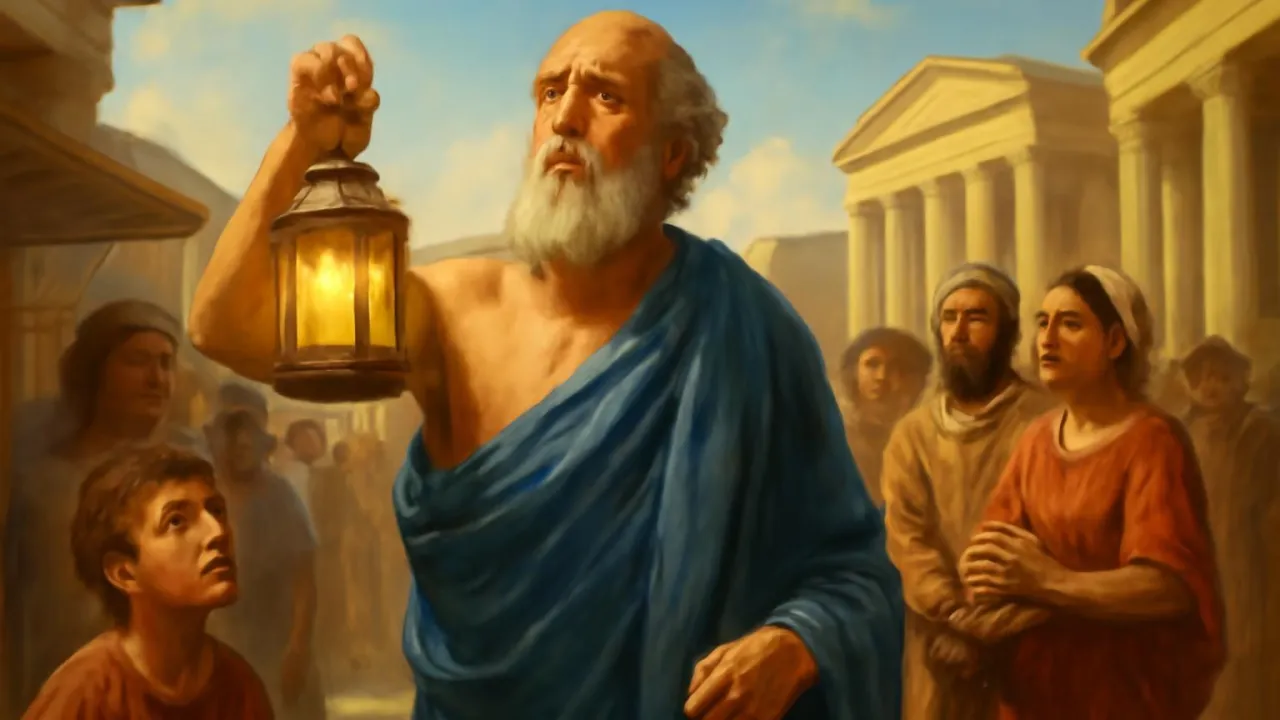
Diogenes once told a powerful king that he only wanted the king to move out of his sunlight!
✨ Word Sparks (Grade 2 Glossary)
Tap 🔊 to hear
honesty
Always telling the truth
barrel
A big round wooden container
simple
Easy, not fancy or extra
🪝
Have you ever wondered what it means to be truly honest?
1
The Lantern Search
Diogenes walked around with a lantern, even when the sun was shining. He told people he was searching for a truly honest person. Many people were surprised by his strange way of asking questions.
2
Living With Less
He believed people should live with only what they need, not extra things. Diogenes slept outside and sometimes made a his home. He wanted everyone to think about what really matters.
3
Making People Think
Diogenes asked tough questions and challenged others to be better. He used clever jokes to teach about and kindness. His ideas made people think differently about their lives.
1. Why did Diogenes carry a lantern in the daytime?
2. What lesson did Diogenes want to teach?
🤯 Mind-Blowing Fact • Grade 3
Diogenes called himself a 'citizen of the world' instead of just his city!
✨ Word Sparks (Grade 3 Glossary)
Tap 🔊 to hear
philosophy
Thinking about big life questions
courage
Being brave even when it's hard
citizen
A person who belongs to a place
🪝
What would you do if you saw someone searching for honesty in the marketplace?
1
The Lantern Mystery
Imagine seeing a man carrying a lantern in broad daylight, searching the busy city streets. Diogenes did this to show people how rare true honesty was in the world. His unusual actions made everyone stop and wonder about their own truthfulness. People began to talk about what it means to be honest.
2
A Life of Simplicity
Diogenes believed happiness came from living with very little. He gave away his belongings and sometimes slept in a large barrel instead of a house. By living simply, he showed people that you do not need many things to be happy. His actions inspired others to question what they really needed.
3
Challenging the Powerful
Diogenes was never afraid to speak his mind, even to kings. When Alexander the Great visited him, Diogenes only asked him to step out of his sunlight. This bold reply showed that Diogenes valued his freedom and honesty more than riches or power. Many admired his and quick thinking.
4
A Lasting Lesson
Diogenes used clever jokes and questions to teach people about honesty and kindness. He became famous for making people think about how they lived their lives. Today, philosophers still talk about his ideas and his fearless way of living. Diogenes reminds us to be honest and true to ourselves.
1. Why did Diogenes ask Alexander the Great to move?
2. What lesson did Diogenes teach with his lantern?
🤯 Mind-Blowing Fact • Grade 4
Diogenes once carried a plucked chicken into a school to make a funny point about what it means to be human!
✨ Word Sparks (Grade 4 Glossary)
Tap 🔊 to hear
Cynicism
A belief in simple, honest living
legacy
What someone leaves behind for others
wit
Smart and funny thinking
🪝
How can one person’s strange questions change how a whole city thinks?
1
A Lantern in the Marketplace
In ancient Greece, Diogenes became famous for walking through crowded marketplaces with a lit lantern, even during the day, claiming to search for an honest person. His odd behavior made people stop and reflect on whether they were truly honest themselves. This public display was his way of challenging people to think about their morals and actions. Diogenes wanted everyone to question what it meant to be truthful.
2
Rejecting Wealth and Comfort
Diogenes believed that people did not need wealth, fancy houses, or many possessions to be happy. He gave up nearly everything and sometimes made a barrel his home, sleeping outdoors in all kinds of weather. By living so simply, he showed that happiness comes from within, not from owning things. He hoped others would see that true freedom meant not being controlled by money or comfort.
3
Fearless Wisdom
Diogenes was known for his sharp and fearless honesty, even when speaking to powerful leaders. When Alexander the Great visited and offered to grant him any wish, Diogenes boldly replied that Alexander should step aside and stop blocking his sunlight. This story became legendary, showing that Diogenes valued freedom and truth above all else. His courage inspired others to question authority and think for themselves.
4
Legacy of Cynicism
Diogenes started a way of thinking called , which taught that people should live simply and honestly. His ideas influenced many later philosophers and are still discussed today. Diogenes' life reminds us that asking tough questions can help people grow and change. He challenged everyone to be brave, honest, and true to their values, no matter what others think.
1. What did Diogenes want people to think about with his lantern?
2. What is Cynicism?
🤯 Mind-Blowing Fact • Grade 5
Diogenes is credited with coining the phrase 'I am a citizen of the world,' showing his belief in global community over local pride.
✨ Word Sparks (Grade 5 Glossary)
Tap 🔊 to hear
virtue
Doing what is right and good
materialism
Caring too much about things and money
paradox
Something that seems silly but is true
🪝
What if someone challenged every rule you followed, just by asking bold questions in public?
1
A Lantern Against Lies
Picture a bustling ancient Greek marketplace, sunlight streaming down, and Diogenes weaving through the crowd, holding a lantern high—even at noon. He announced he was searching for an honest person, using this dramatic act to challenge people’s ideas about truth and . His lantern was not for light, but for exposing the darkness of dishonesty he saw around him. Diogenes’s actions were meant to make people uncomfortable enough to question their own behavior and beliefs. Through his public performances, he became a living riddle that forced his fellow citizens to confront their values.
2
Radical Simplicity and Self-Sufficiency
Diogenes believed that happiness and freedom came from living with only the bare essentials, rejecting luxury, and being self-sufficient. He famously discarded his last possession, a cup, after seeing a boy drink water with his hands, realizing he needed even less than he thought. Diogenes often slept in a large ceramic jar, or pithos, and wore simple clothing regardless of the weather. His lifestyle was a direct challenge to the and social customs of Athens, and he encouraged others to focus on over wealth. His radical simplicity became the foundation of the Cynic philosophy.
3
Fearless Encounters with Power
Diogenes’s wit and courage were legendary, especially in his encounters with the powerful. When Alexander the Great, the most famous ruler of the time, offered to grant him any wish, Diogenes simply asked, 'Stand out of my sunlight.' This fearless reply showed that Diogenes valued independence and honesty more than fame or fortune. He often used humor and clever questions to expose the weaknesses and pretensions of politicians, philosophers, and citizens alike. His boldness inspired both admiration and criticism, but he never wavered from his beliefs.
4
The Birth of Cynicism
As the founder of Cynicism, Diogenes taught that people should live in agreement with nature, free from the artificial needs created by society. He believed that was the only true good, and that living honestly and simply was the path to happiness. Diogenes’s teachings influenced later philosophers, including the Stoics, who built on his ideas about self-control and independence. His public acts, sharp words, and radical lifestyle made him both a legend and a symbol of fearless questioning.
5
A Lasting Legacy of Honest Challenge
Diogenes’s life and ideas continue to inspire people to question what is truly important. Historians remember him as a master of , whose actions forced entire cities to rethink their values. His legacy lives on in the way we admire those who speak truth to power and live according to their principles, even when it is difficult. By daring to be different and challenging others to do the same, Diogenes reminds us that honesty, courage, and simplicity can change the world. His lantern still shines as a symbol for anyone searching for truth.