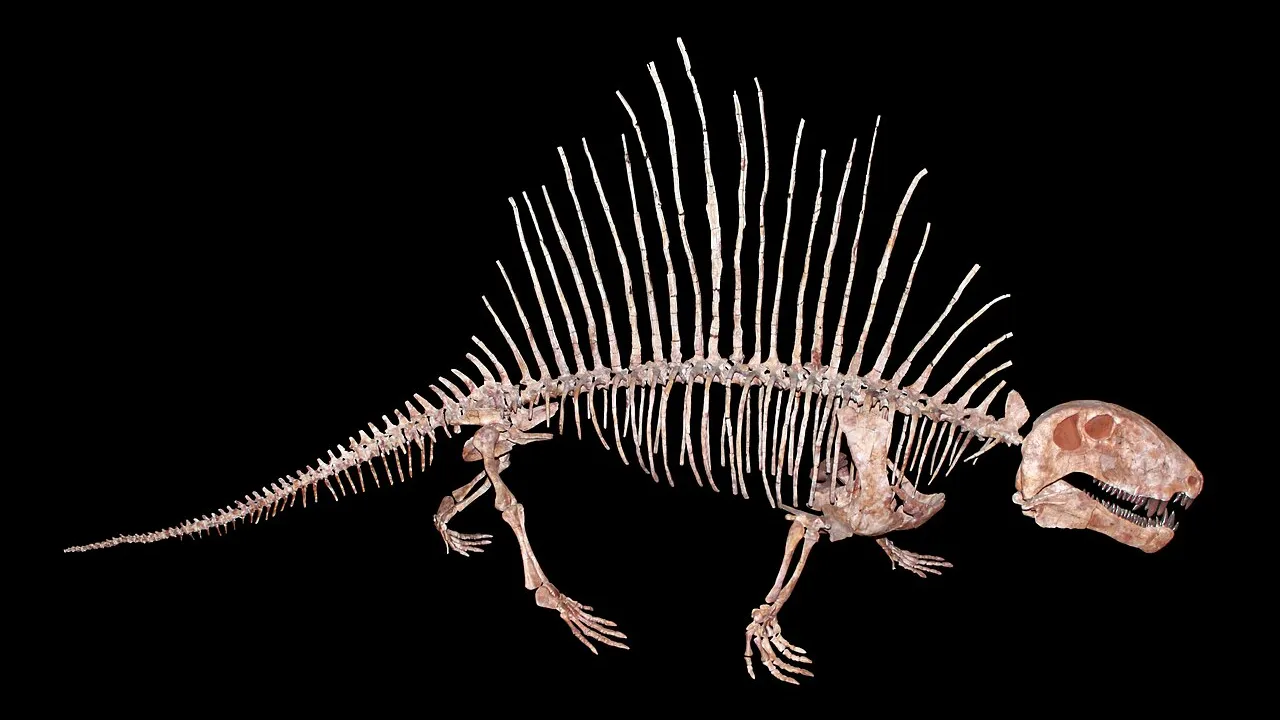
⚡ Survival SuperpowerTall blood-rich back sail and two distinct sizes of steak-knife teeth
🤯 Mind-Blowing Fact • Grade 1
Dimetrodon is more closely related to dogs, cats, and humans than it is to T. rex or any lizard!
✨ Word Sparks (Grade 1 Glossary)
Tap 🔊 to hear
Sail
Tall skin fan held up by back bones
Mammal
Warm-blooded animal group that includes dogs and humans
Bask
To rest in warm sunlight to heat up
🪝
Surprise! Why is this famous sail-backed beast NOT a dinosaur?
1
Check Out That Giant Sail
Warm morning sun shines on a tall spiky fan! Here stands Dimetrodon on four sturdy legs. People often put it in dinosaur toy bins, yet it is NOT a dinosaur!
2
Closer to Mammals
Dimetrodon lived millions of years before the very first dinosaur hatched. Believe it or not, it belongs to our own ancient family tree!
3
Warm Up and Go
Blood flowed into its tall back to soak up morning sunshine. Warmed up fast, Dimetrodon trotted off with big front teeth and smaller back teeth!
2. How could Dimetrodon's tall back sail help it each morning?
🤯 Mind-Blowing Fact • Grade 2
Dimetrodon was the first land vertebrate known to have serrated teeth—tiny saw-like notches along the edges just like a kitchen steak knife!
✨ Word Sparks (Grade 2 Glossary)
Tap 🔊 to hear
Canine
Long pointed tooth used for gripping and slicing
Serrated
Having tiny saw-like notches along a sharp edge
Permian
Geologic time period right before the dinosaur era
🪝
What does the name 'two-measure tooth' reveal about Earth's earliest big land hunter?
1
Before the Age of Dinosaurs
Step onto a sun-baked red riverbank in ancient Texas 280 million years ago! Stretching up to fifteen feet long, Dimetrodon ruled the Early world—more than forty million years before the first dinosaur walked on Earth.
2
The Secret of Two Tooth Sizes
Most reptiles have rows of teeth that all look alike. Dimetrodon's name means 'two-measure tooth' because it grew two different kinds of teeth! Pointed front teeth grabbed slippery amphibians or reptiles, while huge curved teeth sliced smoothly like steak knives.
3
Solar Panel Plus Billboard
Long rod-like bones sprouted straight up from its backbone to hold a tall skin sail. Grooves for blood vessels show the sail helped warm and cool its body—and flashed bold warnings to rivals!
1. Why does the name Dimetrodon mean 'two-measure tooth'?
2. Besides controlling body heat, what else was Dimetrodon's tall sail great for?
🤯 Mind-Blowing Fact • Grade 3
Fossil bones show that Dimetrodon dug right into dried-up mud burrows to pull out giant boomerang-headed amphibians called Diplocaulus during droughts!
✨ Word Sparks (Grade 3 Glossary)
Tap 🔊 to hear
Synapsid
Vertebrate lineage with one skull opening including mammals
Neural spine
Upward bony projection rising from a backbone vertebra
Thermoregulation
Controlling internal body temperature to stay active
🪝
How can paleontologists look at a single hole in Dimetrodon's skull and tell it belongs on the mammal side of the family tree?
1
Look Behind the Eye Socket
Imagine examining a giant fossil skull from the Permian Red Beds of Texas. Behind each eye socket sits one large bone window where powerful jaw muscles attached. That single opening proves Dimetrodon is a —the evolutionary branch that produced mammals—rather than a reptile or dinosaur, which have two openings behind each eye!
2
Engineering the Back Sail
Rising up to five feet above its spine were elongated wrapped in tough skin. Channels carved into those vertical bones carried rich networks of blood vessels. Heat-transfer calculations suggest a 200-kilogram Dimetrodon could warm up in morning sun roughly twice as fast with a sail, giving it a decisive head start over sluggish prey.
3
Display Power
Because smaller Dimetrodon species grew proportionally huge sails they barely needed for heating, scientists agree courtship display and species recognition were major drivers too.
4
Top Hunter of the Wetlands
Fossilized bite marks and stomach clues show Dimetrodon hunted giant freshwater sharks like Xenacanthus, heavy amphibians like Eryops, and plant-eating reptiles across seasonal river deltas.
1. What skull clue proves Dimetrodon is a synapsid related to mammals rather than a dinosaur?
2. What surprising aquatic animal did Dimetrodon regularly catch in shallow Permian rivers?
🤯 Mind-Blowing Fact • Grade 4
Healed bite marks and bent, regrown sail spines on fossil skeletons show rival Dimetrodon battled fiercely face-to-face over territory or mates!
✨ Word Sparks (Grade 4 Glossary)
Tap 🔊 to hear
Ziphodont
Blade-shaped teeth lined with tiny cutting serrations
Allometry
How body part proportions change as animals grow
Fenestra
Natural window-like opening inside a vertebrate skull
🪝
How did tooth serrations and bony sail fibers make Dimetrodon the undisputed apex predator of Early Permian Pangaea?
1
Misidentified Icon of Deep Time
Walk across the rust-red mudflats of the Texas Clear Fork Group 280 million years ago, forty-five million years before the earliest Triassic dinosaurs evolved. Dominating this seasonal floodplain is Dimetrodon grandis, a 4.6-meter non-mammalian synapsid ('pelycosaur' grade). Named by paleontologist Edward Drinker Cope in 1878, Dimetrodon sits near the base of the synapsid stem leading toward therapsids and eventually modern mammals.
2
Biomechanics of the Neural Sail
Up to eighteen times taller than the vertebral centra beneath them, Dimetrodon's hyper-elongated neural spines feature figure-eight cross-sections reinforced internally by Sharpey's fibers where tough interspinous ligaments anchored. Notably, preserved spine tips extend slightly above the vascularized skin web. While vascular grooves confirm physiological heat exchange, pronounced positive —sail height scaling much faster than body mass across twelve species—demonstrates that sexual selection and intraspecific rivalry strongly shaped the sail.
3
Evolution of Ziphodont Dentition
In 2014, scanning electron microscopy revealed another evolutionary milestone across Dimetrodon species. Smaller, older species sliced prey using smooth, teardrop-shaped tooth edges, whereas larger later species like Dimetrodon grandis evolved true denticles—microscopic steak-knife serrations that allowed it to dismember prey larger than its own head.
4
Top of the Food Web
Equipped with a deep, arched premaxillary step and powerful adductor jaw muscles anchored to its single temporal , Dimetrodon subdued armored eryopid amphibians, diadectids, and freshwater sharks.
1. Why do scientists conclude that visual display—not just heating and cooling—drove the evolution of Dimetrodon's sail?
2. What dental upgrade enabled larger species like Dimetrodon grandis to tackle prey bigger than themselves?
🤯 Mind-Blowing Fact • Grade 5
The smallest known species, Dimetrodon teutonis discovered in Germany in 2001, stretched only two feet long—smaller than a dachshund—yet still sported a proud dorsal sail!
✨ Word Sparks (Grade 5 Glossary)
Tap 🔊 to hear
Heterodonty
Having different specialized shapes of teeth in jaws
Histology
Microscopic study of thin slices of biological tissue
Sauropsid
Evolutionary branch containing reptiles, dinosaurs, and birds
🪝
What do histological bone thin-sections and electron microscopy reveal about how an Early Permian synapsid pioneered mammalian skull mechanics and ziphodont slicing?
1
Synapsid Heritage in the Red Beds
Throughout the Cisuralian Epoch of the Early Permian (295–272 MYA), seasonal river deltas across equatorial Euramerica—preserved famously in the Wichita and Clear Fork Groups of Texas and Oklahoma as well as Germany's Tambach Formation—supported complex terrestrial vertebrate ecosystems. Twelve recognized species of Dimetrodon spanned sizes from sixty-centimeter Dimetrodon teutonis to 4.6-meter, 250-kilogram Dimetrodon grandis. First named by Edward Drinker Cope in 1878, this sphenacodontid synapsid diverged from the (reptile-bird-dinosaur) lineage more than 310 million years ago.
2
Cranial Heterodonty and Adductor Mechanics
Dimetrodon's tall, laterally compressed skull displays classic synapsid architecture: a single infratemporal fenestra behind each orbit permitting jaw adductor muscles to bulge outward during forceful bites, paired with a stepped premaxilla-maxilla diastema. Pronounced —large procumbent premaxillary incisors, hypertrophied maxillary caniniforms, and recurved postcanines—inspired its Greek name ('two-measure tooth'). In 2014, Kirstin Brink and Robert Reisz used scanning electron microscopy to show that while basal Dimetrodon species relied on smooth 'isaric' carinae, derived species evolved true ziphodont denticles—making Dimetrodon the earliest known terrestrial amniote with serrated slicing teeth.
3
Histology and Scaling of the Dorsal Sail
Histological bone sections of Dimetrodon's hyper-elongated neural spines reveal dense fibro-lamellar cortex, longitudinal vascular canals at spine bases, and robust Sharpey's fibers anchoring collagenous sail membranes, while distal tips projected bare above the web. Although thermodynamic models by Bramwell and Fellgett estimated substantial basking speedups, strict scaling analysis shows sail area scaled hyper-allometrically (~body mass^1.5 rather than surface-area rules), establishing sexual selection and agonistic display as primary selective forces alongside secondary vascular heat exchange.
4
Paleoecological Trophic Dominance
Excavations of estivation burrows in Texas mudstones preserve dozens of chewed Diplocaulus amphibians and Xenacanthus freshwater sharks dismembered by Dimetrodon during dry seasons, alongside predation on heavy herbivorous diadectids and edaphosaurids.
5
Giving Way to Therapsids
Near the end of the Cisuralian (~272 MYA), climate shifts across Pangaea coincided with the extinction of pelycosaur-grade sphenacodontids—replaced directly by their close cousins, the faster, more upright Middle Permian therapsids that carried the synapsid torch toward true mammals.