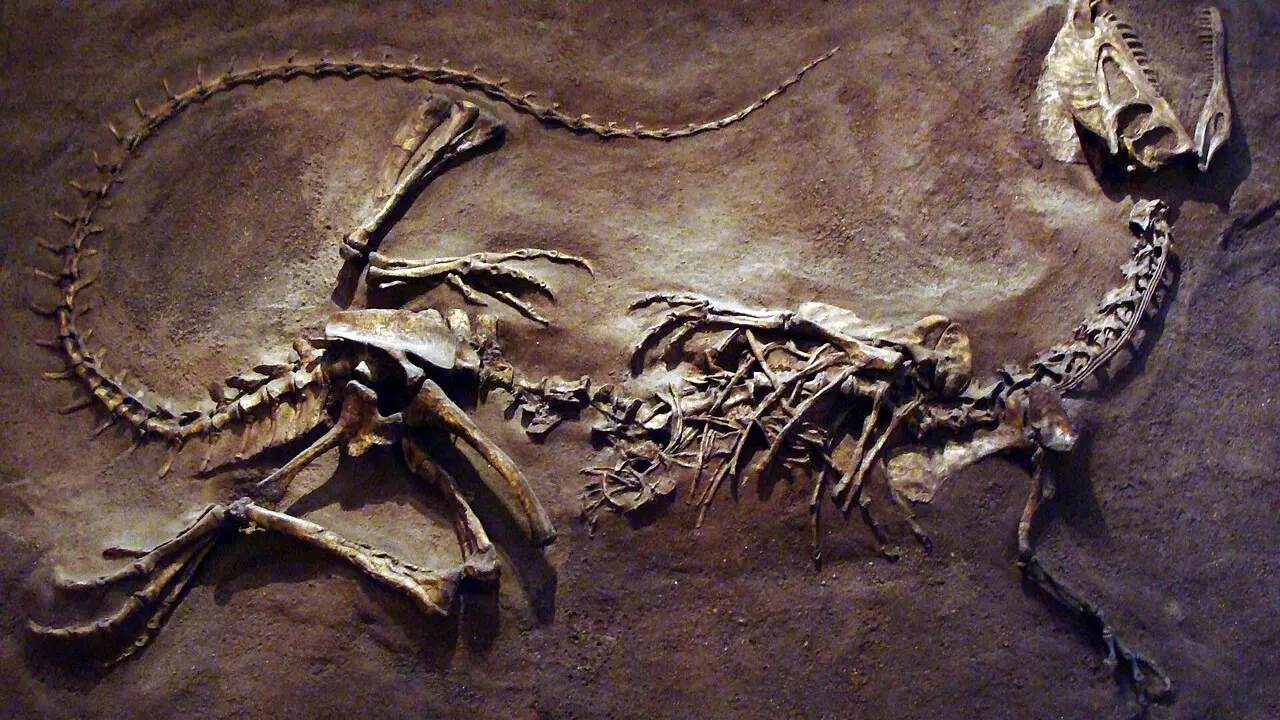
⚡ Survival SuperpowerTwin air-filled head crests and agile, powerful jaws
🤯 Mind-Blowing Fact • Grade 1
Real Dilophosaurus grew 23 feet long, making it the biggest land hunter in North America during the Early Jurassic!
✨ Word Sparks (Grade 1 Glossary)
Tap 🔊 to hear
crest
A tall bony ridge on a dinosaur head
fossil
Ancient bone or footprint turned into stone
prey
An animal that a hunter catches for food
🪝
Why did this fast dinosaur wear two tall crests on its head?
1
Two Tall Crests
Thump, thump! A big hunter dashes by a warm river. Look up at its head! Dilophosaurus had two thin, curved side by side. Its name means two-crested lizard.
2
Bigger Than a Car
Movies show it small, with a neck frill. Real tell a true story! It had no frill and no spit. It was longer than a family car!
3
Fast Footprints
It ran fast on two strong back legs. Sharp claws and curved teeth helped it catch fish and land .
2. How did real Dilophosaurus differ from movie versions?
🤯 Mind-Blowing Fact • Grade 2
Tiny air pockets inside Dilophosaurus skull bones kept its giant two-crested head light enough to carry easily!
✨ Word Sparks (Grade 2 Glossary)
Tap 🔊 to hear
keratin
Tough material that forms fingernails, claws, and horns
paleontologist
A scientist who studies ancient life through fossils
predator
An animal that hunts other animals for food
🪝
What surprises did scientists find when they studied real Dilophosaurus bones?
1
A Crown of Twin Crests
Imagine walking beside a sunny Jurassic stream in ancient Arizona. Suddenly, a tall dinosaur steps out from the ferns! On top of its skull sit two rounded bony plates that stand up like twin fans. Scientists thinks bright covered these crests so Dilophosaurus could recognize friends from far away.
2
Movie Myth Versus Fossil Fact
Popular stories sometimes picture Dilophosaurus as dog-sized with a pop-out neck frill and venom. checked the real skeleton and found neither feature! Instead, this stretched 23 feet from snout to tail and weighed nearly 900 pounds.
3
Built for Speed
Long, muscular hind legs made it a speedy runner across sandy riverbanks. With strong jaws and grasping hands, it hunted fish and plant-eating reptiles with ease.
1. What kept the tall skull of Dilophosaurus surprisingly lightweight?
2. Where were the first Dilophosaurus fossils discovered?
🤯 Mind-Blowing Fact • Grade 3
Navajo tracker Jesse Williams discovered the first Dilophosaurus skeletons in Arizona in 1940, leading scientists to three remarkable specimens!
✨ Word Sparks (Grade 3 Glossary)
Tap 🔊 to hear
theropod
A group of mostly meat-eating, hollow-boned two-legged dinosaurs
floodplain
Flat land beside a river that floods seasonally
sheath
A close-fitting outer covering that protects bone
🪝
How did Dilophosaurus rule North America millions of years before T. rex existed?
1
Meet an Early Jurassic Giant
Splash! Footprints press deep into wet mud along an Early Jurassic 193 million years ago. Long before giant tyrannosaurs evolved, Dilophosaurus ruled southwestern North America as the largest land predator of its time. Measuring 23 feet long and standing taller than an adult human, this sleek combined speed, reach, and striking visual flair.
2
Secrets of the Double Crest
Two tall, parallel ridges of thin bone arched along the top of its snout. Modern X-ray scans reveal that internal air sacs honeycombed these crests, connecting directly to its nasal passages. Covered in protective keratin during life, the crests served as colorful billboards for courtship displays or species recognition rather than weapons.
3
Strong Jaws, Not Venom
Fiction gave this dinosaur a Rattlesnake-like venom spray and a lizard frill, yet fossil bones show no venom grooves or frill attachments. For decades, scientists thought a gap in its upper jaw meant a weak bite, but newer studies proved its jaw muscles anchored firmly for a powerful grip.
4
Hunting Along Ancient Rivers
Armed with blade-like teeth and four-fingered hands, Dilophosaurus patrolled seasonal rivers in what is now Arizona, catching armored fish and early plant-eating dinosaurs.
1. What did X-ray scans reveal inside the bony crests of Dilophosaurus?
2. Why do scientists think Dilophosaurus had its twin head crests?
🤯 Mind-Blowing Fact • Grade 4
Fossilized resting tracks in Utah even preserve impressions of an Early Jurassic theropod crouching down on its heels and hands like a sitting bird!
✨ Word Sparks (Grade 4 Glossary)
Tap 🔊 to hear
pneumatic
Containing air-filled cavities inside bones, like bird skeletons
apex predator
The top hunter in an ecosystem without predators
reconstruction
A scientific model built from fossil evidence
🪝
Why did paleontologists completely rewrite the story of Dilophosaurus in 2020?
1
Rewriting a Famous Predator
Picture an arid Early Jurassic landscape crossed by winding, tree-lined rivers 193 million years ago. Striding across the wet sand comes Dilophosaurus wetherilli, a 23-foot, 880-pound that looked nothing like its miniature pop-culture imitations. For decades after its discovery in Arizona's Kayenta Formation, even paleontologists misunderstood this dinosaur, imagining a delicate scavenger with fragile jaws.
2
A High-Tech Skull Makeover
In 2020, paleontologists Adam Marsh and Timothy Rowe used high-resolution CT scanners to peer inside multiple Dilophosaurus fossils. Earlier had used plaster to fill missing bone, accidentally making the skull look narrow and weak. The new digital scans showed deep muscle attachment sites on the lower jaw and sturdy palate bones, proving Dilophosaurus delivered crisp, forceful bites capable of tackling large prey.
3
Bird-Like Air Sacs
Those same scans uncovered an intricate network of air sacs winding through its vertebrae and up into its twin nasolacrimal crests. Just like modern birds, Dilophosaurus possessed a one-way respiratory system that pumped fresh oxygen efficiently during fast sprints while lightening its skeleton.
4
Ruler of the Kayenta Ecosystem
With a distinctive notch behind the front upper teeth, Dilophosaurus could snag slippery freshwater fish or seize early herbivorous dinosaurs like Sarahsaurus, reigning as North America's first giant theropod.
1. How did 2020 CT scans change how scientists view Dilophosaurus jaws?
2. How did bird-like air sacs help Dilophosaurus survive?
🤯 Mind-Blowing Fact • Grade 5
Fossilized Dilophosaurus arm bones preserve healed fractures and bone infections, proving these predators survived intense struggles with lively Early Jurassic prey!
✨ Word Sparks (Grade 5 Glossary)
Tap 🔊 to hear
intraspecific
Happening between members of the exact same species
osteological
Relating to the scientific study of bone structure
premaxillary
Located at the very front tip of upper jaws
🪝
How did pneumatic engineering turn Dilophosaurus into the Early Jurassic's premier North American super-predator?
1
Titan of the Kayenta Floodplains
Dawn breaks over the seasonal braided rivers of the Kayenta Formation 193 million years ago in Sinemurian-stage Arizona. Stepping across the rippled red siltstone is Dilophosaurus wetherilli, an agile seven-meter theropod weighing roughly 400 kilograms. Following the end-Triassic extinction, dinosaurs rapidly diversified into vacant ecological niches, and Dilophosaurus emerged as one of the earliest large-bodied theropods anywhere on Earth.
2
Discovery on Navajo Land
In 1940, Navajo man Jesse Williams spotted fossilized bones weathering out of purplish mudstone near Tuba City, Arizona, and guided paleontologists from the University of California, Berkeley, to the site. Samuel Paul Welles initially classified the creature within the genus Megalosaurus in 1954, before uncovering a larger skull bearing unmistakable twin cranial ridges and coining Dilophosaurus—'two-crested lizard'—in 1970.
3
Cranial Architecture and Pneumaticity
Each paired crest rises from the nasal and lacrimal bones as a thin, vertical sheet reinforced by ridges and invaded by paranasal air sinuses. In 2020, comprehensive and computed-tomography analyses by Adam Marsh and Timothy Rowe demonstrated that these crests varied subtly between individuals and likely anchored larger keratinous extensions used for signaling. The scans also refuted long-standing claims of weak jaws, revealing robust mandibular adductors and an arched subnarial gap armed with long, recurved teeth.
4
Limb Mechanics and Predatory Reach
Unlike later short-armed tyrannosaurids, Dilophosaurus retained muscular forelimbs equipped with a flexible, grasping first digit capable of pinning struggling prey against its chest while its laterally compressed teeth sliced flesh.
5
Bridge Toward Avian Evolution
By combining hollow limb bones, air-filled vertebrae, and unidirectional airflow long before birds took flight, Dilophosaurus showcases the evolutionary blueprint that powered theropod dominance for the next 127 million years.