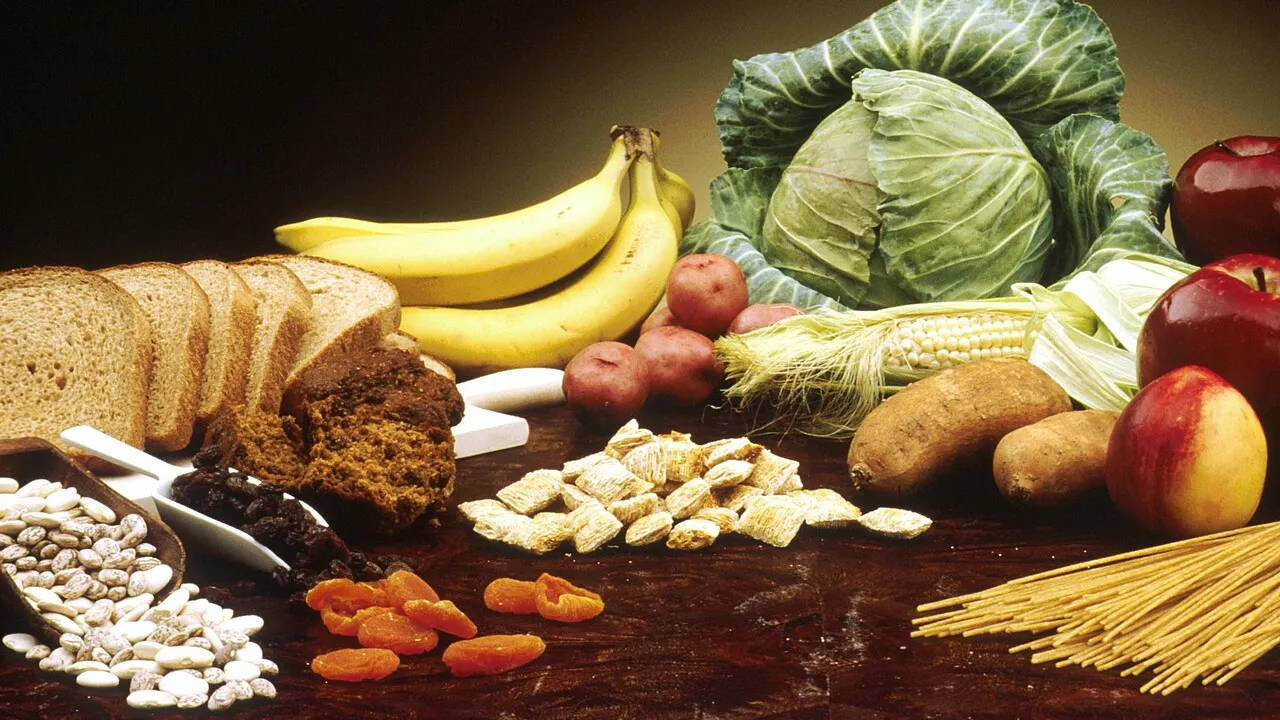
🧬 HUMAN BODY
🧬 Indigestible Plant Polysaccharides • Gastrointestinal Microbiome
VA Science & Health SOL 1.1, 3.1, 4.2, 5.1 (Cells, Organs & Body Systems)
Dietary Fiber
Crunchy Plant Threads Feeding Friendly Gut Microbes
Grade 1 • Early Reader • 68 words
🩺 Body System & LocationStomach, Small Intestine & Large Intestine (Colon)
🔬 Size / Cell CountLong plant cell-wall chains • ~19–25 grams daily need for kids
⚙️ Core JobKeeps digestion moving smoothly, steadies blood sugar, and feeds helpful gut microbes
⚡ Body SuperpowerTravels undigested all the way to your colon to host a gourmet feast for trillions of friendly bacteria
🤯 Mind-Blowing Fact • Grade 1
Air-popped popcorn is actually a crunchy whole grain packed with helpful dietary fiber!
1. Which group of foods is the ONLY place where natural dietary fiber grows?
2. Why should you leave the clean peel on an apple or pear when you munch it?
🤯 Mind-Blowing Fact • Grade 2
Just one single cup of sweet red raspberries packs eight grams of fiber—more than twice as much as a slice of whole-wheat bread!
✨ Word Sparks (Grade 2 Glossary)
Tap 🔊 to hear
Soluble Fiber
Fiber forming a soft gel in water
Insoluble Fiber
Crunchy fiber sweeping food through your gut
Microbe
Tiny helpful living bug inside your gut
🪝
Who eats the crunchy plant fiber that your own stomach enzymes leave behind?
1
Two Kinds of Plant Helpers
Stir hot water into rolled oats and watch them turn creamy! Plants make two teamwork kinds of dietary fiber. —found in oats, apples, and beans—soaks up water like a soft sponge, while —in celery strings, wheat bran, and berry seeds—sweeps your gut clean!
2
Feeding Friendly Microbes
Human digestive enzymes cannot snip fiber chains apart, so fiber arrives intact down in your large intestine. Waiting there live trillions of friendly gut bacteria that cheer and munch fiber for lunch!
3
Feeling Full and Steady
Fiber slows down how fast fruit sugars enter your blood, keeping energy calm and helping your belly feel satisfied long after breakfast.
1. What happens to soluble fiber from oats and apples when it mixes with water?
2. Who feasts on dietary fiber down inside your large intestine?
🤯 Mind-Blowing Fact • Grade 3
Cows, horses, and giant pandas cannot digest tough grass or bamboo fiber on their own either—special gut microbes inside their bellies unlock the energy for them!
✨ Word Sparks (Grade 3 Glossary)
Tap 🔊 to hear
Cellulose
Tough plant cell-wall fiber humans cannot digest
Microbiome
Community of friendly microbes in your gut
Prebiotic
Plant fiber that feeds helpful gut bacteria
🪝
Why does drinking plain apple juice spike blood sugar much faster than crunching a whole apple?
1
Whole Fruit vs. Fruit Juice
Compare a glass of clear apple juice with a crunchy whole apple! Juicing strips away nearly all the plant cell walls made of dietary fiber. When you chew a whole apple instead, its intact fiber mesh slows sugar release so your energy stays smooth!
2
Cellulose: Nature's Crisp Scaffolding
Surprise— fiber in broccoli stems is actually built from long chains of glucose rings, just like potato starch! Yet plants flip the chemical links upside down so human amylase enzymes bounce right off without cutting them.
3
Prebiotic Fuel for Your Microbiome
Down in your colon, trillions of helpful microbes—your gut —possess the special enzymes we lack! Scientists call fermentable fibers because friendly bacteria eat them and make healing compounds for your gut lining.
4
Fiber Loves Water!
Think of fiber and water as best pals. Drinking plenty of water alongside black beans, lentils, chia seeds, pears, and whole grains lets fiber stay soft and glide comfortably!
1. Why is crunching a whole orange or apple healthier for steady energy than drinking clear juice?
2. What drink should always team up with high-fiber foods like beans and whole grains?
🤯 Mind-Blowing Fact • Grade 4
Colon lining cells don't get most of their fuel from your bloodstream—instead, they eat butyrate, a special nutrient brewed right next door by gut bacteria munching your dietary fiber!
✨ Word Sparks (Grade 4 Glossary)
Tap 🔊 to hear
Peristalsis
Wave-like muscle squeezes moving food along gut
Butyrate
Helpful fuel gut bacteria make from fiber
Bran
Fiber-rich outer coat of a whole grain
🪝
How can eating oatmeal and beans clean excess cholesterol out of your bloodstream without ever leaving your gut?
1
Alpha vs. Beta Bonds
Both digestible starch and indigestible cellulose are polysaccharides built from thousands of glucose rings—yet one fuels your sprint while the other passes straight through your small intestine! Starch links glucose rings with 'alpha' bonds that salivary and pancreatic enzymes snip effortlessly. Plant structural fibers—cellulose, hemicellulose, pectin, and oat beta-glucans—use 'beta' bonds or tangled branches that no human enzyme can unlock.
2
The Bile-Trapping Cholesterol Trick
Viscous soluble fibers in oats, barley, lentils, apples, and chia seeds dissolve into a thick gel inside your small intestine. Remember how your liver uses cholesterol to brew fat-digesting bile? Soluble fiber gel traps some of those bile acids and escorts them out of the body! To brew replacement bile, your liver pulls extra LDL cholesterol straight out of your bloodstream—naturally supporting a healthy heart.
3
Short-Chain Fatty Acid Gifts
Meanwhile, insoluble fibers add soft bulk that stimulates rhythmic intestinal muscle waves called . Down in the colon, beneficial bacteria ferment prebiotic fibers into short-chain fatty acids—especially —which serve as the number-one energy source for your colon lining cells and calm gut inflammation!
4
Whole Grains vs. Refined Flour
Milling white flour strips away a wheat kernel's outer coat and nutrient-rich germ, removing over seventy percent of its natural fiber—which is why whole-wheat bread, brown rice, and legumes shine!
1. How does soluble fiber from oats and beans help lower extra LDL cholesterol in blood?
2. What happens when wheat kernels are refined into plain white flour?
🤯 Mind-Blowing Fact • Grade 5
Your gut microbes bring over ten thousand different fiber-chopping enzymes to the dinner table—compared to only about seventeen carbohydrate-digesting enzymes encoded by your own human DNA!
✨ Word Sparks (Grade 5 Glossary)
Tap 🔊 to hear
Glycosidic Bond
Chemical link connecting sugar rings into chains
Colonocyte
Lining cell of the large intestine wall
Resistant Starch
Starch acting like fiber in cooled potatoes
🪝
Why did nutritionists once dismiss fiber as useless 'roughage'—only to discover it orchestrates gut immunity, hormone signals, and thirty-eight trillion microbes?
1
From 'Useless Roughage' to Burkitt's Insight
For much of the twentieth century, textbooks dismissed indigestible plant cell walls as inert 'roughage' carrying zero nutritional value. That view flipped in the 1960s and 1970s when physicians Denis Burkitt and Hugh Trowell compared rural diets rich in unrefined tubers, legumes, and whole grains—supplying fifty-plus grams of fiber daily—with low-fiber industrialized diets, linking fiber intake to digestive, metabolic, and cardiovascular health. Biochemically, human amylases cleave alpha-1,4 in starch yet cannot touch beta-1,4 linkages in cellulose or complex pectins, inulins, beta-glucans, and .
2
Rheology in the Small Intestine
Physiologists now classify fibers along three functional axes: solubility, viscosity, and fermentability. Viscous, gel-forming fibers (oat beta-glucans, psyllium, apple pectin) thicken intestinal chyme, slowing glucose diffusion across enterocytes to blunt postprandial insulin spikes while sequestering bile salts to lower plasma LDL cholesterol. Non-viscous insoluble fibers (cellulose, lignin in vegetables, nuts, and whole-grain bran) retain water and mechanically trigger stretch receptors driving smooth colonic peristalsis.
3
Microbial Fermentation and Butyrate
Entering the anaerobic colon, fermentable prebiotic fibers feed roughly thirty-eight trillion commensal microbes encoding thousands of carbohydrate-active enzymes! Bacterial fermentation yields short-chain fatty acids—acetate, propionate, and butyrate. oxidize butyrate for up to seventy percent of their ATP, tightening epithelial junctions, preserving protective mucus layers (preventing mucus-starved microbes from nibbling the gut barrier!), and training regulatory T-cells.
4
Gut-Brain Fullness Signals
Short-chain fatty acids even bind receptors on enteroendocrine L-cells, prompting release of satiety hormones GLP-1 and PYY that message the hypothalamus that your meal was satisfying!
5
Closing the Modern Fiber Gap
Diverse plant plates—lentils, black beans, raspberries, avocados, chia seeds, oats, and vegetables—nourish a resilient, biodiverse microbiome.